Article Was Last Updated August 26, 2026
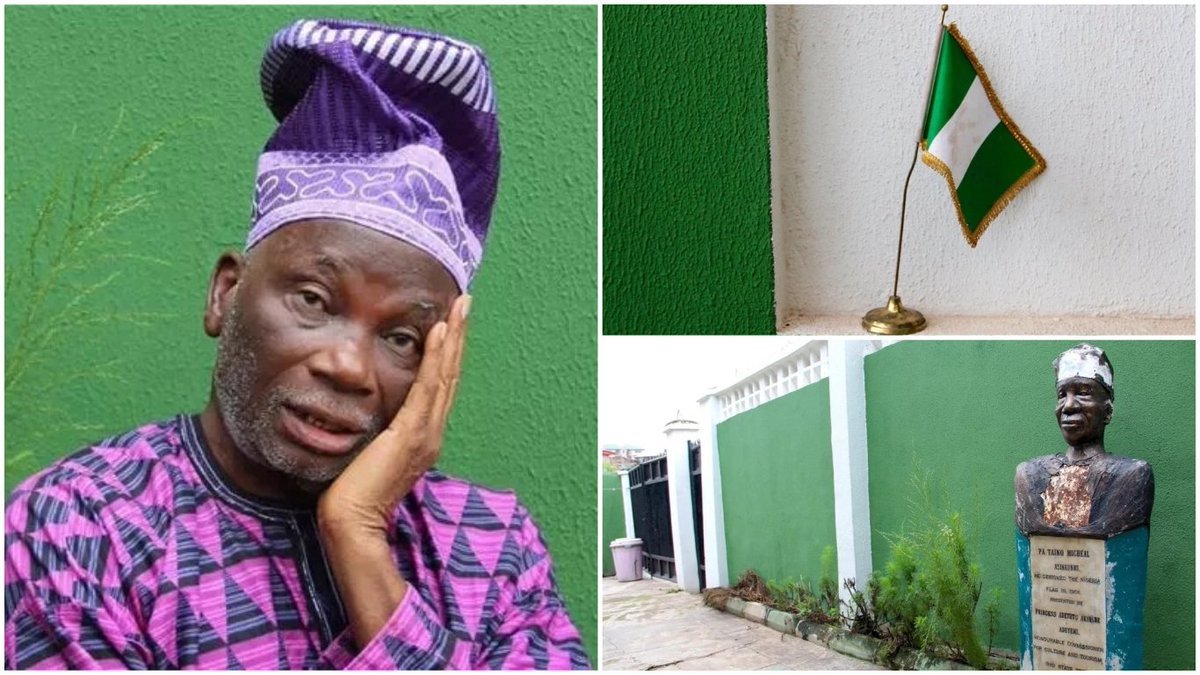
Who designed the Nigerian flag? It was none other than Michael Taiwo Akinkunmi, the Nigerian flag designer from Ogun State. Learn how he designed the flag in London, the meaning of green-white colours, competition details, education background, OFR honour, civil service career, and legacy after his death.
EARLY LIFE AND EDUCATION (1936–1949)
Michael Taiwo Akinkunmi was born in 1936 in Ibadan, in present-day Oyo State, Nigeria. He was Yoruba and grew up during the British colonial period in Nigeria.
As a child, he moved around a bit, including time in northern Nigeria, where he had his first schooling experience. He later returned to Ibadan. There, he attended Baptist Day School, Idi-Ikan, and completed primary education in 1949.
In 1950, he entered Ibadan Grammar School, a respected secondary school in western Nigeria. He studied there until 1955 and completed his secondary education. During these years, he did well in academic work, especially in technical and scientific subjects. This later shaped his interest in engineering and problem-solving.
CIVIL SERVICE ENTRY AND STUDIES IN LONDON (LATE 1950s)
After finishing school in 1955, he joined the Western Region civil service in Ibadan. He worked as an agriculturist. The job exposed him to public administration and practical government work.
Later, he travelled to the United Kingdom to study electrical engineering at Norwood Technical College, now known as Lambeth College. Living in London gave him a broader academic experience and placed him in an international learning environment during the period leading up to Nigeria’s independence.
THE NIGERIAN FLAG COMPETITION AND DESIGN (1958–1960)
In 1958, while in London, he saw a public call for designs for a new national flag for an independent Nigeria. The competition was part of preparations for independence in 1960.
The goal was to create a symbol that reflected unity, peace, and national identity, replacing colonial symbols like the Union Jack.
Akinkunmi submitted a design with three vertical stripes in green, white, and green. The green represented agriculture, natural resources, and growth. The white stood for peace and unity among Nigeria’s many ethnic groups.
In his early version, he also added a red rising sun in the white band. It symbolised a new beginning for the country. However, the committee removed it to keep the design simple.
Many entries were submitted, but his design stood out for its clarity and strong meaning. It was also easy to reproduce.
ADOPTION OF THE NATIONAL FLAG (1960)
The final version kept only the green-white-green stripes. It was officially adopted on 1 October 1960, Nigeria’s Independence Day.
The flag was first raised during the independence celebrations. It quickly became a symbol of national pride and identity.
POST-INDEPENDENCE CAREER (1960s–1990s)
After completing his studies, he returned to Nigeria in 1963. He resumed work in the civil service, continuing in agricultural and administrative roles in the Western Region and later at the federal level.
Even though he designed the national flag, he lived a quiet professional life for many years.
MEANING OF THE FLAG
The Nigerian flag carries simple but powerful meanings.
The green stripes stand for agriculture, natural wealth, and growth. The white stripe represents peace, unity, and harmony among Nigerians.
Together, the design reflects a country rich in resources and held together by peace. Its simplicity also makes it easy to recognise and reproduce.
RECOGNITION AND HONOURS (1960s–2014)
For many years after independence, he received little formal recognition. He was given a small prize for winning the flag competition, but wider national honours came much later.
From the early 2000s, his role became more widely known through schools, media, and public discussions. He was increasingly recognised as the designer of Nigeria’s national flag.
In 2014, he was awarded the national honour of Officer of the Order of the Federal Republic (OFR).
After this recognition, his contribution became firmly established in national education and public memory. His design remained one of Nigeria’s most important national symbols.
LATER LIFE, DEATH AND BURIAL (2023–2024)
Michael Taiwo Akinkunmi died on 29 August 2023 in Ibadan at the age of 87 after a short illness.
His burial was delayed for some time as state arrangements were being organised. He was eventually laid to rest.