The dollar denominations in USA include seven paper bills and six coins that remain legal tender in the United States. Whether you are travelling from Nigeria, exchanging dollars or simply learning about American currency, FirstNigerian.com explains every current US dollar denomination and coin, discontinued notes, and what Nigerians should know before exchanging or using American currency, its value and its key security features.
For Nigerians, understanding US currency is useful because banks, Bureau de Change operators and international payment services regularly handle US dollars. Many also distinguish between older and newer note designs when processing cash transactions.
What Are the Dollar Denominations in USA?
A denomination is the face value printed on a coin or banknote. In the United States, each denomination represents a specific monetary value.
For example:
- A $1 bill is worth one US dollar.
- A $20 bill is worth twenty US dollars.
- A quarter is worth 25 cents, or one-quarter of a dollar.
The United States currently issues both paper bills and coins. Each serves different purposes depending on the transaction amount.
Current Dollar Denominations in USA (Paper Bills)
The United States currently issues these paper denominations:
| Denomination | Common Name | Currently Produced |
| $1 | One-dollar bill | Yes |
| $2 | Two-dollar bill | Produced based on demand |
| $5 | Five-dollar bill | Yes |
| $10 | Ten-dollar bill | Yes |
| $20 | Twenty-dollar bill | Yes |
| $50 | Fifty-dollar bill | Yes |
| $100 | One-hundred-dollar bill | Yes |
Dollar Coin Denominations in USA
The six circulating coin denominations are:
- 1 cent (Penny)
- 5 cents (Nickel)
- 10 cents (Dime)
- 25 cents (Quarter)
- 50 cents (Half Dollar)
- $1 (Dollar Coin)
Although the US Mint stopped producing pennies for general circulation beginning in 2025, existing pennies remain legal tender and people can continue using them for payments.
Current US Dollar Bill Denominations
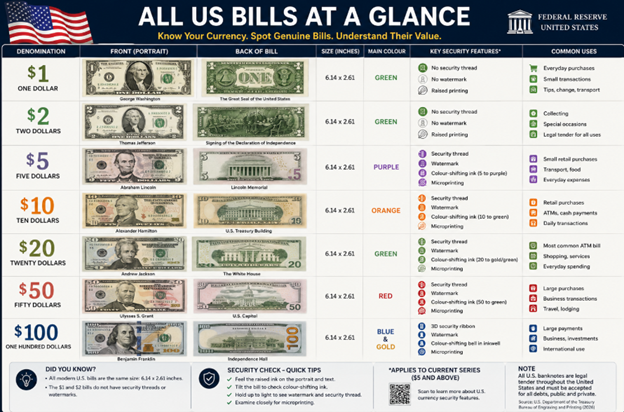
The United States currently has seven paper bill denominations. Each note carries a portrait of a notable historical figure on the front and national imagery on the reverse.
$1 Dollar Bill
The $1 bill is the most widely recognised US banknote. It features George Washington, the first President of the United States, on the front.
Unlike higher denominations, the $1 bill has not received the advanced security redesign found on newer notes. It does not include a security thread or watermark. Instead, it retains its long-standing green design.
People commonly use the $1 bill for:
- Everyday purchases
- Public transport fares
- Cash tips
- Small cash transactions
Because of its frequent use, the $1 bill circulates more widely than any other US paper denomination.
$2 Dollar Bill
The $2 bill features Thomas Jefferson on the front and a reproduction of John Trumbull’s painting of the signing of the Declaration of Independence on the reverse.
Many people believe the $2 bill is rare because they do not encounter it often. In reality, it remains legal tender. The Bureau of Engraving and Printing produces new $2 bills only when the Federal Reserve places an order based on demand.
The $2 bill may appear less frequently because businesses and consumers often keep it as a souvenir rather than spend it.
Common facts about the $2 bill include:
- It remains valid for all payments.
- Banks can still distribute it if available.
- Collectors often save uncirculated notes.
$5 Dollar Bill
The $5 bill carries the portrait of Abraham Lincoln, the 16th President of the United States.
The reverse shows the Lincoln Memorial in Washington, DC.
Modern $5 bills include several security features designed to make counterfeiting more difficult, including:
- Embedded security thread
- Watermark
- Microprinting
- Colour-shifting elements in selected print areas
People often use the $5 bill for small retail purchases, food, transport and everyday expenses.
$10 Dollar Bill
Alexander Hamilton appears on the front of the $10 bill.
The reverse displays the US Treasury Building.
The current design includes:
- Security thread
- Watermark
- Colour-shifting ink
- Fine-line background printing
- Microprinted text
The $10 bill is widely used for cash payments and ATM withdrawals.
$20 Dollar Bill
The $20 bill is one of the most frequently used denominations in the United States.
It features Andrew Jackson on the front and the White House on the reverse.
Most ATMs dispense $20 bills because they suit everyday withdrawals and purchases.
Security features include:
- Embedded security thread
- Watermark
- Colour-shifting numeral
- Microprinting
- Raised printing
For Nigerians exchanging cash before travelling, the $20 bill is one of the denominations most commonly available through banks and licensed Bureau de Change operators.
$50 Dollar Bill
The $50 bill displays Ulysses S. Grant on the front.
The reverse features the United States Capitol.
Although businesses accept the $50 bill as legal tender, many Americans use it less frequently than the $20 or $100 bill. Retailers may request additional verification before accepting high-value notes during cash transactions.
The current design contains:
- Watermark
- Security thread
- Colour-shifting ink
- Microprinting
- Fine background printing
$100 Dollar Bill
The $100 bill is the highest denomination currently printed by the United States for public circulation.
It features Benjamin Franklin on the front and Independence Hall on the reverse.
The current design includes several advanced anti-counterfeiting features, making it the most secure US banknote in circulation.
These features include:
- Blue 3D security ribbon
- Colour-shifting bell inside an inkwell
- Security thread
- Watermark
- Microprinting
- Raised printing
- Gold “100” numeral on the reverse
The $100 bill plays an important role in international trade, travel and cross-border payments. It is also the denomination most commonly exchanged by Nigerians for school fees, business payments, savings and overseas travel.
Because of its higher value, banks and Bureau de Change operators in Nigeria often examine $100 bills carefully before accepting them for exchange. They may also prefer newer note designs that include the latest security features.
Current US Coin Denominations
The United States currently has six coin denominations. Each coin has a different value, design and purpose in everyday transactions.
Unlike paper bills, coins remain in circulation for many years because they are more durable. The United States Mint produces circulating coins at several facilities, including Philadelphia and Denver.
Penny (1 Cent)
The penny is worth one cent, which equals one-hundredth of a US dollar.
Abraham Lincoln appears on the front of the penny. The reverse features the Union Shield, a design introduced in 2010.
Although the US Mint stopped producing pennies for general circulation beginning in 2025, existing pennies remain legal tender. Businesses and consumers can continue using them for purchases and cash payments.
Key facts about the penny:
- Value: $0.01
- Portrait: Abraham Lincoln
- Reverse: Union Shield
- Legal tender: Yes
- Currently circulating: Yes
Nickel (5 Cents)
The nickel is worth five cents.
The front features Thomas Jefferson, while the reverse shows his historic home, Monticello.
The nickel remains one of the most common coins used for everyday transactions.
Key facts:
- Value: $0.05
- Portrait: Thomas Jefferson
- Reverse: Monticello
- Legal tender: Yes
- Currently produced: Yes
Dime (10 Cents)
The dime is worth ten cents.
Despite being the smallest US coin in size, it has a higher value than both the penny and the nickel.
The front shows Franklin D. Roosevelt. The reverse features a torch alongside olive and oak branches.
Key facts:
- Value: $0.10
- Portrait: Franklin D. Roosevelt
- Reverse: Torch, olive branch and oak branch
- Legal tender: Yes
- Currently produced: Yes
Quarter (25 Cents)
The quarter equals one-quarter of a US dollar.
George Washington appears on the front of the coin.
The reverse design changes under the US Mint’s circulating coin programmes, which highlight states, territories or notable American women, depending on the series being issued.
The quarter remains the most widely used US coin because of its convenience for vending machines, parking meters, laundries and retail purchases.
Key facts:
- Value: $0.25
- Portrait: George Washington
- Reverse: Rotating commemorative designs
- Legal tender: Yes
- Currently produced: Yes
Half Dollar (50 Cents)
The half dollar is worth fifty cents.
It features President John F. Kennedy on the front.
Although the coin remains legal tender, it rarely appears in everyday circulation. Most people receive it directly from banks or purchase it from collectors and the US Mint.
Key facts:
- Value: $0.50
- Portrait: John F. Kennedy
- Legal tender: Yes
- Limited circulation: Yes
Dollar Coin ($1)
The dollar coin has the same face value as the $1 paper bill.
The United States continues to produce dollar coins, but they are far less common in daily transactions because consumers generally prefer paper currency.
Several dollar coin programmes have featured different historical figures, including Native American leaders and former US presidents.
Key facts:
- Value: $1
- Legal tender: Yes
- Currently produced: Yes
- Less common than the $1 bill
Complete List of Dollar Denominations in USA (Bills and Coins)
The table below lists every denomination currently recognised as legal tender in the United States.
| Denomination | Type | Value | Currently Produced* | Legal Tender |
| Penny | Coin | $0.01 | No (general circulation) | Yes |
| Nickel | Coin | $0.05 | Yes | Yes |
| Dime | Coin | $0.10 | Yes | Yes |
| Quarter | Coin | $0.25 | Yes | Yes |
| Half Dollar | Coin | $0.50 | Yes | Yes |
| Dollar Coin | Coin | $1 | Yes | Yes |
| $1 Bill | Paper Bill | $1 | Yes | Yes |
| $2 Bill | Paper Bill | $2 | Based on demand | Yes |
| $5 Bill | Paper Bill | $5 | Yes | Yes |
| $10 Bill | Paper Bill | $10 | Yes | Yes |
| $20 Bill | Paper Bill | $20 | Yes | Yes |
| $50 Bill | Paper Bill | $50 | Yes | Yes |
| $100 Bill | Paper Bill | $100 | Yes | Yes |
*Production schedules depend on demand from the Federal Reserve and the US Mint.
Current Value of Each Dollar Denomination in Naira
The value of US currency in Nigeria changes because the exchange rate between the US dollar (USD) and the Nigerian naira (NGN) fluctuates throughout the trading day.
Instead of using a fixed conversion, multiply the current USD/NGN exchange rate by the denomination you want to convert.
For example:
| US Dollar Denomination | Formula |
| $1 | Current USD/NGN rate × 1 |
| $2 | Current USD/NGN rate × 2 |
| $5 | Current USD/NGN rate × 5 |
| $10 | Current USD/NGN rate × 10 |
| $20 | Current USD/NGN rate × 20 |
| $50 | Current USD/NGN rate × 50 |
| $100 | Current USD/NGN rate × 100 |
Example Calculation
If the exchange rate is ₦1,600 for US$1:
| US Dollars | Approximate Value |
| $1 | ₦1,600 |
| $5 | ₦8,000 |
| $10 | ₦16,000 |
| $20 | ₦32,000 |
| $50 | ₦80,000 |
| $100 | ₦160,000 |
These figures serve only as an illustration. Banks, licensed Bureau de Change operators and money transfer services may use different buying and selling rates.
Which Dollar Denominations in USA Are Accepted in Nigeria?
Nigerian commercial banks, licensed Bureau de Change operators and authorised foreign exchange dealers generally accept genuine US dollar bills that remain legal tender in the United States.
The denominations most commonly exchanged include:
- $20
- $50
- $100
These notes are widely used for:
- Personal travel allowance
- Business travel allowance
- School fees
- Medical payments
- International business transactions
- Personal savings in foreign currency
Lower denominations such as $1, $2, $5 and $10 bills remain legal tender and can be exchanged, but they are less common in high-value foreign exchange transactions.
Do Nigerian Banks Accept Old US Dollar Bills?
This question causes confusion because two separate issues often get mixed together.
First, the United States has not withdrawn older-design Federal Reserve Notes from legal circulation. Older genuine US dollar bills remain legal tender in the United States.
Second, individual Nigerian banks and Bureau de Change operators may set their own cash-handling policies. Some may prefer newer-design notes because they contain updated security features or because their overseas banking partners request newer series for processing.
Before exchanging cash, ask your bank or licensed foreign exchange dealer whether it has any requirements regarding:
- Note condition
- Series year
- Design version
- Tears or damage
- Heavy markings or stains
Condition Matters as Much as the Design
Financial institutions often inspect US dollar bills before accepting them.
Bills may be declined if they are:
- Torn
- Burnt
- Missing pieces
- Heavily stained
- Written on extensively
- Defaced
- Suspected of being counterfeit
Keeping dollar notes clean, flat and undamaged can help reduce processing issues during exchange.
Old vs New Dollar Denominations in USA
The United States has redesigned several dollar bills over the years to improve durability and strengthen security against counterfeiting. These updates changed the appearance of many banknotes while keeping their face value the same.
Today, you may come across both older and newer versions of the same denomination. For example, two $100 bills printed years apart may look different but still have the same purchasing power.
The United States has redesigned the following denominations in recent decades:
| Denomination | Current Design Includes |
| $5 | Purple numeral, watermark, security thread and microprinting |
| $10 | Orange background, watermark, security thread and colour-shifting ink |
| $20 | Green and peach background, watermark and colour-shifting numeral |
| $50 | Red and blue background details, watermark and security thread |
| $100 | Blue 3D security ribbon, colour-shifting bell, watermark and microprinting |
The $1 and $2 bills continue to use their long-established designs and do not include the advanced security features found on higher denominations.
Are Older US Dollar Bills Still Legal Tender?
Yes.
All genuine Federal Reserve Notes remain legal tender regardless of when they were printed. This includes older designs that are no longer produced.
For example, an authentic $20 bill printed decades ago still has the same face value as a newly printed $20 bill.
A note does not lose its legal tender status simply because a newer design has replaced it.
Why Do Older Dollar Bills Look Different?
The US government periodically updates banknotes to:
- Improve anti-counterfeiting technology
- Make security features easier to verify
- Increase durability
- Reduce the risk of fraud
These redesigns do not change the value of the note.
Why Nigerian Banks May Prefer Newer Dollar Notes
Many Nigerians notice that some banks or Bureau de Change operators ask for newer US dollar bills, especially when exchanging large amounts of cash.
This preference comes from operational policies rather than US law.
Some financial institutions choose newer notes because they:
- Include the latest security features.
- Are easier to authenticate.
- Show less wear from circulation.
- Meet the cash-handling requirements of correspondent banks abroad.
Requirements can vary between institutions. One bank may accept an older-design $100 bill, while another may request a newer series in good condition.
If you plan to exchange US dollars in Nigeria, it is worth confirming the institution’s requirements before visiting a branch.
Security Features of Dollar Denominations in USA
Modern US banknotes contain several security features that help people identify genuine currency.
The exact features depend on the denomination and design series, but higher-value notes include multiple layers of protection.
Security Thread
Most modern US bills from $5 to $100 contain an embedded security thread.
The thread runs vertically through the paper and becomes visible when held against the light.
Each denomination has its own thread position and printed text.
Under ultraviolet (UV) light, the thread glows in a specific colour that differs by denomination.
Watermark
Most redesigned US bills include a watermark that matches the portrait on the front of the note.
You can see the watermark by holding the bill against a light source.
The image appears within the paper itself rather than being printed on the surface.
Colour-Shifting Ink
The lower-right numeral on many redesigned bills changes colour when you tilt the note.
Depending on the denomination, the numeral shifts between colours such as copper and green.
This feature helps distinguish genuine notes from many counterfeit copies.
3D Security Ribbon
The blue 3D security ribbon appears only on the current $100 bill.
The ribbon is woven into the paper instead of being printed on top.
When you tilt the note, the bells and the number 100 appear to move in different directions.
This feature is unique to the redesigned $100 bill.
Colour-Shifting Bell
Also exclusive to the current $100 bill, the bell inside the copper-coloured inkwell changes colour as you tilt the note.
The bell appears and disappears depending on the viewing angle.
Microprinting
Modern US banknotes contain tiny printed words that are difficult to reproduce accurately.
Microprinted text appears in different locations depending on the denomination.
You may need a magnifying glass to read it clearly.
Raised Printing
Authentic US currency has a distinctive texture created during the printing process.
When you run your fingers across the portrait or other printed areas, you can usually feel slight raised printing.
Counterfeit notes often feel smoother.
Serial Numbers
Every Federal Reserve Note carries a unique serial number.
No two genuine notes of the same series and Federal Reserve Bank combination share the same serial number.
The serial numbers should match in colour and style and align correctly with the Treasury seal.
How to Identify Genuine US Dollar Bills
If you receive US dollars in Nigeria, take a few moments to examine the note before accepting it.
Check several security features rather than relying on just one.
A genuine US dollar bill should have:
- Sharp, clear printing
- Crisp paper with a distinctive texture
- A matching watermark, where applicable
- An embedded security thread on redesigned denominations
- Colour-shifting ink on applicable notes
- Clearly printed serial numbers
- Fine lines and detailed engraving
Avoid judging a note solely by its colour or age. Genuine older notes may look different from recently printed bills while remaining valid legal tender.
Common Mistakes When Checking US Dollar Bills
Some people incorrectly assume that a note is counterfeit because it:
- Has an older design.
- Shows signs of normal circulation.
- Uses a different portrait style from a newer series.
- Lacks a blue security ribbon.
For example, only the current $100 bill has the blue 3D security ribbon. Its absence on a $20 or $50 bill does not indicate that the note is fake.
Similarly, genuine $1 and $2 bills do not contain many of the advanced security features found on higher denominations.
When in doubt, compare the note with one obtained from a reputable bank or have it examined by a financial institution with experience handling foreign currency.
Discontinued US Dollar Denominations
The United States once issued paper money in denominations larger than $100. These high-value notes supported transactions between banks and financial institutions before electronic payment systems became common.
The government stopped printing these denominations decades ago because electronic transfers replaced the need for large cash payments.
Although most people will never encounter one, several discontinued notes remain legal tender if they are genuine. Collectors often value them far above their face value because of their rarity and historical significance.
$500 Bill
The $500 bill featured President William McKinley on the front.
Banks mainly used the note to settle large transactions before modern electronic banking.
The government discontinued production in 1945, and the Federal Reserve officially withdrew it from routine circulation in 1969.
Today, collectors buy and sell genuine $500 bills through specialist dealers and auctions.
$1,000 Bill
The $1,000 bill displayed President Grover Cleveland.
Like the $500 bill, it mainly supported large financial transactions between banks.
The note no longer circulates in everyday commerce, although genuine examples remain legal tender.
Because relatively few survive, collectors often pay far more than the printed face value.
$5,000 Bill
The $5,000 bill featured James Madison, the fourth President of the United States.
The government produced only a limited number of these notes.
Banks used them almost exclusively for high-value transfers before electronic settlement systems became standard.
Very few examples remain outside museums and private collections.
$10,000 Bill
The $10,000 bill carried the portrait of Salmon P. Chase, who served as Secretary of the Treasury during the American Civil War.
It represented the highest denomination ever issued for public circulation.
Like the other large-denomination notes, it mainly served banking institutions rather than consumers.
Collectors rarely encounter authentic examples because only a small number remain.
$100,000 Gold Certificate
The $100,000 Gold Certificate differs from every other denomination on this list.
It featured President Woodrow Wilson.
The government never released this note into public circulation.
Instead, it served only as an accounting instrument for transactions between Federal Reserve Banks during the 1930s.
Private individuals could not own or spend these certificates in ordinary commerce.
Are Discontinued Dollar Bills Still Legal Tender?
Yes, with one important exception.
The following Federal Reserve Notes remain legal tender if they are genuine:
- $500
- $1,000
- $5,000
- $10,000
Although people can technically use them for payments, their collector value usually exceeds their printed face value.
The $100,000 Gold Certificate does not fall into this category because the government never issued it for public use.
Why Is There No $200 Bill?
The United States has never issued a $200 bill for general circulation.
Several reasons explain why.
First, the existing range of denominations already covers most cash transactions.
Second, electronic payment methods have reduced demand for larger paper denominations.
Third, introducing a new denomination would require changes to banking equipment, ATMs, vending machines, cash registers and anti-counterfeiting systems.
From time to time, images of supposed $200 bills circulate online. These images usually show novelty items or altered designs rather than official US currency.
Interesting Facts About Dollar Denominations in USA
The $2 Bill Is Not Rare
Many people believe the $2 bill is rare because they seldom receive one in change.
In reality, it remains legal tender. The Federal Reserve orders new supplies when demand requires them.
The $100 Bill Is the Largest Note Printed Today
Although larger denominations once existed, the United States currently prints only up to the $100 bill for public circulation.
The $1 Bill Has Changed Very Little
Compared with higher denominations, the $1 bill still resembles its historical design.
It does not include features such as a watermark, security thread or colour-shifting ink.
Every Genuine US Bill Has the Same Physical Size
Whether a bill is worth $1 or $100, every modern US banknote has identical dimensions.
This standard makes printing, handling and storage more efficient.
Coins and Bills Remain Legal Tender
Both paper money and coins continue to serve as legal tender in the United States.
Consumers may use either form of currency for cash transactions unless a business sets its own payment policies before the sale.
FAQs About Dollar Denominations in USA
What are the current dollar denominations in USA?
The United States currently issues seven paper bills and six coin denominations.
Paper bills:
- $1
- $2
- $5
- $10
- $20
- $50
- $100
Coins:
- 1 cent (Penny)
- 5 cents (Nickel)
- 10 cents (Dime)
- 25 cents (Quarter)
- 50 cents (Half Dollar)
- $1 (Dollar Coin)
What is the highest US dollar denomination today?
The $100 bill is the highest denomination currently printed for public circulation.
Is the $2 bill still legal tender?
Yes.
The $2 bill remains legal tender throughout the United States. Although it appears less frequently in circulation, banks may still distribute it when available.
Can you still spend a $500 bill?
Yes.
A genuine $500 Federal Reserve Note remains legal tender. However, most surviving examples have significant collector value, so owners rarely use them for ordinary purchases.
Are old US dollar bills still valid?
Yes.
Older-design Federal Reserve Notes remain legal tender if they are genuine, even when newer versions of the same denomination exist.
Are dollar coins still produced?
Yes.
The United States Mint continues to produce dollar coins, although people use them less often than $1 paper bills.
Is the penny still legal tender?
Yes.
Existing pennies remain legal tender even though the United States ended production for general circulation beginning in 2025.
Why do some Nigerian banks prefer newer dollar notes?
Some banks and foreign exchange dealers prefer newer notes because they include updated security features and may better meet the handling requirements of overseas banking partners. Individual institutions may have different acceptance policies for older designs or heavily worn notes.