Article Was Last Updated August 25, 2026
The origin of the Igbo people remains one of the most debated topics in Nigerian history. Historians have proposed several theories of Igbo origin, but no single explanation has gained universal acceptance. Most modern scholars believe the Igbo developed in present-day south-eastern Nigeria over thousands of years, with migration and cultural exchange shaping their civilisation.
The leading theories of Igbo origin include the Indigenous Origin Theory, the Nri Origin Theory, the Migration Theory, the Jewish (Israelite) Origin Theory and the North African or Nile Valley Theory. Among these, the Indigenous Origin Theory has the strongest support from archaeological, linguistic and historical evidence.
Archaeological discoveries at Igbo-Ukwu, Lejja, Ugwuele and Nsukka reveal early settlements, iron technology and advanced bronze casting long before European contact. Linguistic studies and Igbo oral traditions also support the long history of Igbo communities in the Lower Niger region.
This article examines the main theories of Igbo origin, the evidence behind each one and the history of the Igbo people from prehistoric settlements to the present day.
Who Are the Igbo People?
The Igbo are one of Nigeria’s three largest ethnic groups, alongside the Hausa and Yoruba. Their traditional homeland lies in south-eastern Nigeria, covering Abia, Anambra, Ebonyi, Enugu and Imo States, with significant communities in Delta, Rivers, Akwa Ibom and Cross River. These states remain the cultural heartland of the Igbo people. Today, Imo State continues to play an important role in the region’s political, economic and cultural development under leaders such as Hope Uzodinma.
In 2026, the global Igbo population is estimated at between 35 and 45 million people. Large diaspora communities also live in the United Kingdom, the United States, Canada, South Africa, Cameroon and Equatorial Guinea, where they continue to preserve their language and cultural heritage.
The Igbo Language
The Igbo language belongs to the Volta-Niger branch of the Niger-Congo language family. Although many dialects exist across Igboland, they remain closely related. Standard Igbo, developed during the twentieth century, serves as the common written language used in education, literature, broadcasting and government communication.
Beyond communication, the language preserves proverbs, folktales, songs and oral traditions that provide valuable insights into early Igbo history and culture. The richness of the language has also inspired world-renowned writers such as Chinua Achebe, whose works introduced Igbo history, traditions and philosophy to millions of readers across the world.
Today, contemporary authors such as Chimamanda Ngozi Adichie continue to celebrate Igbo identity by weaving its language, customs and history into internationally acclaimed literature.
Geography of Igboland
Igboland stretches across the rainforest and forest zones east of the lower River Niger. Fertile soil, abundant rainfall and numerous rivers supported agriculture and encouraged the growth of independent communities.
Unlike many African societies that formed large kingdoms, most Igbo communities developed as autonomous village republics connected by language, trade, kinship and shared beliefs. This decentralised system became a defining feature of traditional Igbo society.
Economy and Traditional Occupations
Agriculture formed the foundation of the traditional economy. Yam held special cultural importance, while farmers also cultivated cassava, cocoyam, maize, vegetables and oil palm.
Trade linked communities throughout Igboland and neighbouring regions. Merchants exchanged farm produce, pottery, textiles, iron tools, and later imported goods through well-established market networks.
Specialised crafts also flourished. Blacksmiths, potters, weavers, wood carvers and bronze casters produced goods that reflected advanced technical skill. The bronze artefacts discovered at Igbo-Ukwu remain among the finest examples of early African metalworking.
Igbo Culture and Identity
Despite regional differences, Igbo communities share cultural values centred on family, hard work, personal achievement and communal responsibility.
Traditional religion, known as Odinani, recognises Chukwu as the Supreme Creator alongside spiritual beings connected to morality and nature. Although Christianity is now the dominant faith, many traditional customs continue to influence festivals, marriage ceremonies, naming traditions and community life.
Entrepreneurship has become another defining characteristic of modern Igbo society. Across Nigeria and the diaspora, Igbo business networks, manufacturing enterprises and the apprenticeship system have contributed significantly to economic development. This entrepreneurial tradition has produced some of Nigeria’s most successful business leaders, including billionaire businessman Arthur Eze.
Together, their language, culture, history and social institutions have shaped one of Africa’s most dynamic civilisations.
Why the Origin of the Igbo People Is Debated
Determining the origin of the Igbo presents unique challenges because early communities relied on oral tradition rather than written records. Historians therefore combine evidence from archaeology, linguistics, anthropology and historical research to reconstruct the past.
Oral Traditions
For centuries, elders preserved history through storytelling, genealogy and ritual. These traditions record ancestral migrations, founding communities and sacred sites that written sources never documented.
Although oral accounts often include symbolic and religious elements, they remain valuable historical sources when compared with archaeological and linguistic evidence.
Archaeology
Archaeological discoveries have transformed our understanding of early Igbo history. Excavations at Ugwuele, Nsukka, Lejja and Igbo-Ukwu reveal continuous human settlement, early agriculture, iron technology and advanced bronze casting long before European contact.
These discoveries strongly support the view that complex societies developed within south-eastern Nigeria over many centuries.
Linguistic Evidence
Comparative studies place the Igbo language within the Volta-Niger branch of the Niger-Congo family. Most linguists conclude that the language evolved in the Lower Niger region over several millennia, although some researchers suggest earlier population movements from areas around the Niger-Benue confluence.
Language cannot identify precise migration routes, but it helps explain how related communities expanded and interacted over time.
Colonial and Modern Scholarship
Early European writers often interpreted Igbo history through biblical or North African migration theories because they underestimated the complexity of indigenous African civilisations.
Modern research paints a different picture. Archaeologists, historians and linguists increasingly agree that Igbo civilisation emerged through long-term settlement, technological development and interaction among neighbouring communities rather than a single migration or founding event.
While debate continues, most evidence supports a gradual evolution of Igbo society within present-day south-eastern Nigeria.
The Main Theories of Igbo Origin
Scholars have proposed several theories to explain the origin of the Igbo people. While these theories differ, they are not always mutually exclusive. Many historians argue that Igbo civilisation developed through long-term settlement, population movement and cultural exchange rather than a single migration or founding event.
Indigenous Origin Theory
The Indigenous Origin Theory, also known as the autochthonous theory, is the most widely accepted explanation among modern historians and archaeologists. It holds that the ancestors of the Igbo developed within present-day south-eastern Nigeria over thousands of years instead of migrating from a distant homeland.
Archaeological discoveries strongly support this view. Excavations at Ugwuele, Nsukka, Lejja and other sites reveal continuous human occupation from prehistoric times. Stone tools, pottery, early farming communities and iron-smelting furnaces show steady cultural and technological development long before written history.
The discovery of the ninth-century bronze artefacts at Igbo-Ukwu further strengthened this theory. The exceptional craftsmanship demonstrates that skilled artisans, organised religious institutions and thriving trade networks already existed in the region centuries before European contact.
Linguistic research also supports long-term settlement. The Igbo language evolved within the Volta-Niger branch of the Niger-Congo family, with no convincing evidence of a large ancient Igbo-speaking population outside the Lower Niger region.
Many oral traditions reinforce this interpretation. Numerous communities describe themselves as indigenous to their present homeland rather than descendants of migrants from distant lands. Although oral traditions cannot serve as definitive historical proof, they align with archaeological and linguistic evidence.
Most historians therefore regard indigenous development as the strongest explanation for the emergence of the Igbo people while recognising that neighbouring communities influenced one another through migration, trade and intermarriage.
Nri Origin Theory
The Nri Origin Theory focuses on the Kingdom of Nri as the cultural and spiritual centre that shaped many aspects of Igbo civilisation.
According to tradition, Eri, a revered ancestral figure, settled in the Anambra River valley under the guidance of Chukwu. His descendants later established Nri, where the institution of the Eze Nri emerged as the highest spiritual authority in much of Igboland.
Whether Eri was a historical person or a symbolic ancestor remains uncertain. However, historians agree that Nri became one of the most influential institutions in pre-colonial Igbo history.
Between the tenth and eighteenth centuries, Nri expanded its influence through diplomacy, ritual authority and religious leadership rather than military conquest. Priests travelled across Igboland to perform purification ceremonies, settle disputes and promote shared customs. This peaceful network helped strengthen a common cultural identity among otherwise independent communities.
Archaeological evidence from nearby Igbo-Ukwu supports the existence of an advanced ceremonial and religious centre closely linked to the wider Nri cultural sphere.
Rather than claiming that all Igbo people originated from Nri, most historians view the kingdom as a major force in shaping Igbo religion, governance and cultural traditions.
Migration Theory
The Migration Theory argues that the ancestors of the Igbo gradually moved into south-eastern Nigeria from neighbouring regions over many centuries.
Unlike older accounts that describe a single large migration, this theory proposes a slow process of expansion. Communities established new settlements, interacted with neighbouring groups and adapted to changing environmental conditions.
Some researchers place the earliest homeland of Proto-Igbo speakers near the Niger-Benue confluence. Population growth, climate change and the search for fertile farmland may have encouraged gradual movement into present-day Igboland.
Linguistic studies provide limited support for this view by suggesting that Volta-Niger languages diversified before spreading across southern Nigeria. Archaeology also indicates continuous settlement rather than sudden population replacement, implying that incoming groups mixed with existing communities instead of displacing them.
Many historians see migration as part of the broader development of Igbo civilisation rather than an alternative to indigenous settlement.
Jewish (Israelite) Origin Theory
The Jewish or Israelite Origin Theory remains one of the most widely discussed but controversial explanations of Igbo origins.
Supporters argue that the Igbo descend from one of the Lost Tribes of ancient Israel. They point to similarities between certain Igbo customs and Jewish practices, including circumcision, ritual purification, dietary traditions and aspects of religious worship. Some also associate the ancestral figure Eri with biblical history.
Despite its popularity among some religious groups and members of the Igbo diaspora, mainstream scholarship does not support this theory as the primary explanation for Igbo origins.
Historians note that similar customs appear in many cultures without indicating shared ancestry. Archaeological research has uncovered no evidence linking early Igbo settlements directly to ancient Israel. Linguistic studies also classify Igbo as a Niger-Congo language rather than a Semitic one, while genetic research has not established a unique Israelite origin for the wider Igbo population.
Although the theory continues to hold cultural and religious significance for some communities, it remains unproven from a historical perspective.
North African and Nile Valley Theory
During the nineteenth and early twentieth centuries, some European writers argued that the Igbo originated from ancient Egypt, Nubia or other parts of the Nile Valley.
They based this theory on perceived similarities in religion, kingship, metallurgy and symbolism. At the time, many scholars assumed that complex African societies must have developed through outside influence rather than local innovation.
Modern research has largely rejected this interpretation.
Archaeological discoveries across Nigeria demonstrate that advanced iron-working, bronze casting, agriculture and trade developed independently within West Africa. The Igbo language also belongs to the Niger-Congo family and shares no close historical relationship with the Afroasiatic languages of ancient Egypt or the Nile Valley.
While trade and cultural contact occurred between different regions of Africa, no convincing evidence shows that Igbo civilisation originated in North Africa.
Comparing the Main Theories
Each theory contributes to the study of early Igbo history, but the evidence does not support them equally.
The Indigenous Origin Theory enjoys the strongest academic support because archaeology, linguistics and many oral traditions all point to long-term settlement in south-eastern Nigeria.
The Nri Origin Theory explains how shared religious beliefs and cultural institutions strengthened a common Igbo identity without suggesting that every community descended directly from Nri.
Migration theories remain relevant because population movement formed part of human history. Most researchers accept that neighbouring communities interacted and migrated over many centuries while local societies continued to develop.
The Jewish Origin Theory retains cultural importance for some people but lacks sufficient archaeological, linguistic and historical evidence to establish it as the principal explanation for Igbo origins.
Likewise, the North African and Nile Valley Theory is now viewed mainly as an example of early colonial scholarship rather than a credible account of Igbo history.
Taken together, current evidence suggests that Igbo civilisation emerged through indigenous development shaped by gradual migration, trade and cultural exchange. Instead of a single point of origin, the Igbo evolved over thousands of years into one of Africa’s most enduring civilisations.
Archaeological Evidence of Early Igbo Civilisation
Archaeological discoveries provide the strongest physical evidence for the long history of human settlement in Igboland. Excavations across south-eastern Nigeria reveal continuous occupation, technological innovation and expanding trade networks that predate European contact by many centuries.
Rather than supporting the idea of a civilisation introduced from elsewhere, the archaeological record shows that complex societies developed locally over thousands of years.
Ugwuele: Early Human Settlement
Ugwuele in present-day Abia State is one of the oldest known archaeological sites in Igboland. Excavations uncovered stone tools and other artefacts dating back several millennia, confirming that prehistoric communities lived in the region long before the rise of organised states.
The site contains multiple occupation layers, showing that successive generations settled there over an extended period. These early inhabitants relied on hunting, gathering and simple stone technology before gradually adopting pottery and more permanent forms of settlement.
Nsukka and Afikpo: Farming Communities
Excavations at Nsukka and Afikpo reveal the gradual transition from hunting and gathering to settled agriculture. Archaeologists recovered pottery, food-processing tools and evidence of permanent villages, indicating that farming supported population growth and increasingly organised communities.
Some pottery styles resemble those still found in parts of Igboland today, suggesting continuity in local craft traditions, although archaeology alone cannot establish direct cultural descent.
Lejja: Early Iron Technology
Lejja in present-day Enugu State contains one of West Africa’s oldest known iron-smelting sites. Scientific dating suggests that iron production began during the second millennium BC.
Archaeologists uncovered furnaces, slag deposits and other evidence of large-scale metalworking. Iron tools improved farming, hunting and woodworking, while blacksmiths became respected specialists whose products circulated through regional trade.
Nearby Opi has yielded similar discoveries, reinforcing the conclusion that advanced metallurgy developed within the region rather than arriving solely through outside influence.
Igbo-Ukwu: A Landmark Discovery
No archaeological site has reshaped the study of Igbo history more than Igbo-Ukwu in present-day Anambra State.
In 1938, Isaiah Anozie accidentally uncovered bronze objects while digging a water cistern. British archaeologist Thurstan Shaw later carried out systematic excavations that revealed one of Africa’s most remarkable archaeological discoveries.
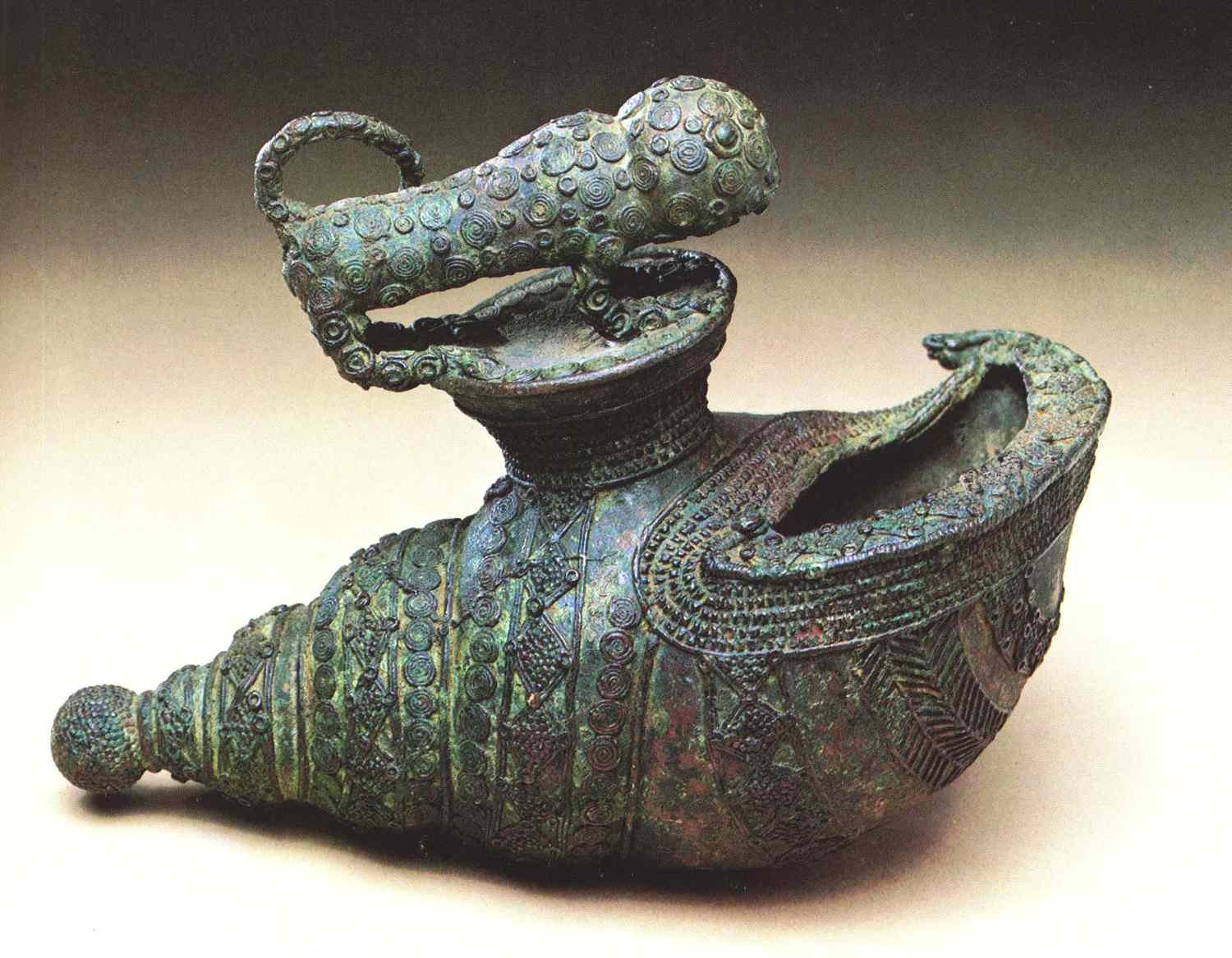
Researchers recovered more than 700 bronze objects, including ceremonial vessels, jewellery, staffs, ornaments and ritual artefacts, together with over 165,000 glass and carnelian beads. Radiocarbon dating places most of these finds in the ninth and tenth centuries AD.
The bronze casters produced intricate works using sophisticated lost-wax techniques that rivalled the finest metalworking traditions of their time. The discoveries confirmed that highly skilled artisans, organised religious institutions and prosperous communities flourished in south-eastern Nigeria centuries before European contact.
Long-Distance Trade Networks
The artefacts from Igbo-Ukwu also reveal extensive trade connections.
Scientific analysis indicates that many glass beads and other luxury materials originated outside the region, reaching Igboland through trans-Saharan trade routes. These exchanges connected local communities with wider commercial networks across West Africa and beyond.
Trade encouraged the movement of goods, ideas and technology, contributing to the continued growth of early Igbo society.
What Archaeology Reveals
Although archaeology cannot identify the exact origin of the Igbo people, it provides several important conclusions.
The evidence confirms continuous human occupation in parts of Igboland for thousands of years. It also demonstrates steady technological progress, from Stone Age communities to iron-smelting centres and sophisticated bronze workshops.
Most importantly, archaeology shows that complex civilisation developed within south-eastern Nigeria through long-term local innovation. These discoveries strongly support the view that the Igbo emerged through indigenous development while interacting with neighbouring societies over many centuries.
Timeline of Igbo History
Before 5000 BC
Prehistoric hunter-gatherers occupied parts of present-day Igboland, leaving behind stone tools and other evidence of early human activity.
c. 4000–2000 BC
Permanent settlements expanded as farming, pottery production and village life gradually replaced a purely hunting and gathering economy.
c. 2000–500 BC
Iron-smelting emerged at sites such as Lejja and Opi, transforming agriculture, craftsmanship and trade.
Ninth–Tenth Centuries AD
Igbo-Ukwu flourished as a major centre of bronze casting, religious activity and long-distance commerce.
Tenth–Eighteenth Centuries
The Kingdom of Nri became the leading spiritual authority across much of Igboland, promoting shared customs and peaceful cultural integration.
Fifteenth Century
Portuguese traders established contact with communities along the Niger coast, introducing new commercial links with Europe.
Sixteenth–Nineteenth Centuries
Regional trade expanded as autonomous village republics and the Aro commercial network strengthened economic and cultural connections across the region.
Late Nineteenth Century
British forces incorporated Igboland into the Protectorate of Southern Nigeria, ending political independence and introducing colonial administration.
1929
The Women’s War became one of Africa’s most significant anti-colonial protests as thousands of Igbo women challenged taxation and colonial policies.
1960
Nigeria gained independence, and Igbo leaders played prominent roles in national politics, education and public administration.
1967–1970
The Nigerian Civil War followed the declaration of the Republic of Biafra, leaving lasting political, economic and humanitarian consequences.
1970–Present
The Igbo rebuilt their economy through commerce, manufacturing, education and entrepreneurship. Today, thriving communities across Nigeria and the global diaspora continue to preserve and promote Igbo language, culture and heritage.
The Nri Kingdom and Its Influence
The Kingdom of Nri was one of the most influential institutions in pre-colonial Igbo history. Emerging around the ninth or tenth century AD in present-day Anambra State, it became the spiritual and cultural centre of much of Igboland.
According to Igbo tradition, the kingdom traces its origins to Eri, a revered ancestral figure believed to have settled in the Anambra River valley. His descendants established Nri, where the institution of the Eze Nri developed into the highest spiritual authority among many Igbo communities.
Unlike kingdoms that expanded through military conquest, Nri relied on religious authority, diplomacy and ritual leadership. Priests travelled across Igboland to perform purification rites, settle disputes and confer titles. Communities accepted Nri’s influence because of its spiritual significance rather than political control.
Nri also helped regulate trade, promote ethical conduct and preserve religious traditions centred on Ala, the Earth goddess. Through its rituals and institutions, the kingdom reinforced shared customs that united otherwise independent communities.
British colonial rule weakened Nri’s authority in the late nineteenth and early twentieth centuries. Even so, its religious traditions, symbols and cultural practices continue to influence Igbo identity today.
Traditional Political Organisation
Traditional Igbo society developed one of Africa’s best-known republican systems of government. Instead of concentrating power in a single monarch, most communities governed themselves through consultation, consensus and shared responsibility.
The village formed the basic political unit. Councils of elders, family heads, title holders and age-grade associations worked together to settle disputes, enforce customary law and manage community affairs. Leadership depended on integrity, experience and public trust rather than hereditary succession.
Age-grade associations organised public works, maintained roads and markets, provided security and coordinated festivals. Title societies, including the Ozo institution, recognised individuals who demonstrated integrity, generosity and service to the community.
Women also played an important role in governance. Organisations such as the Umuada and married women’s associations mediated disputes, promoted social welfare and defended community interests. Their influence became especially evident during the Women’s War of 1929, when thousands of Igbo women united to challenge colonial policies.
This decentralised system encouraged accountability and civic participation, values that continue to shape many Igbo communities.
Igbo Culture and Traditions
Religion and Beliefs
Traditional Igbo religion, known as Odinani, recognises Chukwu or Chineke as the Supreme Creator. Other deities represent natural forces and moral authority, with Ala, the Earth goddess, occupying a central place in law, fertility and community life. Ancestors also hold an important position as guardians of family traditions and moral values.
Although Christianity is now the dominant religion, many traditional beliefs continue to influence ceremonies, festivals and customary practices.
Festivals and Cultural Heritage
Festivals preserve history, strengthen community ties and celebrate agricultural success. The New Yam Festival (Iri Ji) remains the most important traditional celebration, marking the beginning of the harvest season with prayers, feasting, music and dance.
Masquerade performances also form an essential part of Igbo cultural life. Beyond entertainment, masquerades represent ancestral spirits, reinforce community values and preserve traditions passed down through generations.
Music, dance, storytelling and proverbs continue to transmit history and moral lessons, while traditional instruments such as drums, wooden gongs, flutes and rattles remain central to cultural celebrations.
Family, Language and Social Values
Family lies at the heart of Igbo society. Marriage traditionally unites two extended families rather than only two individuals, with elders guiding negotiations and ceremonies.
The Igbo language remains a vital expression of cultural identity. Despite numerous dialects, Standard Igbo provides a common written form that supports education, literature, broadcasting and cultural preservation.
Across generations, the Igbo have placed great value on hard work, personal achievement, respect for elders and communal responsibility. These principles continue to shape social relationships both within Nigeria and across the global diaspora.
Entrepreneurship has also become a defining feature of modern Igbo identity. The indigenous apprenticeship system has produced generations of successful traders, manufacturers and business leaders, contributing significantly to economic development across Nigeria.