Article Was Last Updated August 26, 2026
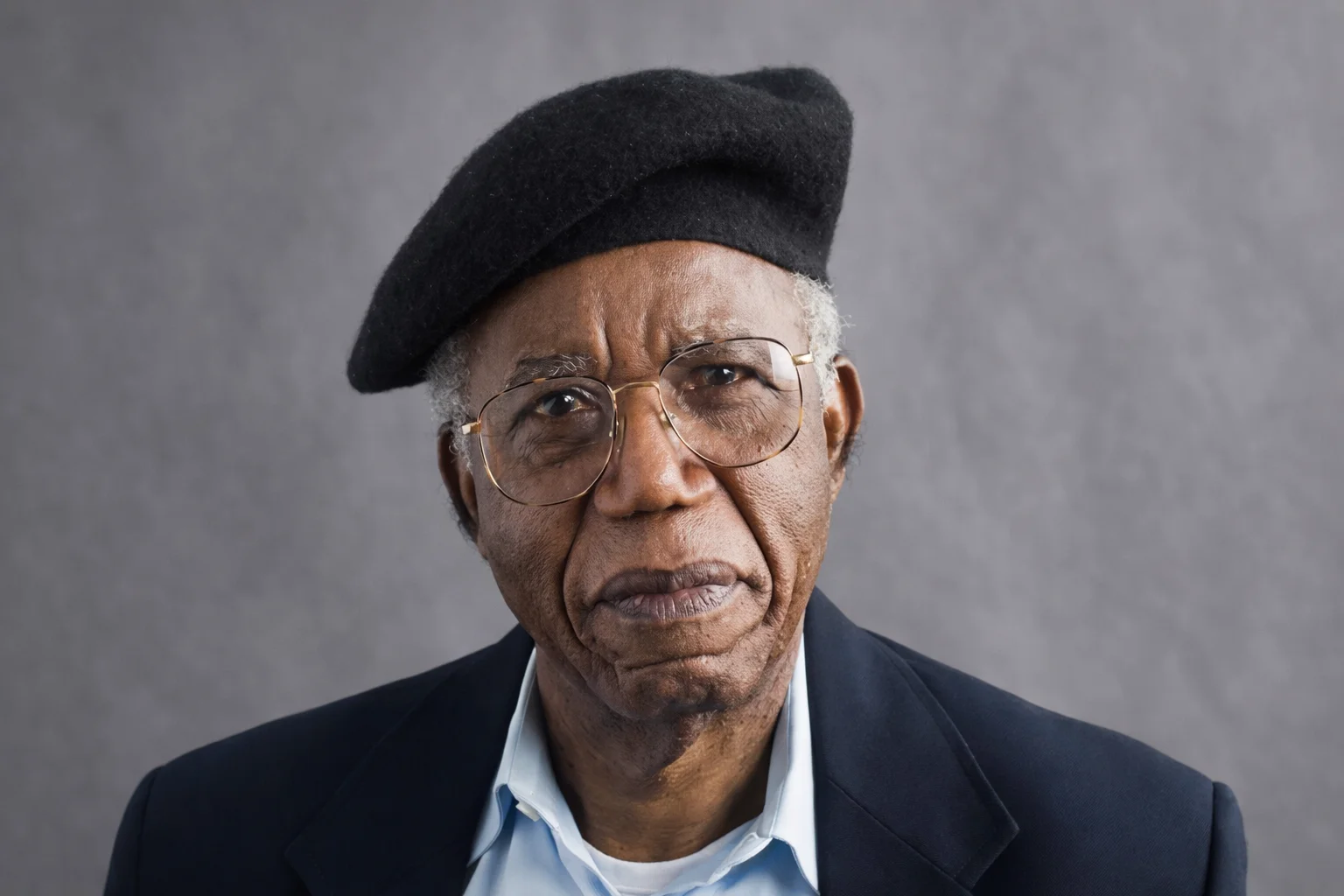
Chinua Achebe biography focuses on the life of the Things Fall Apart author, Nigerian writer Chinua Achebe, and an African literature pioneer who shaped postcolonial literature criticism.
Chinua Achebe Biography
He was born on 16 November 1930 at Saint Simon’s Church, Nneobi, near the Igbo town of Ogidi in what was then Colonial Nigeria.
Known also as Albert Chinụalụmọgụ Achebe, his father, Isaiah Okafo Achebe, was a teacher and Christian evangelist, and his mother, Janet Anaenechi Iloegbunam, was a farmer and church leader from a blacksmith’s family in Awka, so he grew up right at the crossroads of Igbo tradition and colonial Christianity.
His parents were converts to the Church Mission Society, and while his father stopped practising Odinani, the family still respected traditional beliefs, especially through the influence of Isaiah’s uncle, the titled chief Udoh Osinyi.
Chinua Achebe was one of six surviving children, with siblings named Frank Okwuofu, John Chukwuemeka Ifeanyichukwu, Zinobia Uzoma, Augustine Ndubisi, and Grace Nwanneka, and after the youngest was born, the family settled in Ogidi, now in Anambra State.
As a child, Chinua Achebe grew up immersed in Igbo storytelling and village life. His mother and his sister, Zinobia, repeatedly told him folk stories, and he delighted in watching masquerade ceremonies and traditional events.
At home, he read books his father owned, including an Igbo version of The Pilgrim’s Progress and a prose version of A Midsummer Night’s Dream.
Education
In 1936, he started primary school at St Philip’s Central School in Ogidi, where teachers quickly noticed how smart he was.
He later went to Government College Umuahia for secondary school, attended church regularly, and saw debates between Christian converts and traditional believers.
In 1942, he also studied at Nekede Central School near Owerri and passed tough entrance exams for higher education. In 1948, he entered University College Ibadan, Nigeria’s first university, intending to study medicine on a bursary.
While there, he grew increasingly dissatisfied with how Western literature represented Africa, particularly in Joseph Conrad’s Heart of Darkness and Joyce Cary’s Mister Johnson.
He argued that these works often reduced Africans to foolish caricatures and dehumanising stereotypes instead of portraying them as fully developed people with complex societies, histories, and identities.
This pushed him to switch from medicine to English, history, and theology, which cost him his scholarship and forced his family to help pay his fees.
During university, he started writing seriously, publishing his first piece, “Polar Undergraduate,” in 1950 in the University Herald, later editing the magazine and writing essays and short stories.
Between 1951 and 1953, he wrote stories like “In a Village Church,” “The Old Order in Conflict with the New,” and “Dead Men’s Path,” all about tradition clashing with modern life.
He graduated in 1953 with a second-class degree, returned briefly to Ogidi, then taught English for a few months at a poorly equipped school in Oba.
Broadcasting Career and the Writing of Things Fall Apart
Later in 1954, Achebe moved to Lagos to work for the Nigerian Broadcasting Service, where he wrote radio scripts and learned how spoken language worked in everyday settings, which later helped him create realistic dialogue in his fiction.
Lagos exposed him to intense political and social activity, and during this time, he began writing his first novel. In 1956, he travelled to London for BBC staff training, his first trip outside Nigeria, and while there, he shared his manuscript with novelist Gilbert Phelps, who encouraged him but advised further revision.
Back in Nigeria, Achebe reworked the manuscript, eventually titling it Things Fall Apart after a line from W. B. Yeats. In 1957, he sent the manuscript to a London typing service, which nearly lost it until his colleague Angela Beattie intervened.
Heinemann eventually accepted the novel and published it on 17 June 1958.
Literary Breakthrough and International Recognition
British critics praised Things Fall Apart in Britain, and readers in Nigeria gradually recognised it, although early responses in Nigeria remained mixed. The novel told the story of Okonkwo, a yam farmer confronting colonial disruption, and it quickly became a cornerstone of African literature.
After its publication, the NBS promoted Achebe and placed him in charge of Eastern Region broadcasting. At around the same time, he began a relationship with Christiana Chinwe Okoli, known as Christie, whom he later married, and the couple settled in Enugu.
In 1960, he published No Longer at Ease, centred on Obi, Okonkwo’s grandson, dealing with corruption in modern Lagos, and later that year, he received a Rockefeller Fellowship that allowed him to travel across East Africa, where he encountered racial classification systems, segregation, and debates around African languages and literature.
Two years later, he travelled to the United States and Brazil on a UNESCO fellowship, meeting writers such as Ralph Ellison and Arthur Miller and reflecting on translation and global readership.
African Writers Series and Major Novels
In 1961, Achebe became Director of External Broadcasting at the NBS and helped establish the Voice of Nigeria, which began broadcasting in 1962.
That same year, he attended a major conference of African writers at Makerere University, where he met figures like Wole Soyinka and Langston Hughes and later helped bring Ngũgĩ wa Thiong’o and Flora Nwapa into print through Heinemann’s African Writers Series, which he became general editor of.
In 1964, he published Arrow of God, a novel inspired by Igbo history and colonial records that centred on the chief priest Ezeulu and received widespread praise. In 1966, Achebe released A Man of the People, a satirical novel about corruption after independence, shortly before a military coup struck Nigeria and drew unwanted attention from authorities, who suspected he had foreknowledge of the events.
Books By Chinua Achebe
1958 – Things Fall Apart
1960 – No Longer at Ease
1964 – Arrow of God
1966 – A Man of the People
1966 – Chike and the River
1971 – Beware, Soul Brother
1972 – How the Leopard Got His Claws
1972 – Girls at War and Other Stories
1975 – Morning Yet on Creation Day
1983 – The Trouble with Nigeria
1987 – Anthills of the Savannah
1988 – Hopes and Impediments
2000 – Home and Exile
2009 – The Education of a British-Protected Child
2012 – There Was a Country
The Biafran War and Political Commitment
As Nigeria fell into chaos, Achebe sent his pregnant wife and children to safety, though Christie sadly lost the baby during the journey.
When the south-eastern region declared itself independent as Biafra in 1967, Achebe supported the move and served as a cultural ambassador, travelling abroad to explain the situation during the Nigerian Civil War. The war affected him deeply, particularly after the death of his close friend, the poet Christopher Okigbo, in 1967.
During the war, Achebe mostly wrote poetry, later collected in Beware, Soul Brother, and helped shape Biafra’s political ideas through documents like the Ahiara Declaration.
After Biafra surrendered in January 1970, he returned to Ogidi and found his home in ruins. He later took a job at the University of Nigeria, Nsukka, and authorities temporarily confiscated his passport.
Academic Career and Critical Essays
In the early 1970s, Achebe helped found literary journals such as Okike and Uwa Ndi Igbo, published the short story collection Girls at War, and accepted a professorship at the University of Massachusetts Amherst in 1972, where he examined Western perceptions of Africa.
In 1975, he delivered his famous lecture “An Image of Africa: Racism in Conrad’s Heart of Darkness,” criticising Joseph Conrad and Albert Schweitzer, a talk that sparked lasting controversy but reshaped postcolonial literary criticism.
He returned to Nigeria in 1976, held a chair in English at the University of Nigeria until retiring in 1981, and became increasingly involved in political commentary, publishing The Trouble with Nigeria in 1983.
Later Works, Accident, and Life in the United States
In 1987, Chinua Achebe published Anthills of the Savannah, a novel exploring military power and political corruption. The Booker Prize committee shortlisted the book for the award.
In March 1990, a car accident badly injured him and left him paralysed from the waist down. After this, he moved permanently to the United States and became a long-term professor at Bard College, while still speaking out about Nigerian politics during the 1990s.
In the 2000s, he published Home and Exile, then The Education of a British-Protected Child, won the Man Booker International Prize in 2007, and from 2009 until his death taught African studies at Brown University. In 2012, he published There Was a Country, reflecting on the Biafra war.
Awards and Honours
- Chinua Achebe, Chinua Achebe, won the Man Booker International Prize (2007) for lifetime achievement in fiction.
- He received multiple honorary doctorates from universities worldwide.
- Major international literary and academic institutions recognised him for his influence on modern literature.
- Nigerian National Merit Award (NNMA)
- He declined some Nigerian state honours, citing political and governance concerns.
Chinua Achebe Wife & Children
Chinua Achebe married Christiana Chinwe Okoli, often called Christie Achebe. They met while both were working at the Nigerian Broadcasting Service in Enugu, Nigeria, and married on 10 September 1961 in the Chapel of Resurrection at the University of Ibadan.
Their marriage lasted more than five decades, ending with the death of Chinua Achebe in 2013. Christie supported him throughout his literary and academic career and later became a professor herself.
The couple had four children:
- Chinelo Achebe – The eldest daughter, born 11 July 196, pursued a professional life in the United States.
- Ikechukwu Achebe – Their eldest son, born 3 December 1964, has worked in banking and financial services.
- Chidi (Chidi Chike) Achebe – A medical doctor and healthcare executive based in the United States, born 24 May 1967.
- Nwando Achebe – A historian and professor, born 7 March 1970, known for academic work focusing on African history and gender studies.
The family also includes six grandchildren, reflecting the next generation of Achebe’s family legacy.
Chinua Achebe Net Worth
Some sites say Chinua Achebe’s estimated net worth was around 3 million US dollars at the time of his death in 2013. Other sources put it closer to $5 million, and a few unreliable ones claim as much as $17 million.
Achebe made money from a few main sources. His books, especially Things Fall Apart, sold widely across the world. Publishers translated them into many languages, and schools used them in classrooms, so royalties accumulated over time.
He also worked as a university professor in Nigeria and the US at places like the University of Massachusetts, Bard College and Brown University, which gave him steady pay. Awards like the Man Booker International Prize gave him money too, and they also boosted his fame, which likely increased sales and speaking offers.
Finally, he travelled for lectures, fellowships and cultural work, and those events usually paid him fees or honoraria.
After his death in 2013, Chinua Achebe’s estate still earns money from ongoing book sales, university use of his texts, and academic licensing. His novels remain widely studied, so they continue to generate steady royalties.
Chinua Achebe Cause of Death
Chinua Achebe died on 21 March 2013 in Boston, Massachusetts, United States, at the age of 82. He was laid to rest in Ogidi. His agent attributed his death to a brief illness.
Family accounts shared in Nigerian media later connected Achebe’s declining health to long-term effects from a serious car accident in 1990, which left him paralysed from the waist down.
According to his son, complications from injuries sustained in that accident contributed to health issues in later years. Obituaries reported that the accident left him using a wheelchair for the rest of his life.
Because neither his family nor official representatives revealed a specific medical condition, the precise cause of Chinua Achebe’s death remains undisclosed publicly. Most reliable sources describe his death simply as occurring after a brief illness.
His legacy as a novelist, critic, and cultural voice remains central to African literary studies, alongside other detailed profiles available on First Nigerian.