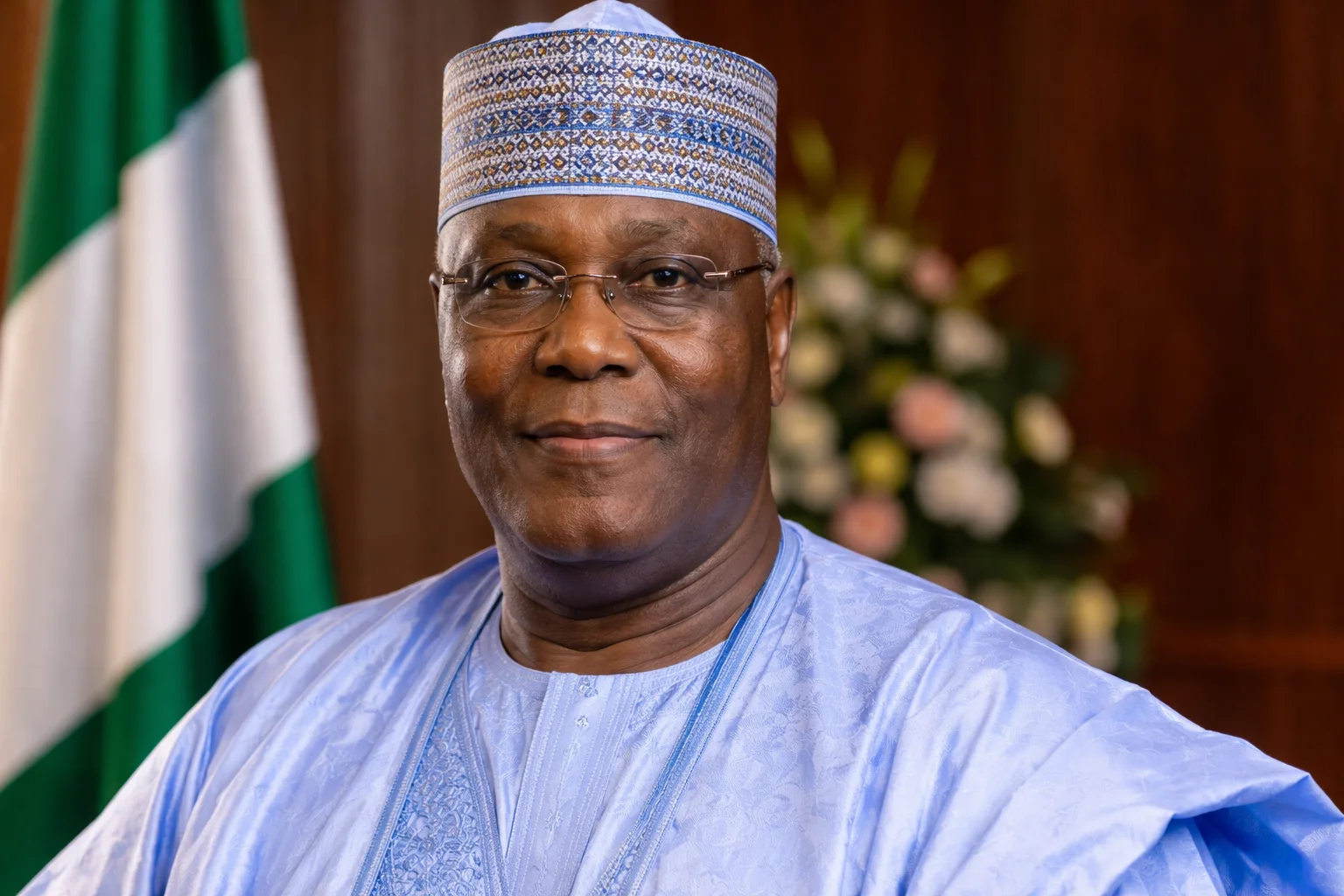
Article Was Last Updated August 26, 2026
Atiku Abubakar biography covers his net worth, political career, early life, education, history in presidential elections, and wives and children. This article also examines Nigeria’s presidential election results, PDP candidate’s history, and his role as Nigerian vice president in 1999 under Olusegun Obasanjo, as documented on First Nigerian.
Atiku Abubakar Biography
Atiku Abubakar was born on 25 November 1946 in the village of Jada. Jada was then a part of British Cameroon. But in 1961, the people of Jada voted for their country to join Nigeria. They now belong to Adamawa State.
His father’s name was Garba Abubakar and was of the Fulani ethnic group; he was into the trade of goods and agriculture. His mother’s name was Aisha Kande. Atiku’s grandfather, Atiku Abdulqadir, came from Wurno in Sokoto State and later moved to Jada. The family named Atiku after him. His mother’s father, Inuwa Dutse, also relocated from Dutse in the state of Jigawa to
Atiku Abubakar had only one sister, but she died as a baby, so he had no siblings. At the age of eleven, in 1957, Atiku’s father died from drowning in a river on the way to a village called Toungo.
Education
Atiku’s father did not like Western education and tried to stop him from going to school. Because Atiku was not attending school as required by law, the government arrested his father for a short time. Atiku’s mother paid a fine, and he was released afterwards.
At the age of eight, Atiku finally started school at Jada Primary School. He finished primary school in 1960 and moved straight to Adamawa Provincial Secondary School. He completed secondary school in 1965 and passed his final exam with a grade three result.
After school, Atiku went briefly to the Nigeria Police College in Kaduna but left because he could not show a Mathematics result. He then worked for a short time as a Tax Officer at the Regional Ministry of Finance.
In 1966, he gained admission into the School of Hygiene in Kano and completed his studies in 1967 with a diploma. While studying there, he became the Interim Student Union President. In the same year, he received a government scholarship to study for a Law Diploma at Ahmadu Bello University. He finished in 1969.
During the Nigerian Civil War, he joined the Nigeria Customs Service. Many years later, in 2021, he earned a master’s degree in International Relations from Anglia Ruskin University.
Early Career in Customs Service
Atiku Abubakar worked with the Nigeria Customs Service for twenty years. Over time, he rose to the position of deputy director, which was one of the highest roles at the time. He retired from Customs in April 1989. While still working there, he started investing in businesses, especially property.
Business Empire
In 1974, Atiku borrowed 31,000 Naira to build his first house in Yola. He rented it out and used the rent money to buy more land and build more houses. Over time, he owned many properties in Yola.
In 1981, he went into farming and bought 2,500 hectares of land near Yola to grow maize and cotton. This farming business failed and closed in 1986. He later said this was his first big failure in agriculture.
After that, he started trading food items like rice, flour and sugar in large amounts. One of his biggest business successes started while he was still a Customs Officer at Apapa Ports. An Italian businessman named Gabrielle Volpi asked him to help start a company called Nigeria Container Services, also known as NICOTES. This company later became Intels Nigeria Limited, a large oil servicing and logistics company that made Atiku very wealthy. He is one of its founders.
His other businesses include Adama Beverages Limited, an animal feed factory, and the American University of Nigeria in Yola, which became the first American-style private university in Sub-Saharan Africa.
Because Atiku owned business shares while working for the government, some people accused him of a conflict of interest. He said the rules allowed this and explained that he did not manage the businesses himself. Later, while he served as Vice President, the United States government linked Intels to money laundering accusations involving him.
Entry into Politics
Atiku first became involved in politics in the early 1980s by quietly helping Bamanga Tukur run for governor. He helped gather votes and donated money.
Near the end of his Customs career, he met General Shehu Musa Yar’Adua. Yar’Adua introduced him to a group of politicians who met often in Lagos. These meetings led to the creation of the People’s Front of Nigeria, which included many people who later became important leaders.
In 1989, Atiku became National Vice-Chairman of the People’s Front. He also won a seat in the Constituent Assembly, which drafted a new constitution. When the military government refused to allow political groups to register, the People’s Front joined the Social Democratic Party.
In 1990, Atiku said he wanted to run for governor of Gongola State. Before elections took place, the government split the state into Adamawa and Taraba. Atiku won the SDP primaries in Adamawa in 1991, but the government later barred him from contesting the election.
First Presidential Ambitions
In 1993, Atiku ran in the SDP presidential primaries. He came third, behind Moshood Abiola and Baba Gana Kingibe. There were talks about joining forces to defeat Abiola, but Atiku later withdrew after advice from Shehu Yar’Adua. Abiola reportedly promised to make him his running mate, but party pressure forced Abiola to choose Kingibe instead.
After the cancellation of the June 12 election and during General Sani Abacha’s rule, Atiku planned to run for governor under the United Nigeria Congress Party. That political process ended when Abacha died.
In 1998, Atiku joined the Peoples Democratic Party and won the election to become Governor of Adamawa State. Before taking office, Olusegun Obasanjo chose him as his running mate after winning the 1999 presidential election.
Vice Presidency Years
Atiku became Vice President on 29 May 1999. During his first term, he led the National Economic Council and headed the National Council on Privatisation, which sold many government-owned companies.
His second term was difficult because he had serious disagreements with President Obasanjo, especially over Obasanjo’s attempt to stay in power for a third term.
In 2005, reports linked Atiku to an alleged bribery case involving the United States Congressman William Jefferson and a businesswoman named Lori Mody. Investigators claimed the money aimed to influence Atiku, but he denied any wrongdoing. A court convicted Jefferson in 2009 and sent him to prison. His sentence was later reduced in 2017.
After the third-term plan failed, the ruling party became deeply divided. In 2006, Atiku left the PDP and joined the Action Congress to prepare for the 2007 election.
2007 Presidential Election
Atiku announced he would run for president in November 2006 and became the Action Congress candidate.
At first, the electoral commission removed his name from the ballot because of corruption claims. The Supreme Court later ruled that this was wrong and allowed him to run.
He came third in the election, which he described as the worst in Nigeria’s history, and he refused to attend the new president’s swearing-in.
Return to PDP and Further Contests
After the election, Atiku returned to the PDP. He tried again to become president in 2011 but lost the party primaries to Goodluck Jonathan.
In 2014, he left the PDP and helped form the All Progressives Congress. He ran in the APC primaries in 2015 but lost to Muhammadu Buhari.
In 2017, he rejoined the PDP and said that past problems had been resolved.
2019 and 2023 Elections
In 2018, Atiku won the PDP presidential primaries and ran against President Buhari in 2019. During the campaign, he promised to privatise most of the national oil company and made controversial comments about forgiving people who stole public money. He lost the election and challenged the result in court.
In 2022, he again won the PDP presidential primaries for the 2023 election. In the general election, he finished second behind Bola Tinubu and joined other opposition candidates in asking for a revote.
After the 2023 general election, Atiku Abubakar challenged the result in court against Bola Ahmed Tinubu, but in October 2023, the Supreme Court dismissed his appeal and affirmed Tinubu’s victory, ruling that the evidence presented was insufficient to overturn the election and that the case did not meet the constitutional requirements for nullifying the result.
And in 2025, he left the PDP, saying it had moved away from its original values, and joined the African Democratic Congress with Peter Obi. They planned to work together ahead of the 2027 elections.
Current Situation Going Into 2027
By May 2026, the alliance began to fall apart more openly. Some major politicians left the group entirely, including Peter Obi and Rabiu Kwankwaso. They moved to a new political arrangement called the Nigeria Democratic Congress. Their exit happened because of disagreements about leadership and who should be the main candidate.
After these exits, the idea of one strong opposition group no longer worked. The African Democratic Congress still existed but was weaker. The new Nigeria Democratic Congress became another centre of opposition activity. The PDP was also still struggling with internal issues. Instead of one united front, there were now several opposition groups working separately.
The main reasons for the failure were simple. Many politicians cared more about their own chances than the group plan. Regional politics also made it hard to agree on one candidate.
And now, the opposition has split into different groups instead of forming one strong coalition. This means they are likely to compete against each other in the elections. That division makes it harder for them to challenge the ruling party effectively.
Why Atiku Abubakar has never won the presidency despite multiple attempts
2007: Party Breakup And Weak Structure
In 2007, Atiku Abubakar left the ruling Peoples Democratic Party after a serious clash with President Olusegun Obasanjo. He joined a smaller opposition party, which had little national strength. This immediately reduced his chances because Nigerian presidential elections depend heavily on strong party networks across all states.
The ruling PDP controlled most political structures at the time and had a stronger organisation nationwide. Umaru Musa Yar’Adua benefited from this advantage. The election period faced widespread condemnation for irregularities, and court challenges failed to change the result.
Another major issue was that northern political leaders were divided. Some supported the PDP candidate, while others backed different figures like Muhammadu Buhari. Because of this split, Atiku could not build a strong northern base, which is very important in Nigerian elections.
2019: Strong Opponent And Regional Voting Advantage
In 2019, Atiku returned to the PDP and ran against sitting president Muhammadu Buhari.
The biggest challenge was Buhari’s advantage as an incumbent. He already controlled government structures and had strong support in many northern states.
Nigeria’s voting pattern also worked against Atiku. He performed well in the South-East and South-South, but Buhari’s strong support in the North outweighed those gains because northern states often have higher voter numbers.
Inside Atiku’s own party, the PDP was not fully united. Some governors and influential members did not fully support his campaign, which weakened coordination and voter turnout in key areas.
There was also a public perception issue. Many voters saw him as part of the long-standing political elite, which reduced enthusiasm among undecided voters.
2023: Split Opposition And Internal Rebellion
In 2023, Atiku again ran under the PDP against Bola Tinubu of the APC.
The biggest problem this time was that the opposition was divided. Peter Obi of the Labour Party attracted a large number of young and urban voters, especially in the South-East and South-West. This split the opposition vote and reduced Atiku’s support in areas where he previously performed well.
Atiku also faced serious problems inside his own party. A group of governors known as the G5 openly opposed him and did not fully support his campaign. This reduced coordination and weakened turnout in important states.
Voting patterns became more unpredictable. The APC retained strong support in the North, Labour grew stronger in cities, and the PDP remained stuck in the middle without a clear advantage.
Even though the incumbent president was leaving office, the APC still had strong political networks, which helped Tinubu win.
Atiku also struggled with his message. Voters did not view him as a fresh alternative or the main continuity candidate, which made it harder for him to win over undecided voters.
Bottomline
Across all three elections, three main reasons stand out.
First, his party situation was often weak or divided, which reduced campaign strength.
Second, Nigeria’s regional voting system favours candidates with strong, united support in key northern states, and Atiku never fully secured that consistently.
Third, in later elections, especially in 2023, competition from other opposition figures split the vote and made it harder for him to build a clear winning coalition.
In other words, he kept running into a mix of weak party unity, strong regional voting patterns, and divided opposition camps.
What He Believes In
Atiku believes strongly in federalism. He thinks Nigerian states should have more power and control over their own resources so they can develop better and be more accountable.
He also cares deeply about education. In 2005, he founded the American University of Nigeria to improve learning and encourage critical thinking.
He has spoken many times about the poor state of education in Nigeria and has given scholarships, including to girls who escaped from the Chibok school kidnapping.
Corruption Allegations and International Issues
Atiku has faced many corruption accusations over the years, including claims involving bribery and money laundering. For a long time, people questioned whether he could travel to the United States, but he later visited in 2019. He, his wife Rukaiyatu, and his daughter Hadiza own several properties in Dubai.
Atiku Abubakar Wives & Children
Atiku Abubakar has a large family. He has four wives and twenty-eight children. He said he married multiple wives because he grew up as an only child and did not want his children to feel lonely.
First wife: His first wife, Titilayo “Titi” Albert, married in 1971, has four children named Fatima, Adamu, Halima, and Aminu. Second wife: His second wife, Saadatu Ladi Yakubu, married in 1979, had six children: Abba, Atiku, Zainab, Ummi-Hauwa, Maryam, and Rukaiyatu, before they divorced.
His third wife, Princess Rukaiyatu Mustafa, married in 1983, and they have seven kids named Aisha, Hadiza, Aliyu, Asmau, Mustapha, Laila, and ‘Abdusalam. His fourth wife, Fatima Shettima, married in 1986, and they too have seven kids: Amina (Meena), Mohammed, twins Ahmed and Shehu, twins Zainab and Aisha, and Hafsat.
He later married Jennifer Iwenjiora Douglas (Jamila), but Islamic teachings do not recognise her as his wife. The couple had three children before they divorced in 2022 as a result of longstanding differences. Their children’s names are Abdulmalik, Zahra, and Faisal.
According to certain reports, he might have also married a Moroccan woman, but details are unclear.
Atiku Abubakar Net Worth
As of 2026, some media reports place Atiku Abubakar’s net worth at $1.4–$1.6 billion, ranking him among Nigeria’s richest politicians.
His wealth comes from diverse investments: co-founding Intels Nigeria Limited (oil and logistics), early and ongoing real estate ventures in Nigeria and abroad, and founding the American University of Nigeria. He also owns farmland in Adamawa and has stakes in media, beverage manufacturing, fast food chains, property development, and microfinance banking.
Titles and Awards
In 1982, the traditional council of Adamawa conferred the title of Turaki of Adamawa on Atiku Abubakar. In 2017, he received a higher title, Waziri of Adamawa. And in 2011, a United States organisation, the National Peace Corps Association, honoured him with the Harris Wofford Global Citizen Award for his work in education and democracy in Africa.