Article Was Last Updated August 26, 2026
What killed Fela Kuti? The official cause of death was heart failure resulting from complications of AIDS. Dr. Olikoye Ransome-Kuti, Fela’s younger brother and a former Nigerian Minister of Health, announced the diagnosis on 3 August 1997. His statement remains the official account of how the Afrobeat star died. Even so, many people questioned the announcement. Some disputed the diagnosis, while others objected to making it public. Those arguments continued for years and are explored later in this article.
What Killed Fela Kuti?
What killed Fela Kuti remains one of the most searched questions about the Afrobeat pioneer.
Fela Kuti died on 2 August 1997 in Lagos. He was 58 years old. The official cause of death was heart failure resulting from complications of AIDS. Dr. Olikoye Ransome-Kuti, his younger brother and a former Nigerian Minister of Health, announced the cause of death on 3 August 1997.
The immediate cause of death was heart failure, which refers to the final medical event that caused his death. The underlying illness was AIDS, which had led to serious health complications before the heart failure occurred. This distinction is standard in medical reporting: the immediate cause identifies the event that directly results in death, while the underlying condition explains the disease responsible for that fatal outcome.
The official medical account has remained unchanged since it was announced in August 1997.
Why Is Fela Kuti’s Cause of Death Still Debated?
Many readers still ask what killed Fela Kuti because the official announcement was followed by years of public debate.
News of Fela Kuti’s official cause of death drew mixed reactions. Some people accepted the announcement. Others questioned whether it told the full story. The debate began almost immediately and continued long after his death.
The timing also mattered. In the 1990s, HIV/AIDS carried a strong social stigma in many parts of the world, including Nigeria. Misunderstanding and discrimination were common. As a result, some people found it difficult to accept the official explanation.
Questions also came from within Fela’s family. Some relatives publicly challenged the diagnosis and said they did not believe AIDS caused his death. At the same time, several of his associates pointed to the years he spent facing arrests, beatings and other forms of military brutality. They argued that those experiences had severely affected his health.
These views remain part of the public discussion. They have not, however, changed the official record. The announced cause of death remains heart failure resulting from complications of AIDS, as stated by Dr. Olikoye Ransome-Kuti in August 1997.
Fela Kuti’s Health Before His Death
Fela Kuti’s health appeared to decline during the 1990s, although he revealed little about his condition in public. Reports from the period suggested that he was becoming increasingly frail, but no official diagnosis was announced while he was alive.
Despite these signs, he continued to perform and remained active in public life. He also maintained his outspoken public presence, even as rumours about his health became more common. Without confirmation from Fela or his doctors, those reports remained speculative.
By mid-1997, many observers believed his condition had worsened. Even then, the nature of his illness was not publicly known. That changed after his death on 2 August 1997 in Lagos. The following day, Dr. Olikoye Ransome-Kuti announced that the official cause of death was heart failure resulting from complications of AIDS. For many people, this was the first confirmation that Fela had been living with the illness.
How Nigeria Reacted to Fela Kuti’s Death
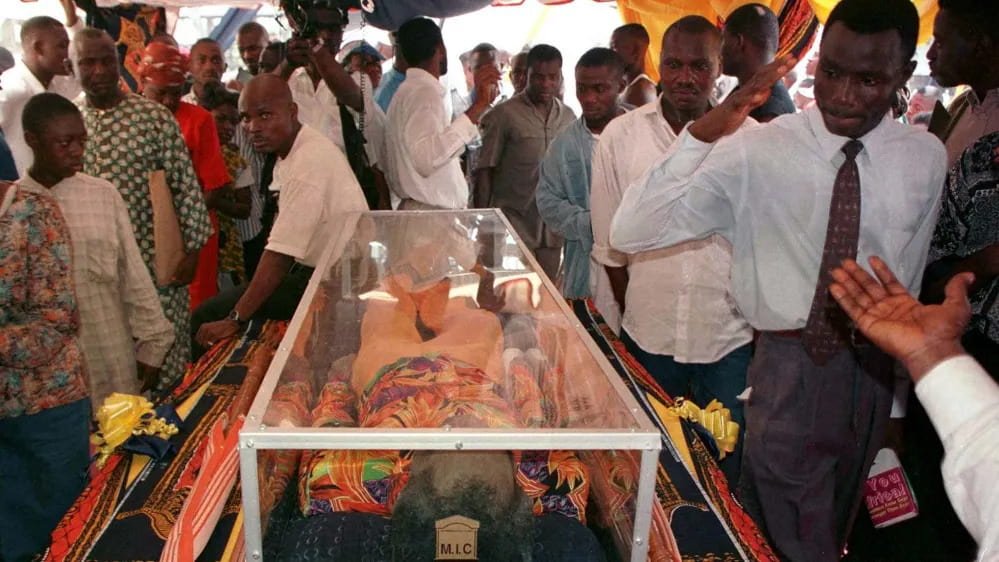
Fela Kuti’s death was front-page news across Nigeria. People gathered in homes, workplaces and public spaces as news of his passing spread. Many saw it as the loss of one of the country’s best-known public figures.
The funeral drew a huge crowd. Tens of thousands of mourners attended, reflecting the scale of public grief. The turnout showed how widely he was recognised across different parts of Nigerian society.
News of his death also travelled quickly beyond Nigeria. International newspapers, broadcasters and news agencies covered the story. Tributes came from artists, writers and other public figures, many of whom acknowledged his influence on culture and public life.
The response was striking both at home and overseas. Although debate continued over the circumstances of his death, there was little doubt about the impact he had made. The widespread mourning and global attention reflected the place he held in the public consciousness.
Fela Kuti’s Legacy After His Death
Fela Kuti’s influence did not end with his death. His music helped establish Afrobeat as a major African genre, and its sound continues to inspire performers, producers and audiences around the world. Decades later, his recordings remain a reference point for musicians exploring rhythm, social commentary and African musical traditions.
His influence reached beyond music. Fela showed that songs could become a platform for discussing political power, social justice and everyday life. That combination of art and public debate has remained an important part of his cultural legacy.
His family has also carried forward parts of that tradition. Femi Kuti has built his own career while preserving many elements of Afrobeat. Seun Kuti has continued the work of Egypt 80, the band founded by his father, and has introduced the music to new generations of listeners. Each has developed a distinct style, but both have helped keep Afrobeat active on the global stage.
Today, Fela Kuti is widely recognised as one of the defining figures in African music. His influence can still be seen in the genre he helped shape, the artists he inspired and the continuing conversation about the relationship between music, culture and public life.