Article Was Last Updated August 26, 2026
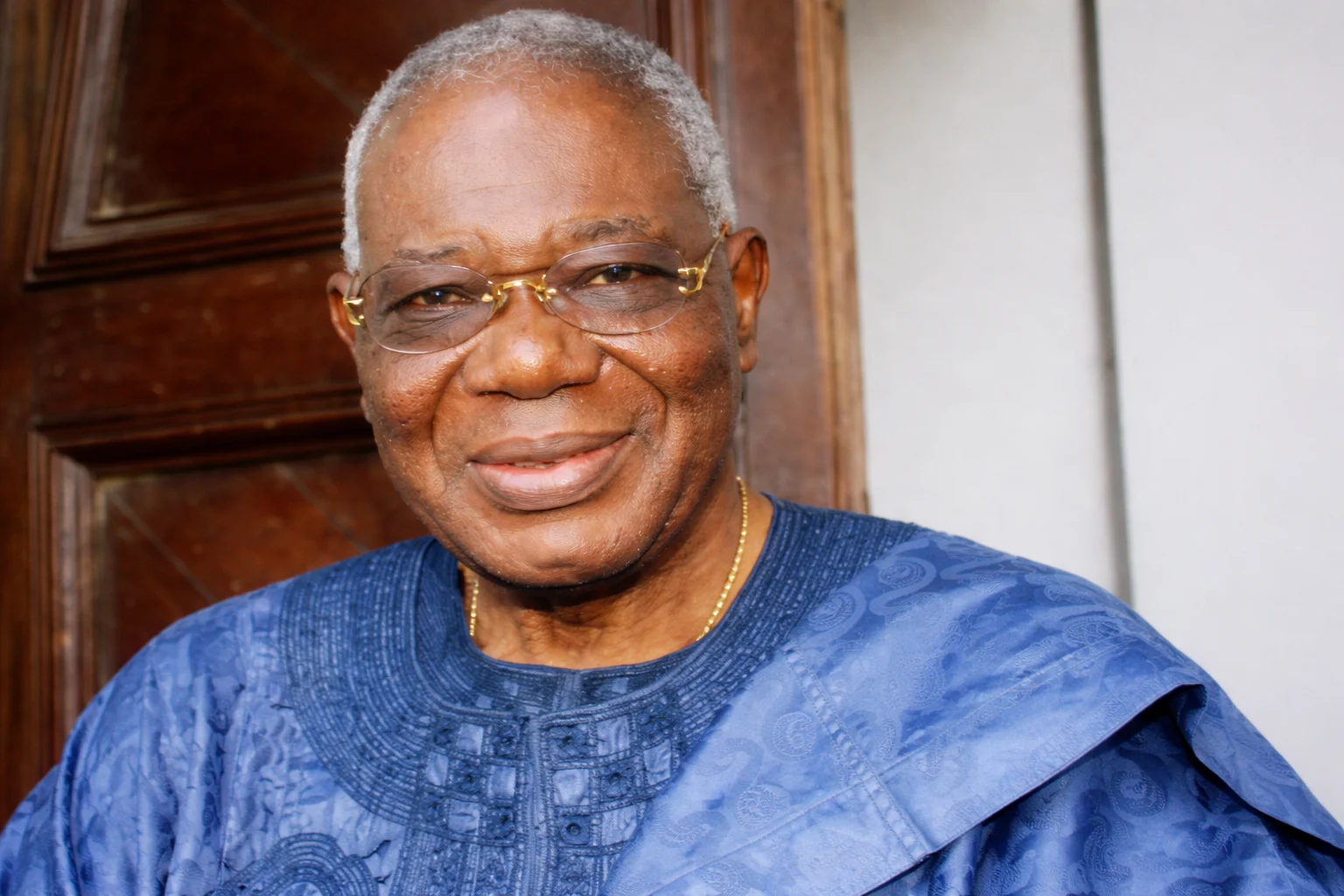
Ernest Shonekan biography focuses on the life of the Nigerian businessman and statesman who served as Interim President of Nigeria in 1993 and died in 2022. It includes key details such as his education, wife, children, religion, state of origin, net worth, and explains why he became interim leader after military rule.
Ernest Shonekan Biography
Ernest Adegunle Oladeinde Shonekan was born on 9 May 1936 in Lagos. At the time, Lagos was part of British Nigeria.
He grew up in a family of six children. His father was a civil servant from Abeokuta.
He spent his early years in Lagos and went to school there. He attended CMS Grammar School in the late 1940s, during his early teenage years.
Shonekan later moved on to Igbobi College, Lagos, where he completed his secondary schooling in the early 1950s.
Education
Ernest Shonekan attended the University of London, where he studied law and obtained an LLB degree. His training focused on English common law, contract law, company law, and equity.
After completing his studies, he qualified as a barrister and was admitted to the Bar in England and Wales. He also met the requirements to practise law in Nigeria, linking his UK training directly to his home country’s legal system.
He experienced a highly structured legal and administrative environment while in the UK. This experience strengthened his understanding of corporate governance, regulatory compliance, and institutional discipline. It supported his UAC rise.
Much later, he also attended Harvard Business School to strengthen his management and leadership skills after moving into senior executive roles, particularly to handle large-scale corporate strategy, finance, and organisational decision-making.
Early Legal Practice After Being Called To The Bar
Ernest Shonekan began his professional life as a lawyer before moving into corporate leadership, where he built the foundation of his reputation long before becoming chairman of UAC Nigeria.
After completing his legal studies at the University of London, he returned to Nigeria and entered the legal department of the United Africa Company (UAC) in 1964, which at the time was part of a major international trading group operating across West Africa.
Rather than working in private litigation chambers, his early legal career was in-house corporate law, focusing on commercial and industrial legal work within a large multinational company.
He began as a legal officer and gradually moved upward within UAC’s legal and administrative structure, gaining experience in corporate governance, contracts, and regulatory compliance.
Areas Of Law He Specialised In
Shonekan did not centre his legal work on courtroom litigation. He specialised mainly in:
- Commercial and corporate law
- Industrial and business regulation
- Company administration and governance
- Contract and trade-related legal advisory work
Transition From Law Into The Corporate Sector
His shift from law into executive business leadership was gradual and based on internal promotions within UAC:
- After joining UAC’s legal department, the company promoted him to assistant legal adviser.
- He later became deputy legal adviser
- He then joined the company’s board level management at the age of 40
- In 1980, he rose to become Chairman and Chief Executive of UAC Nigeria
Thus, Shonekan became one of the most prominent Nigerian business figures before entering national politics.
Shonekan’s Entry into Government
Shonekan entered government in January 1993. On 2 January, President Ibrahim Babangida appointed him head of the transitional council and head of government. The council was to guide Nigeria from military rule to democracy.
While in this role, Shonekan discovered that the country was in serious financial trouble. Nigeria owed a lot of money to other countries and had to keep negotiating to delay or change its debt payments, but the problems were too big for him to fix.
Response To The June 12 Annulment Crisis
Shonekan assumed leadership at a time of severe political instability marked by protests, strikes, and international condemnation following the annulled election.
His administration prioritised stabilisation and attempted to restore order through engagement with civil servants and economic managers, while also signalling support for a return to democratic elections.
However, the government faced widespread labour strikes and civil unrest that significantly weakened its effectiveness.
In practice, authority remained heavily constrained, as the military retained decisive control over security and political direction, limiting his capacity to respond independently.
The 1993 Political Crisis and Interim Government
In August 1993, everything changed.
Authorities cancelled the presidential election held on 12 June, triggering widespread anger and unrest across the country.
Because of this crisis, Babangida stepped down from power. Before leaving, he created the Interim National Government and chose Shonekan to lead it.
On 26 August 1993, Shonekan became head of state and Nigeria’s ninth leader. He held this position until 17 November 1993.
During this time, General Sani Abacha served as vice chairman of the interim government and also controlled the military as minister of defence and senior minister.
Public Criticism Of Interim Government Legitimacy
The military established Shonekan’s Interim National Government by decree after it annulled the June 12, 1993, election, and many observers widely viewed it as lacking democratic legitimacy.
- Many pro-democracy groups and political actors regarded it as an extension of military control rather than a genuine transition to civilian rule.
- Supporters of Moshood Abiola, the presumed election winner, rejected the arrangement outright and demanded full restoration of the electoral mandate.
- A court ruling during the period further challenged aspects of the interim structure, reinforcing concerns about its constitutional standing.
Challenges During His Short Rule
Being interim head of state was not an easy job for Shonekan at all. A lot of people did not believe in his government. Moshood Abiola was one of the loudest critics and said the whole setup was illegal.
Shonekan tried to organise a new election and hand power back to civilians. That plan did not go far. Workers went on strike, and the military still held real power.
Ernest Shonekan still managed to do a few important things. He released political prisoners whom the former government had imprisoned. He also pushed a bill to remove three tough military laws. Even with these efforts, his government remained weak. Babangida had already ensured that the military retained control.
Detention Or Release Of Political Prisoners
His tenure marked a partial easing of repression compared with the preceding military regime, including the release of several political detainees.
There were also efforts to review or repeal restrictive decrees inherited from military rule.
Despite these measures, concerns persisted among activists, as political pressure, surveillance, and wider instability continued under the unresolved crisis environment.
Economic Struggles and National Issues
The economy continued to suffer badly. After the election crisis, many Western countries placed sanctions on Nigeria. Prices rose quickly, foreign investors outside the oil sector pulled out, and inflation became difficult to control.
Shonekan sought debt relief for Nigeria and ordered an audit of the Nigerian National Petroleum Corporation to address operational inefficiencies. At the same time, he served as an executive of Royal Dutch Shell.
His government had to respond to the hijacking of a Nigerian Airways plane in 1993 and attempted to plan when Nigerian soldiers would leave the ECOMOG peacekeeping mission in Liberia, although real power over the army remained with General Abacha.
Major Policies and Decisions
As head of Nigeria’s Interim National Government, Ernest Shonekan pursued economic stabilisation measures, managed political crises, and introduced limited structural reforms.
Economic Reforms Attempted
Shonekan inherited a severe economic downturn marked by inflation, weak investor confidence, and currency instability following the political crisis after the annulled June 12, 1993, election.
His government pursued early stabilisation measures to restore macroeconomic credibility, including:
- Efforts to restore investor confidence through dialogue with private sector actors and international stakeholders
- The government introduced tighter fiscal discipline to curb inflationary pressure, but weak political authority hindered enforcement.
- Introduction of policy discussions on liberalisation and economic restructuring
- Support for private sector engagement in economic planning, including groundwork that later evolved into broader economic reform platforms such as the Nigerian Economic Summit initiative
Debt Restructuring Efforts
Nigeria’s external debt burden was a central issue during Shonekan’s administration.
Key actions included:
- Engagement with international creditors on debt rescheduling rather than full repayment
- Diplomatic lobbying for debt relief or restructuring terms
- Continued reliance on negotiations to avoid default pressures, reflecting limited fiscal space and declining oil-sector revenues
Petroleum Sector Oversight And NNPC Audit
The petroleum sector was central to Nigeria’s economy.
During his tenure:
- The government initiated scrutiny of the Nigerian National Petroleum Corporation (NNPC) accounts to address inefficiencies and governance concerns
- Administrative changes reinforced greater ministerial control over NNPC operations, reversing earlier moves toward partial autonomy
- The oil sector faced declining investment and operational instability
Handling Of Labour Strikes And Protests
His government faced:
- National strikes organised by labour unions protesting the annulment of the 1993 elections
- Widespread civil agitation and political resistance questioning the legitimacy of the Interim National Government
- Efforts to maintain continuity of government services while negotiating with labour groups, though with limited success due to weak political backing
The strikes contributed to the crisis, leading to the November 1993 military takeover.
Public Perception During His Tenure
Public opinion was largely negative in terms of legitimacy and effectiveness, with many Nigerians viewing him as a compromise figure installed by the military rather than elected through popular mandate.
In the south-west, June 12 supporters widely rejected his government because they believed it disregarded Moshood Abiola’s electoral victory.
Some commentators, however, regarded him as a technocratic stabiliser attempting to manage a collapsing political system under severe constraints.
Overall, Shonekan spent most of his 83-day administration managing a constitutional crisis rather than implementing lasting policies, until General Sani Abacha seized power in a military coup.
Removal from Power and Later Activities
On 18 November 1993, just three months after he became head of state, General Sani Abacha removed Shonekan from office in a palace coup and then took full control of the country.
Later that same year, Shonekan helped set up the Nigerian Economic Summit Group with other well-known Nigerians and foreign partners. They formed a group to support economic growth. Its focus remained on businesses rather than the government. The idea was simple: private companies lead development and create jobs.
Ernest Shonekan Wife And Children
Ernest Shonekan married Margaret O. Shonekan, who briefly held the role of First Lady during her husband’s time as interim head of state in 1993.
Wife: Margaret Shonekan
Margaret Shonekan is a Nigerian civil servant and education administrator. She worked for many years with the West African Examinations Council (WAEC) and later served in the Federal Civil Service Commission.
She maintains a relatively low public profile, even while in official roles, and continues her professional career after the 1993 political transition.
Children
Ernest and Margaret Shonekan had four children:
- Adeboye Shonekan
- Korede Shonekan
- Kemi Shonekan
- Yele Shonekan
Adeboye Shonekan has appeared occasionally in public to represent the family at commemorative events, including his father’s memorial in 2022.
Korede, Kemi, and Yele Shonekan maintain private lives with no public careers or media presence.
Net Worth
Ernest Shonekan got rich mostly from business, not from money that was officially tracked.
Before becoming Nigeria’s interim president, he worked as a lawyer and built a strong reputation in business. He joined the United Africa Company of Nigeria and steadily rose through the ranks. He eventually became chairman and managing director of the company, then one of the largest African-owned firms in Sub-Saharan Africa. His leadership position and business connections explain much of his wealth.
People don’t really agree on how much he was worth. Some sites say his net worth is about $50 million, while others give different numbers. Those estimates come from his investments, property, and business shares, not from official records.
Awards, Titles, and Recognition
Traditional Titles
- Abese of Egbaland (1981)
National Honours
- GCFR (only if verified and sourced)
Major Leadership Roles
- Chairman and CEO, UAC Nigeria
Legacy And Institutional Contributions
- Founder, Nigerian Economic Summit Group
Ernest Shonekan Death and Funeral
Ernest Shonekan died on 11 January 2022 in Lagos at the age of 85.
His family and Nigerian media reported that he had been receiving medical care before his death. Doctors at the Lagos hospital confirmed natural causes as the cause of death.
The Federal Government of Nigeria formally acknowledged his death as the passing of a former head of state and elder statesman.
The Presidency issued condolences on behalf of the nation, describing Shonekan as a leader who played a stabilising role during a turbulent political transition in 1993.
Senior government figures, including then Vice President Yemi Osinbajo, publicly paid tribute to his integrity and service.
State Funeral and Burial Arrangements
Nigeria honoured Shonekan with a state burial in Lagos in February 2022.
Funeral rites started with a service of songs at the Cathedral Church of Christ, Marina, Lagos, followed by a night of tributes held at the same venue.
The programme included participation from family members, government officials, and members of the diplomatic and business communities.
On 4 February 2022, the final funeral service concluded. The family then laid him to rest at Ebony Vaults in Ikoyi, Lagos, during a burial ceremony. Top political leaders attended the event, including representatives of the presidency, state governors, and former heads of state.