Article Was Last Updated August 26, 2026
Olusegun Obasanjo biography explores the life of one of Nigeria’s most influential political leaders. Olusegun Obasanjo is a Nigerian military officer, statesman, businessman and politician who served as Nigeria’s military Head of State from 1976 to 1979 and later as civilian President from 1999 to 2007. This biography covers his age, date of birth, education, military career, wives, children, presidency, achievements and net worth.
Olusegun Obasanjo Biography
| Fact | Details |
| Full Name | Olusegun Matthew Okikiola Aremu Obasanjo |
| Popular Name | Olusegun Obasanjo |
| Date of Birth | 5 March 1937 |
| Age | 89 years old (as of 2026) |
| Place of Birth | Ibogun-Olaogun, Owu Kingdom, Ogun State, Nigeria |
| State of Origin | Ogun State |
| Nationality | Nigerian |
| Ethnicity | Yoruba |
| Religion | Christianity (Baptist) |
| Occupation | Politician, Military Officer, Farmer, Businessman, Statesman |
| Military Rank | General |
| Political Party | Peoples Democratic Party (PDP) |
| Former Offices Held | Head of State (1976–1979), President of Nigeria (1999–2007) |
| Spouses | Esther Oluremi Akinlawon, Stella Abebe Obasanjo, Mojisola Adekunle-Obasanjo |
| Children | Widely reported to be about 20 children |
| Notable Child | Iyabo Obasanjo-Bello |
| Major Business | Obasanjo Farms Limited |
| Education | Baptist Boys’ High School, Military Training in Ghana, United Kingdom and India |
| Net Worth | Estimated $1.5–$1.7 billion |
Olusegun Obasanjo was born on 5 March 1937, according to his passport. Because no contemporary birth record exists, historians estimate the date. He was born in Igbogun Olaogun village within the Owu Kingdom.
His father, Obasanjo Bankole, belonged to the early group of settlers and helped found the village in the early 1920s. He worked as a successful farmer and palm wine tapper, but society still considered him poor because he had no formal education, which carried significant prestige in Yorubaland at the time. His mother, Bernice Ashabi, worked as a petty trader.
The family originally had six children, but only two survived: Olusegun and his sister, Adunni Oluwola. Obasanjo grew up in a Baptist household. His sister later converted to Islam to marry a Muslim man.
Education and Early Challenges
Olusegun Obasanjo began primary school at age eleven in his village. After three years, he transferred to Baptist Day School in Abeokuta and later to Baptist Boys’ High School in 1952. His education was partly supported by state grants, and he performed well academically while also becoming an enthusiastic Boy Scout.
During secondary school, he avoided politics but dropped his Christian forename “Matthew” as an anti-colonial gesture. His schooling was difficult after his father abandoned the family, leaving them in poverty. To continue his education, he worked on cocoa and kola farms, fished, collected firewood, sold sand, and did manual labour during holidays.
In 1956, he sat his exams after borrowing money for fees. He became engaged to Oluremi Akinlawon in 1958. After school, he worked as a teacher in Ibadan. Although he passed entrance to University College, Ibadan, he could not afford it. In 1958, he joined the Nigerian Army as an officer cadet.
Joining the Nigerian Army
In March 1958, Olusegun Obasanjo joined the Nigerian Army to continue his education while earning a salary. He initially kept the decision from his family due to fear of disapproval.
At that time, the army was transitioning from British to Nigerian control ahead of independence, with emphasis on training local officers.
He trained in Teshie, Ghana and kept contact with his fiancée while there. In September 1958, he went to Mons Officer Cadet School in Aldershot, England, where he disliked the unfair treatment of non-British trainees and struggled with the weather. He completed training, became an officer and earned an engineering qualification. Both parents died.
Early Military Career
In 1959, Olusegun Obasanjo returned to Nigeria and was posted to Kaduna as an infantry subaltern with the Fifth Battalion, his first experience in a Muslim-majority region. In October 1960, Nigeria gained independence while he remained there.
Soon after, the battalion deployed to Congo for a United Nations peacekeeping mission during the Congo Crisis, based in Kivu Province with headquarters in Bukavu, where he helped protect civilians, including ethnic Belgians, from mutinous soldiers opposing Patrice Lumumba’s government.
In February 1961, he was captured while evacuating missionaries near Bukavu but was released and briefly made acting captain. The unit returned to Nigeria in May 1961.
He later recovered from illness, transferred to the Engineering Corps, and trained in England in 1962, earning top Commonwealth honours.
He married in 1963, later served in Kaduna, was promoted to major in 1965, and invested in property across major Nigerian cities including Lagos, Ibadan, Abuja respectively.
Advanced Military Training Abroad
In 1965, the Nigerian Army sent him to India to study at the Defence Services Staff College in Wellington and the School of Engineering in Poona.
On his way, he visited his wife in London. He felt disturbed by the poverty he saw in India, but developed a strong interest in its culture and comparative religion.
Crisis and Civil War
Olusegun Obasanjo returned to Nigeria in January 1966 during a military coup led by Major Emmanuel Ifeajuna. Concerned about growing instability, he warned of civil war and offered to mediate between the coup plotters and General Johnson Aguiyi-Ironsi’s government.
Following Ironsi’s unification decree and the July counter-coup that brought General Yakubu Gowon to power, Obasanjo narrowly escaped violence in northern Nigeria and was later appointed Chief Army Engineer in Lagos.
After Biafra declared independence in 1967, he commanded the Western State, helping prevent Biafran advances towards Lagos. He later served as rear commander of the Second Division, overseeing logistics and military training.
In 1969, Gowon appointed him commander of the Third Division. Based in Port Harcourt, he led up to 40,000 troops, repelled counterattacks, and was injured while visiting frontline positions.
Obasanjo directed key operations that hastened Biafra’s collapse and accepted its surrender on 13 January 1970. He promoted discipline, punished abuses, supported reintegration, and helped restore essential services.
Post-War Career and Rise to Leadership
Olusegun Obasanjo returned to Abeokuta in June 1970 to a hero’s welcome.
He became a brigadier commanding the Corps of Engineers in Lagos, served on the army decommissioning committee, studied at the Royal College of Defence Studies, and was appointed Commissioner for Works and Housing by Yakubu Gowon in 1975. He also expanded his business interests and invested in property.
His first marriage ended, and he married Stella Abebe in 1976. After the 1975 coup, he became Murtala Muhammed’s deputy, leading reforms.
Following Muhammad’s assassination during a failed 1976 coup, Obasanjo assumed power as Head of State, soon thereafter securely.
Head of State: Policies and Reforms
As head of state, Olusegun Obasanjo pursued austerity to curb inflation, cut public spending and promoted agriculture, education, housing and infrastructure.
His government launched Operation Feed the Nation, introduced the 1978 Land Use Decree, merged oil agencies into the Nigerian National Petroleum Corporation and advanced irrigation, power and steel projects.
He expanded free education but faced student unrest and criticism over political repression, including the Kalakuta Republic incident.
Internationally, he backed anti-apartheid struggles and elevated Nigeria’s influence. Obasanjo also oversaw a new constitution, restored party politics and transferred power to Shehu Shagari in 1979 after a military transition process.
Obasanjo vs Military Leaders Before Him
Compared with earlier military rulers such as Johnson Aguiyi-Ironsi and Yakubu Gowon, Obasanjo’s administration is often seen as more structured and transition-focused.
Aguiyi-Ironsi governed briefly during a period of instability without consolidating long-term reforms. Gowon presided over the civil war and post-war reconciliation but delayed the return to civilian rule.
In contrast, Obasanjo completed a planned handover in 1979, becoming the first Nigerian military leader to voluntarily transfer power to an elected government. This remains one of the defining distinctions of his leadership style.
Return to Civilian Life
After leaving office, Obasanjo returned to Abeokuta, became a farmer, expanded Obasanjo’s Farms Limited and remained influential at home and abroad. He published several books, co-chaired the Commonwealth Eminent Persons Group on apartheid and undertook mediation roles across Africa.
He opposed military rule under Ibrahim Babangida and later Sani Abacha. In 1995, the government arrested Obasanjo, tried him before a military court and sentenced him to prison on treason charges. He spent three years in harsh prison conditions, deepened his Christian faith and attracted international support. He regained his freedom after Abacha died in 1998.
Olusegun Obasanjo Presidency: 1999–2007
After gaining broad national support, he won the February 1999 presidential election with 63 percent of the vote and selected Atiku Abubakar as vice-president. Both were sworn in on 29 May 1999, marking Nigeria’s return to civilian rule.
During his presidency, he expanded press freedom, retired senior military officers, strengthened civilian oversight of the armed forces and promoted national reconciliation.
Re-elected in 2003, he increased the size of the police force, addressed internal security challenges and signed the Greentree Agreement, which resolved the Bakassi Peninsula dispute.
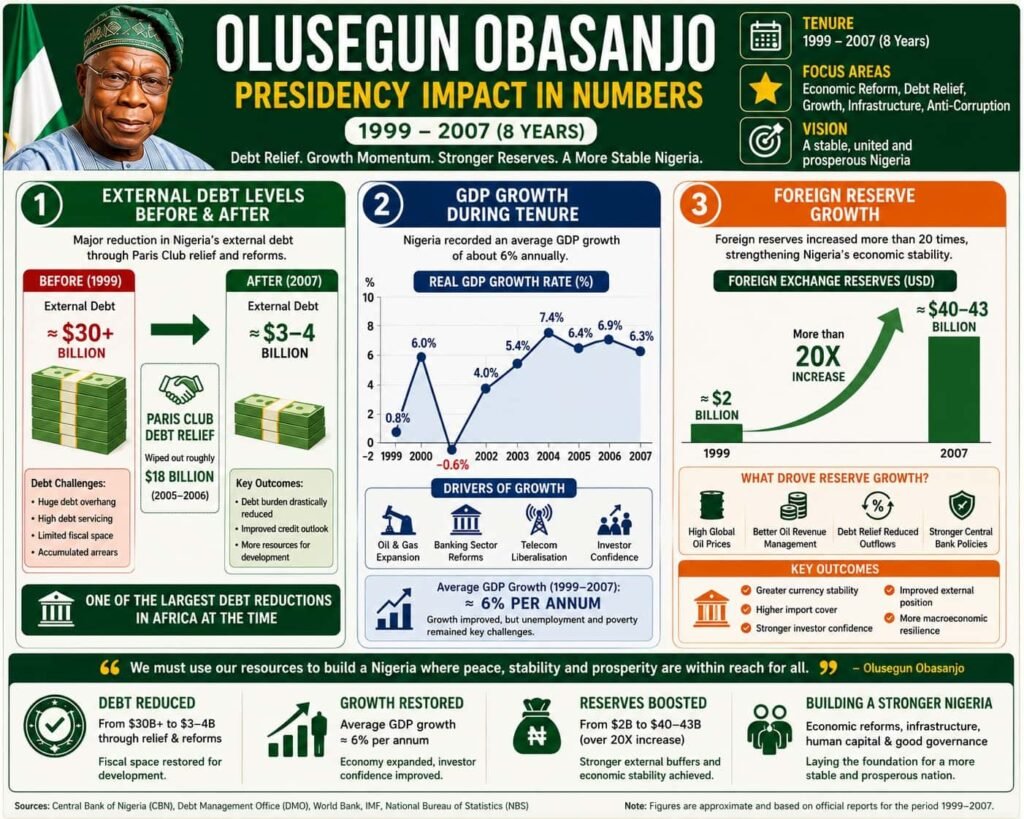
Economically, he inherited a weak economy characterised by slow growth, inflation, unemployment and poverty.
Under his administration, GDP growth rose to about 6 percent, foreign reserves increased significantly and Nigeria secured substantial debt relief from international creditors.
He also established the Niger Delta Development Commission, expanded basic education, raised the minimum wage and created anti-corruption agencies such as the ICPC and EFCC.
Despite achievements in healthcare and foreign relations, fuel subsidy reforms, privatisation efforts and persistent corruption generated public criticism.
Nigeria Before vs After Debt Relief
Before Obasanjo’s debt negotiations, Nigeria faced heavy external debt burdens, limited fiscal space and reduced investor confidence.
Before debt relief:
High debt servicing costs
Low foreign reserves
Restricted infrastructure funding
After debt relief (2005):
Significant reduction in external debt
Increased government spending capacity
Improved sovereign credit profile
Stronger investor confidence
The Paris Club debt cancellation is widely regarded as one of his most significant economic achievements.
Major Achievements of Olusegun Obasanjo
- Successfully handed over power to a civilian government in 1979.
- Returned Nigeria to democratic rule in 1999.
- Secured major debt relief from the Paris Club.
- Established the Economic and Financial Crimes Commission (EFCC).
- Expanded Universal Basic Education (UBE).
- Increased Nigeria’s foreign reserves significantly.
- Improved Nigeria’s international reputation and diplomatic relations.
- Strengthened anti-corruption efforts through the EFCC and ICPC.
Challenges and Controversies
Obasanjo’s presidency was marked by severe ethnic and religious tensions, including the adoption of sharia penal law in twelve northern states, which he later described as the most difficult challenge he faced in office.
He expanded the police force, intervened in major internal conflicts and created the Niger Delta Development Commission.
In November 1999, the military entered Odi in Bayelsa State after police officers were killed, destroying much of the town. Obasanjo later called the incident regrettable but did not apologise.
During his second term, allegations of a third-term agenda emerged, but the National Assembly blocked the proposal entirely thereafter.
Obasanjo vs Later Nigerian Presidents
Compared with later presidents such as Umaru Musa Yar’Adua, Goodluck Jonathan and Muhammadu Buhari, Obasanjo’s presidency is often regarded as more reform-driven and economically stabilising.
Yar’Adua focused on electoral reforms and governance restructuring but had a short tenure due to ill health. Jonathan presided over democratic expansion but faced criticism over corruption and insecurity. Buhari emphasised anti-corruption and security but struggled with economic growth and inflation pressures.
Obasanjo’s administration is frequently assessed as the foundation period for modern economic reforms, particularly in banking consolidation, telecom liberalisation and debt restructuring.
Later Political Career and Mediation
After leaving office, Olusegun Obasanjo chaired the Board of Trustees of the PDP before resigning in 2012. He remained politically active, mediating national issues, leaving and rejoining political parties, and formally retiring from partisan politics in January 2022.
Internationally, he served as a United Nations Special Envoy to the Democratic Republic of the Congo, led African Union election observation missions and played a central role in mediating the Ethiopian–Tigray conflict, culminating in a ceasefire in November 2022. In 2025, he took on the role of mediator in the Democratic Republic of the Congo amid the M23 insurgency.
Olusegun Obasanjo Wives and Children
Throughout his life, Olusegun Obasanjo entered into multiple marriages and also had other long-term relationships.
His first wife was Esther Oluremi Obasanjo (née Akinlawon). He married her in London in 1963. When Obasanjo first became military head of state, she served as First Lady. Later, they separated and divorced.
He later had a relationship with Lynda Soares, a businesswoman. Sadly, armed robbers killed her in 1987.
In 1976, Obasanjo married Stella Abebe Obasanjo. She became Nigeria’s First Lady when Obasanjo won the presidential election in 1999. She served as First Lady until her death in 2005 following complications from surgery.
Another woman he married was Mojisola Adekunle-Obasanjo. She was an army officer and later became a politician. Mojisola even started her own political party. She died in 2009.
Beyond his marriages, Obasanjo also had other serious relationships that produced children, even though he did not marry all the women officially. One such relationship was with journalist Gold Oruh.
Obasanjo has about twenty children, although there is no agreement on the exact number. Most of them work in various fields, including politics, business, technology, and education.
Iyabo Obasanjo-Bello is his first and best-known child. She served as a senator from 2007 to 2011 and later worked as Ogun State health commissioner. She studied veterinary medicine and built a career in public service.
Another child, Dare Obasanjo, works in the technology sector outside Nigeria, mainly in the United States. Adeboye Obasanjo served in the Nigerian Army and sustained injuries during a Boko Haram attack in 2014. Olumuyiwa, also known as Muyiwa, is the son of Stella Obasanjo and keeps a low public profile, appearing only at family or official events.
Olusegun Obasanjo Net Worth
Olusegun Obasanjo’s net worth is estimated at $1.5 billion to $1.7 billion, based on public estimates. His wealth mainly comes from agriculture, investments, real estate, and consultancy work.
A major source is Obasanjo Farms (Ota Farm), a large agribusiness involved in poultry, livestock, crops, and fish farming. He also owns properties in Nigeria and abroad, including residential and commercial buildings.
After leaving office, he earns from international speaking engagements, advisory roles, and mediation work. He has written several books, generating royalties. He also holds investments in companies such as Transcorp. Smaller earnings come from pensions and past public service, alongside private luxury assets.