
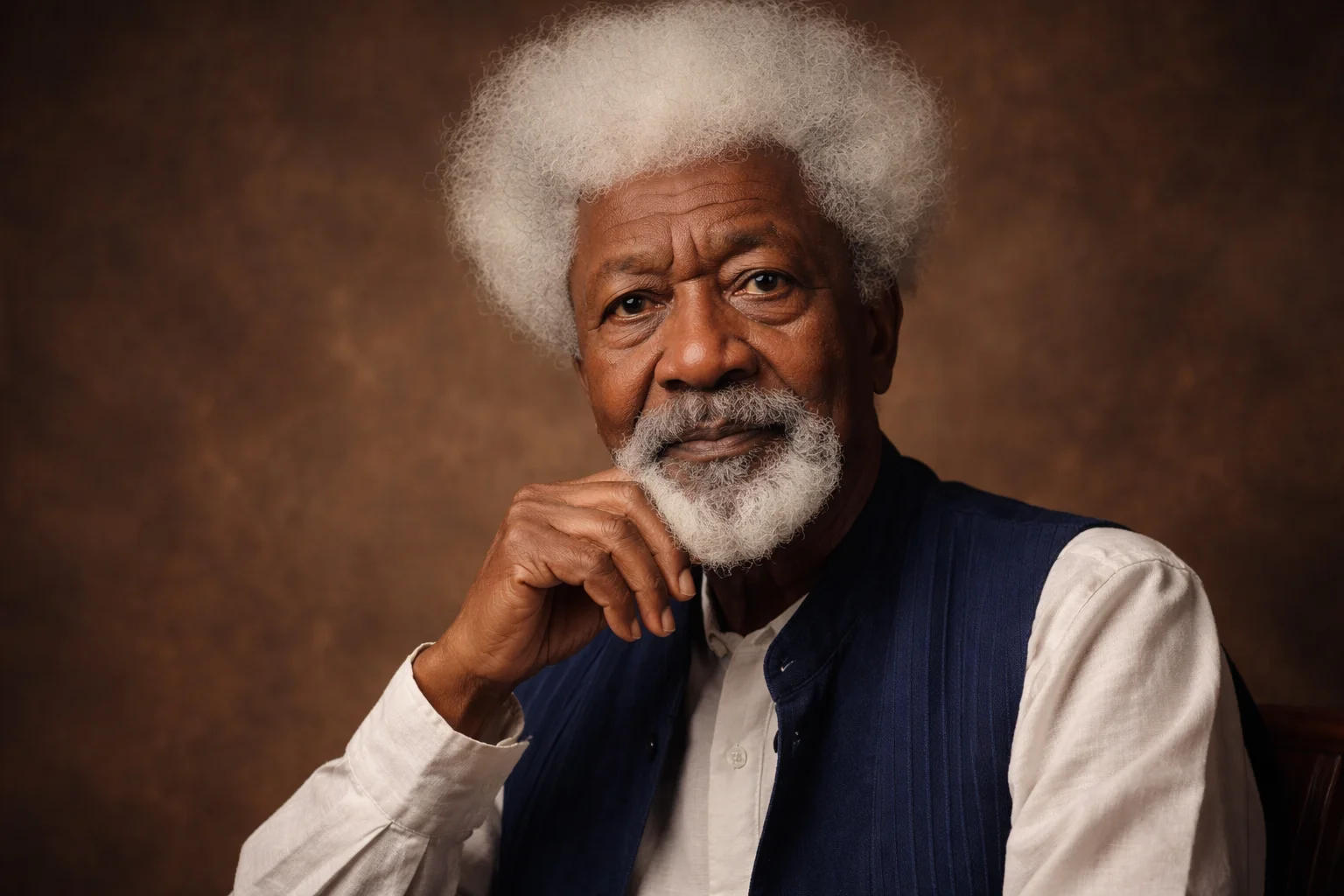
Wole Soyinka stands among Africa’s most influential writers and public intellectuals. For more than six decades, he has used literature, theatre and public speech to interrogate power, challenge tyranny and explore the moral foundations of society.
A playwright, poet, novelist, essayist and teacher, he became in 1986 the first Black African to receive the Nobel Prize for Literature, recognised for shaping “the drama of existence in a wide cultural perspective and with poetic overtones”. His life and work reflect the enduring connection between art, conscience and civic responsibility.
Early Life and Family Background
Akinwande Oluwole Babatunde Soyinka was born on 13 July 1934 in the Aké quarter of Abeokuta, in present-day Ogun State, western Nigeria. He was the second of seven children in a Yoruba Anglican family.
His father, Samuel Ayodele Soyinka, known as “Essay”, was an Anglican minister and headmaster of St Peter’s School in Abeokuta, with ancestral ties to the royal family of Isara-Remo.
His mother, Grace Eniola Soyinka, whom he famously described as a “Wild Christian”, was a trader and community activist. She was from the influential Ransome-Kuti family.
Through his mother, Wole Soyinka was connected to some of Nigeria’s most notable activists and cultural figures, including Funmilayo Ransome-Kuti and her descendants.
Musicians Fela Kuti, Femi Kuti and Seun Kuti, as well as activist Beko Ransome-Kuti and politician Olikoye Ransome-Kuti, are among his extended relations.
These family networks placed him early within a tradition of political engagement and social critique.
He grew up learning two different belief systems at the same time.
At school, he was taught Christian ideas and practices by missionaries.
At home and in his community, he learned Yoruba stories, rituals and traditional beliefs.
Although he later rejected organised religion and identified as an atheist, this dual cultural inheritance became central to his imaginative world.
Education And Intellectual Formation
Wole Soyinka began formal education at St Peter’s Primary School, Abeokuta, in 1940.
He proceeded to Abeokuta Grammar School, where his literary talent quickly emerged and earned him several awards for composition.
In 1946, he gained admission to Government College Ibadan, one of Nigeria’s most prestigious secondary schools.
From 1952 to 1954, he studied English literature, Greek and Western history at University College Ibadan, then affiliated with the University of London.
During this period, he wrote Keffi’s Birthday Treat, a short radio play broadcast in July 1954 by the Nigerian Broadcasting Service.
At university, he also co-founded the Pyrates Confraternity, Nigeria’s first student confraternity, conceived as an anti-corruption and justice-seeking organisation.
In 1954, Wole Soyinka went to England to study at the University of Leeds under the supervision of the critic G. Wilson Knight. He studied English literature and earned a B.A. degree in 1958 and later undertook postgraduate research.
While he was there, he helped run a student magazine and wrote funny but critical pieces about university life. He also worked with the BBC, writing and recording programmes.
This helped him develop a strong public voice that mixed humour with serious ideas.
Early Literary Career And Theatre Work
Soyinka’s professional writing career began to take shape in the late 1950s.
His first well-known play, The Swamp Dwellers, was performed in 1958, followed by The Lion and the Jewel in 1959.
These plays looked at the conflict between old traditions and modern life in Nigeria.
They were so successful that they caught the attention of the Royal Court Theatre in London.
An earlier play, The Invention, staged in 1957, was his first work to be performed there.
He went back to Nigeria on a Rockefeller Research Fellowship to study African theatre.
In 1959, he became co-editor of a big literary magazine called Black Orpheus, which helped promote modern African writing.
In April 1960, his play The Trials of Brother Jero was premiered at University College Ibadan.
That same year, his play A Dance of the Forests was selected as the official drama for Nigeria’s independence celebrations and premiered in Lagos on 1 October 1960.
Far from being celebratory, the play offered a biting critique of political elites and historical amnesia, signalling Soyinka’s refusal to romanticise power.
Academic Life and Early Activism
In the early 1960s, Soyinka taught at two Nigerian universities: Obafemi Awolowo University in Ile-Ife and at the University of Lagos.
He also started a small theatre group called the Nineteen-Sixty Masks and helped set up the Drama Association of Nigeria, which helped make modern Nigerian theatre more organised and official.
His first full-length television drama, My Father’s Burden, was broadcast on Western Nigeria Television on 6 August 1960. This made him the first Nigerian to write a full-length play for TV.
In 1963, he released his first feature film, Culture in Transition.
Then in 1965, he published his first novel, The Interpreters, which explored the lives of educated Nigerians after the country became independent.
During this time, Soyinka spoke out more and more against government corruption and unfair rule.
In 1964, he quit his university job because the government was interfering too much.
In 1965, he was arrested for allegedly storming a radio station to challenge electoral fraud. He later wrote about this in his book You Must Set Forth at Dawn.
International pressure from writers and intellectuals contributed to his release.
Civil War, Imprisonment and Creative Resistance
Following Nigeria’s military coups and the outbreak of civil war in 1967, Soyinka attempted to act as an informal mediator, secretly meeting the Biafran leader Chukwuemeka Odumegwu Ojukwu in an effort to avert war.
For this, he was declared a traitor by the federal government and forced into hiding.
He was arrested later in 1967 and imprisoned for 22 months, much of it in solitary confinement, under the regime of General Yakubu Gowon.
Denied access to books and writing materials, he nonetheless continued to compose poems and notes, often writing on scraps of paper.
These writings later formed the basis of The Man Died: Prison Notes.
Despite his imprisonment, his works continued to circulate internationally.
The Lion and the Jewel was staged in Accra, while The Trials of Brother Jero and The Strong Breed were performed in New York.
In 1967, he published Idanre and Other Poems, inspired by his engagement with Ogun, the Yoruba deity he regards as a symbolic companion and creative force.
While still incarcerated, he translated D. O. Fagunwa’s Yoruba novel The Forest of a Thousand Demons into English.
Release, Exile And Major Works
An amnesty following the end of the civil war in October 1969 secured Soyinka’s release.
He spent several months in self-imposed isolation in southern France, where he wrote The Bacchae of Euripides, a radical reworking of the Greek classic.
Poems from Prison was published soon after.
The 1970s marked an extraordinarily productive phase. He completed Madmen and Specialists, published A Shuttle in the Crypt, and released the novel Season of Anomy.
His play Death and the King’s Horseman, first read at Cambridge in the mid-1970s, is widely regarded as one of the most important works of modern African drama.
He also published influential essays and poetry. During this time, Soyinka chose voluntary exile for a while. He kept writing and teaching in other countries but still stayed involved in Nigerian political issues.
Soyinka’s Major Published Works
Plays:
- A Dance of the Forests (1960)
- The Lion and the Jewel (1963)
- Kongi’s Harvest (1965)
- The Road (1965)
- Madmen and Specialists (1970)
- Death and the King’s Horseman (1975)
- The Bacchae of Euripides (1973, adaptation)
- The Strong Breed (1963)
- A Play of Giants (1984)
Novels:
- The Interpreters (1965)
- Season of Anomy (1973)
Poetry:
- Idanre and Other Poems (1967)
- A Shuttle in the Crypt (1972)
- Samarkand and Other Markets I Have Known (1974)
- Selected Poems (1975, multiple editions later)
- Collected Poems (published later as a comprehensive volume)
Essays and Criticism:
- The Man Died: Prison Notes (1972)
- Myth, Literature and the African World (1976)
- Art, Dialogue and Outrage (1994)
- Climate of Fear (2004)
Memoirs:
- Aké: The Years of Childhood (1981)
- Ibadan: The Penkelemes Years (1989)
- You Must Set Forth at Dawn (2006)
International Recognition And The Nobel Prize
In 1986, Soyinka was awarded the Nobel Prize for Literature, becoming the first sub-Saharan African laureate.
His Nobel lecture was dedicated to Nelson Mandela, then still imprisoned under apartheid.
The award recognised not a single work but a sustained body of writing across drama, poetry, fiction and essays, unified by moral urgency and formal innovation.
Academic Career and Global Influence
From 1975 to 1999, Soyinka served as Professor of Comparative Literature at Obafemi Awolowo University and was later named Professor Emeritus.
Internationally, he held appointments at Cornell University, Emory University, Loyola Marymount University, the University of Nevada, Las Vegas, and New York University’s Institute of African American Affairs.
He lectured at Cambridge, Oxford, Harvard and Yale, and was Distinguished Scholar in Residence at Duke University.
In 2017, he joined the University of Johannesburg as a Distinguished Visiting Professor, and in 2022, he was appointed Professor of Theatre at New York University Abu Dhabi.
Later Life, Honours And Public Engagement
Wole Soyinka has continued to write, lecture and intervene in public debates well into his later years. In 2014, he disclosed that he had been diagnosed with prostate cancer, from which he recovered following treatment.
His honours include the Benson Medal of the Royal Society of Literature, multiple honorary doctorates, the Anisfield-Wolf Book Award for Lifetime Achievement, the International Humanist Award, and the Europe Theatre Prize Special Award.
In 2005, he was enstooled as the Akinlatun of Egbaland, conferring traditional aristocratic status.
In 2018, the University of Ibadan renamed its arts theatre in his honour, and in 2024, Nigeria’s National Arts Theatre was also renamed after him.
Wole Soyinka Net Worth
Wole Soyinka’s net worth is estimated to be around US $1.5 million. Most of his money comes from his life’s work, not from businesses.
He earns from his books—plays, novels, poetry, and essays that sell worldwide. He also makes money teaching at universities around the world and giving lectures.
Because he’s a Nobel Prize winner and a famous writer, he’s paid to speak at events and appear publicly.
Personal Life And Beliefs
Wole Soyinka has been married three times: to British writer Barbara Dixon in 1958, to Nigerian librarian Olaide Idowu in 1963, and to Folake Doherty in 1989. He has children from these marriages, including sons and daughters active in medicine, the arts and public life.
Soyinka says he’s more interested in myths and stories than in organised religion. He rejects organised religion while affirming the creative reality of myth and cultural symbolism.