
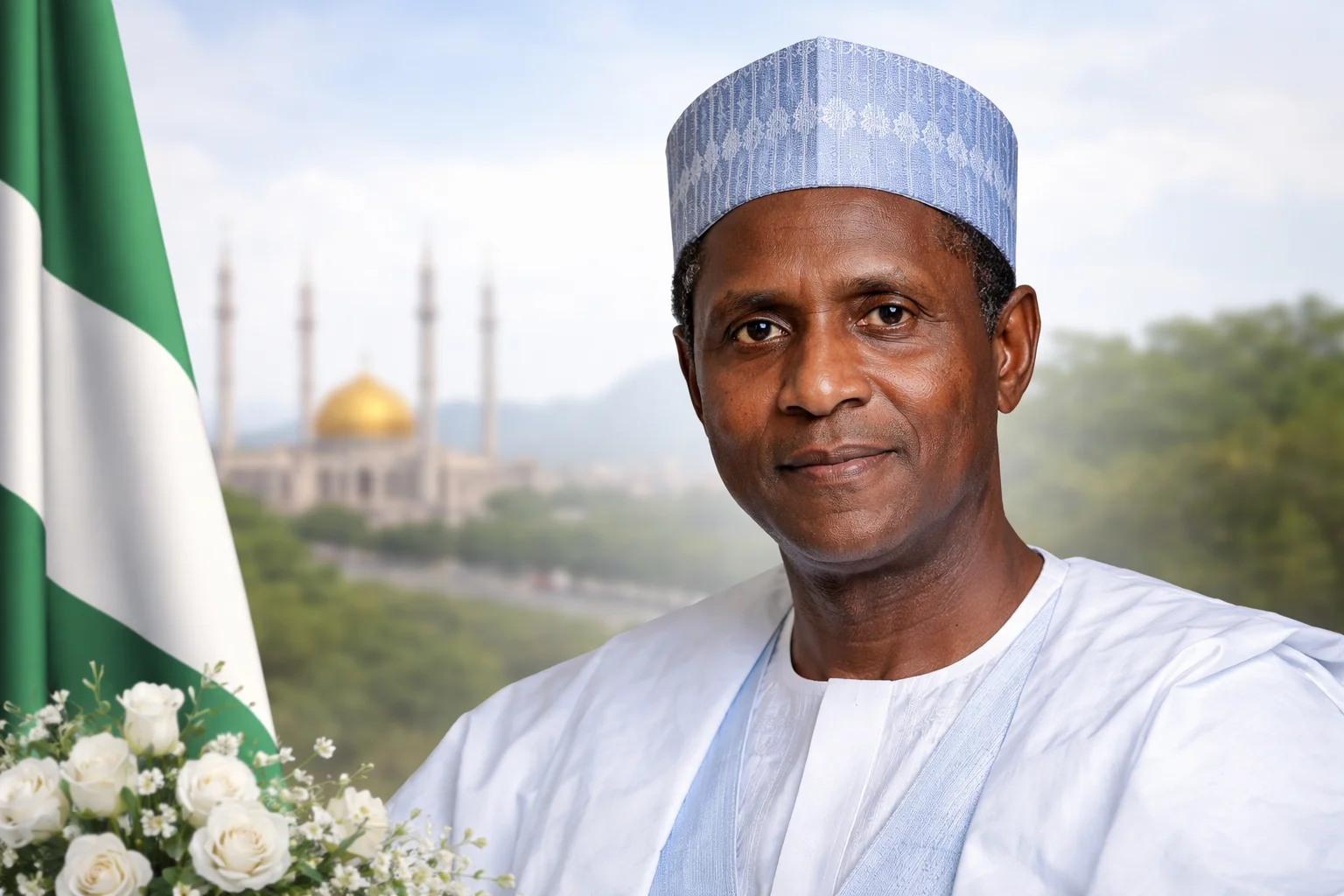
Umaru Musa Yar’Adua was born on 16 August 1951 in Katsina, Northern Region, British Nigeria (now in Katsina State, Nigeria).
His father was Musa Yar’Adua, a Federal Minister during the Nigerian First Republic and custodian of the royal treasury (Matawalle) of the Katsina Emirate, a title which Umaru later inherited. His mother was Fatima Dada Yar’Adua.
Umaru Musa Yar’Adua’s paternal grandfather, Malam Umaru, also held the title of Matawallen Katsina, while his paternal grandmother, Malama Binta, was a sister of Emir Muhammadu Dikko of Katsina.
Education and Academic Career
Yar’Adua began his education at Rafukka Primary School in 1950 and moved to Dutsinma Boarding Primary School in 1962. From 1965 to 1969, he attended Government College at Keffi. In 1971, he received a Higher School Certificate from Barewa College.
He studied at Ahmadu Bello University (ABU) in Zaria from 1972 to 1975, earning a bachelor’s degree in Education and Chemistry, and returned in 1978 to pursue a master’s degree in Analytical Chemistry.
After graduating from ABU, Yar’Adua worked as a teacher at Holy Child College in Lagos from 1975 to 1976 as part of his National Youth Service Corps. He then lectured at Katsina College of Arts, Science, and Technology from 1976 to 1979 and at Katsina Polytechnic from 1979 to 1983.
During this period, he was active in radical circles led by Marxist historian Yusufu Bala Usman. He joined the leftist People’s Redemption Party in the Second Republic (1979–83), while his father was briefly National Vice Chairman of the National Party of Nigeria.
Business and Corporate Involvement
Between 1983 and 1989, Yar’Adua was the pioneer General Manager of Sambo Farms Ltd. in Funtua, Katsina State. He also served as director of multiple companies, including Habib Nigeria Bank Ltd (1995–99), Lodigiani Nigeria Ltd (1987–99), Hamada Holdings (1983–99), and Madara Ltd., Vom, Jos (1987–99).
He chaired Nation House Press Ltd., Kaduna, from 1995 to 1999. Yar’Adua was also involved in several boards and governing councils, including Katsina State Farmers’ Supply Company (1984–85), Katsina College of Arts, Science and Technology, Katsina Polytechnic (1978–1983), and Katsina State Investment and Property Development Company (1994–1996).
Early Political Career
During General Ibrahim Babangida’s transition programme to the Third Republic, Yar’Adua became a founding member of the Peoples Front of Nigeria, led by his elder brother Shehu Musa Yar’Adua. This association later formed the Social Democratic Party (SDP).
Yar’Adua was a member of the 1988 Constituent Assembly, served as SDP State Secretary in Katsina, and contested the 1991 governorship election, losing to Saidu Barda of the National Republican Convention.
After the death of his brother during General Sani Abacha’s regime (1993–1998), Yar’Adua formed the political association K34 in 1998 to contest the 1999 Katsina State governorship election. The K34 group joined other associations to form the Peoples Democratic Party (PDP).
Yar’Adua was elected Governor of Katsina State, defeating Junaidu Yantumaki of the All People’s Party.
Governorship of Katsina State (1999–2007)
As governor (29 May 1999 – 29 May 2007), Yar’Adua focused on socioeconomic development, particularly in education and health. His administration cleared state debt, accumulated a $50 million surplus, and he became the first Nigerian governor to publicly declare his assets. He was re-elected in 2003.
Under his leadership, Katsina adopted sharia law in August 2000, while taking steps to accommodate non-Muslims through educational and religious programs. Notable cases during this period included Sani Yakubu Rodi, executed in 2002, and Amina Lawal, whose death sentence was overturned in 2003.
Presidential Ambition and Election (2006–2007)
Between 16 and 17 December 2006, Yar’Adua was chosen as the PDP presidential candidate for the April 2007 election, winning 3,024 votes from party delegates. His vice-presidential candidate was Goodluck Jonathan, governor of Bayelsa State.
Yar’Adua officially won the 21 April 2007 presidential election with 70% of the votes (24.6 million votes), though the election was widely criticised for alleged rigging.
Presidency of Nigeria (2007–2010)
Yar’Adua was sworn in as Nigeria’s 13th President on 29 May 2007, succeeding Olusegun Obasanjo. His cabinet, sworn in on 26 July 2007, included 39 ministers, with two from the opposition ANPP. He launched a seven-point agenda on infrastructure, power, food security, wealth creation, transport, land reform, security, and education, and set up a committee to improve election credibility.
When Yar’Adua was president of Nigeria, the country ran into a lot of problems. On the international stage, Nigeria tried to improve its image and economy and fight corruption, but these attempts didn’t really work. Nigerian citizens traveling or living abroad also had a hard time, especially in South Africa, where in May 2008 there were attacks against foreigners, and Nigerians were among those targeted.
At home, the country faced serious security problems. The Niger Delta, a region in the south, was very unstable because armed gangs operated there and the local government didn’t manage things well. This caused a lot of unrest and danger for people living in the area.
Another major problem was the rise of Boko Haram, a violent extremist group. Their uprising officially started on 26 July 2009, and it quickly spread to multiple states. The clashes between Boko Haram and government forces, along with attacks on civilians, were extremely deadly, killing more than 700 people.
Illness and Transfer of Power
Yar’Adua fell seriously ill in late 2009 and left for Saudi Arabia on 23 November 2009 to receive treatment for pericarditis. He returned to Nigeria on 24 February 2010.
His absence had created a power vacuum, prompting the Supreme Court to instruct the Federal Executive Council to determine his capacity to govern. On 9 February 2010, the Senate invoked the “doctrine of necessity” to transfer presidential powers to Vice President Goodluck Jonathan, declaring him Acting President.
Net Worth
Umaru Musa Yar’Adua’s net worth came from declared assets, family inheritance, business interests, and earnings from public service.
In June 2007, he publicly disclosed his assets, a first for a Nigerian president. His total declared assets were ₦856,452,892 (about USD 5.8 million), with liabilities of ₦88,793,269.77 (USD 0.5 million). His wife, Turai Yar’Adua, held ₦19 million (USD 0.1 million). At his death in 2010, independent sources estimated his net worth between USD 6 million and 10 million.
His wealth came from salaries as a lecturer, teacher, public servant, corporate board member, Governor of Katsina State, and President of Nigeria. These alone did not fully explain his assets. He inherited property and shares from his family, including holdings linked to his elder brother, Major‑General Shehu Musa Yar’Adua. Many lands and buildings, especially in Katsina and Abuja, were inherited or long-held family property. He also held private sector investments, including director roles in banks and companies like Habib Nigeria Bank Ltd, shares in local businesses, farms in Katsina State, and real estate across multiple states.
His 2007 asset declaration listed cash in banks, residential and commercial property in Katsina, Abuja, and Kaduna, farms and undeveloped land, vehicles, personal property, and shares in Nigerian businesses.
Umaru Musa Yar’Adua’s wife, children and siblings
Turai Umaru Yar’Adua was Umaru Musa Yar’Adua’s first wife, whom he married in 1975. She served as First Lady of Nigeria from 2007 to 2010 during her husband’s presidency. Hauwa Umar Radda was his second wife from 1992 to 1997. The marriage ended in divorce.
With Turai Umaru Yar’Adua, he had seven children: five daughters and two sons. Daughters include Zainab and Nafisat; sons include Shehu Umaru Musa Yar’Adua and Musa Umaru Musa Yar’Adua. With Hauwa Umar Radda, he had two children. Some of his children’s marriages link the Yar’Adua family to other political figures. Zainab Yar’Adua is married to Usman Saidu Nasamu Dakingari, former Kebbi State governor. Nafisat Yar’Adua married Isa Yuguda, former Bauchi State governor. Also, Maryam Yar’Adua married a former governor of Katsina State, Ibrahim Shema.
Umaru Musa Yar’Adua came from a prominent family with notable brothers. Shehu Musa Yar’Adua was his elder brother, a retired major general and influential Nigerian politician. Abdulaziz Musa Yar’Adua was another brother who held political and traditional titles.
How Umaru Musa Yar’Adua died
Umaru Musa Yar’Adua suffered from serious health problems for months before his death. In late 2009, he travelled abroad—first to Germany and then to Saudi Arabia—for medical treatment, where officials said he was being treated for pericarditis, an inflammation of the membrane around the heart.
He also had a long history of chronic kidney ailments that weakened his health significantly. After extended treatment overseas, Yar’Adua returned to Nigeria on 24 February 2010, but he did not resume active government duties and was largely absent from public view due to ongoing health issues.
Umaru Musa Yar’Adua died on 5 May 2010 at his official residence in the Aso Rock Presidential Villa, Abuja. He was 58 years old. Nigerian officials and reputable news sources confirm that his death followed the lengthy illness; there was no single publicly disclosed dramatic event, such as an accident or acute episode, beyond the progression of his serious health conditions.