
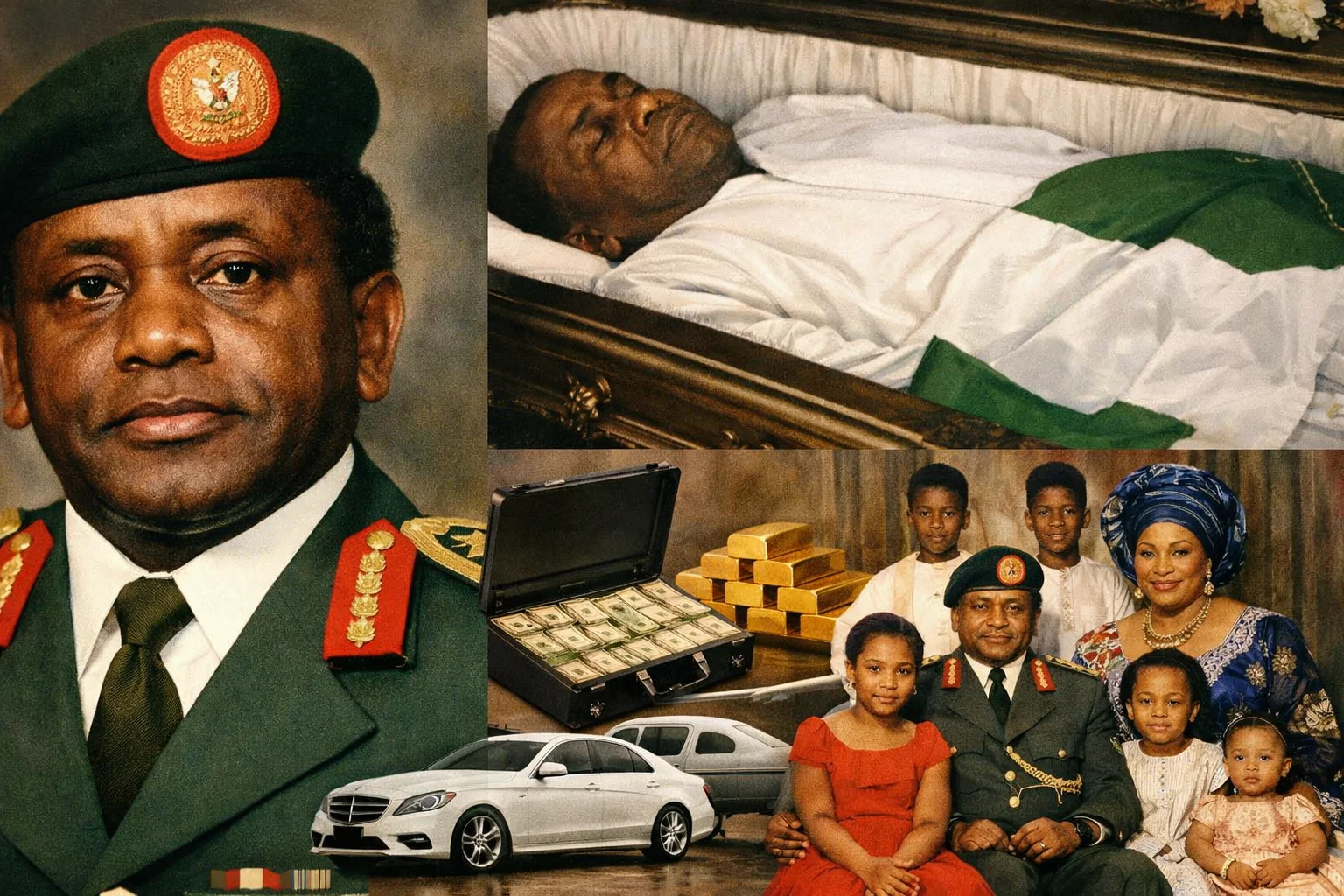
Sani Abacha was a Nigerian military leader who basically ran the country like a dictator from 1993 until he died in 1998. He took power through a military coup, which means he overthrew the government by force, and his rule was the last successful military takeover in Nigeria’s history.
Once he was in charge, he ruled very strictly, ignoring human rights, and had political opponents and activists killed or imprisoned. One famous case was Ken Saro-Wiwa, an environmental activist who was executed, which made Nigeria look bad internationally.
Abacha and his family were very corrupt, allegedly stealing between 2 and 5 billion dollars and hiding it in countries like Switzerland, the United Kingdom, Liechtenstein, and the United States.
When Abacha died in 1998, General Abdulsalami Abubakar took over and later Nigeria returned to civilian rule.
Early Life and Military Education
Abacha was born on 20 September 1943 in Kano to a Kanuri family from what is now Borno State. He was Muslim and went to military school in Nigeria and then in England, getting his officer training in 1963.
Military Career and Coups
During his career, Abacha was involved in almost every major military coup in Nigeria starting in 1966. That year he was a second lieutenant and took part in a counter-coup.
He also fought in the Nigerian Civil War in 1969 as a platoon and battalion commander. Later, he commanded the 2nd Infantry Division in 1975.
By 1983, he was a senior officer in the 2nd Mechanised Division and part of the Supreme Military Council, which was a top military ruling group. He helped bring Buhari to power in 1983 and then helped remove him in 1985 to put Babangida in charge.
Babangida then made Abacha Chief of Army Staff in 1985, and in 1990 he became Minister of Defence. Abacha was the first Nigerian Army officer to reach the rank of general without skipping any ranks.
Coup and Assumption of Power
By 1993, Abacha was the defence minister and the most senior military officer when Nigeria had a political crisis. He staged a coup to remove the Interim National Government led by Ernest Shonekan and justified it as bringing stability because the 1993 elections had caused political uncertainty.
Rule and Repression
As head of state, Abacha ruled from 1993 to 1998. He passed decrees making himself above the law and allowed the government to hold people for three months without trial. He also removed Decree 691, which had limited some government powers.
To keep control, Abacha had a private security force of 3,000 men trained in North Korea, and his top security officer, Hamza al-Mustapha, ran security tightly. The police were retrained, criminals and dissidents were cracked down on, and groups like the National Democratic Coalition were blamed for bombings and arrested.
People like Moshood Abiola, who said he was president, and former leader Olusegun Obasanjo were jailed for treason. Others, like Shehu Yar’Adua, died in custody. Human rights were badly abused, especially against activists like Ken Saro-Wiwa. Wole Soyinka was even charged with treason in his absence.
Abacha also faced opposition from international pro-democracy activists.
Economic Policies and Corruption
Despite all the corruption, Nigeria’s economy grew under Abacha. Foreign reserves increased from $494 million in 1993 to $9.6 billion in 1997, and external debt fell from $36 billion to $27 billion. Abacha built between 25 and 100 km of urban roads in major cities and stopped Babangida’s privatisation programs. Inflation dropped from 54% to 8.5% between 1993 and 1998, while oil stayed around $15 a barrel. GDP growth was mostly in oil, but Abacha pushed for a market economy. The corruption and economic growth happened together.
His national security adviser, Ismaila Gwarzo, his son Mohammed Abacha, and friend Mohammed Sada helped launder money out of Nigeria. They used fake funding requests, collected cash from the Central Bank, and sent it offshore. About $1.4 billion was moved this way.
Abacha and his family were ranked among the top corrupt leaders, allegedly stealing $1–5 billion. Some money was returned later, and the U.S. and Jersey recovered hundreds of millions in civil forfeitures even 20 years after his death.
Political Reorganisation and Elections
Politically, Abacha reorganised Nigeria into six zones: North Central, North East, North West, South East, South South, and South West. He added six new states to reach the current 36.
He held a constitutional conference from 1993 to 1995. In early 1998, he announced elections for August and said civilian rule would start in October, but he had no intention of stepping down.
By April, he had forced all five political parties to support him as the only presidential candidate.
Foreign Relations
In foreign affairs, Nigeria was suspended from the Commonwealth in 1995 after Ken Saro-Wiwa’s execution. Abacha hosted Nelson Mandela and promised he would try to stop the death sentence, but didn’t.
In 1997, Libya’s Muammar Gaddafi visited Nigeria, breaking UN sanctions, and thousands supported Abacha. Abacha also sent troops to Liberia during its civil war through ECOWAS.
Despite criticism from the US, Abacha had some connections there. In 1997, Senator James Inhofe visited Nigeria, representing a group called the Family. Abacha maintained political and business relationships with the Family until his death.
He also had ties with other US figures like Senator Carol Moseley Braun, Rev. Jesse Jackson, and Louis Farrakhan, who visited Nigeria and supported his administration.
Wife and Children
Sani Abacha was married to Maryam Abacha. Before marriage, her name was Maryam Jidah. She became First Lady when Abacha ruled Nigeria from 1993 to 1998. She was born on 4 March 1947 in Kaduna, and her family originally came from what is now Borno State.
While she was First Lady, she was often seen in public and was linked to charity work, especially projects for women, children, and health. One well-known project connected to her time in office is the National Hospital in Abuja, which was first meant mainly for women and children.
Sani Abacha and Maryam Abacha had ten children together. They had seven sons and three daughters. Their eldest son, Ibrahim Abacha, died in a plane crash in 1996, while his father was still in power. The other sons are Mohammed Abacha, Abba Abacha, Mahmud Sani Abacha, Sadiq Abacha, Abdullahi Abacha, and Al Mustapha Abacha. Some of these sons later became known because of business activities and court cases linked to money that was taken out of Nigeria during Abacha’s rule.
Their daughters are Zainab Abacha, Fatima Gumsu Sani Abacha, who is often called Gumsu, and Rakiya Abacha. Over time, some of the daughters became known to the public through marriages, personal work, or by speaking publicly about their father. The family also has as many as thirty-three grandchildren.
Net Worth
Sani Abacha did not have a normal net worth like a businessman. When people mention his net worth, they are referring to money taken from Nigeria while he ruled from 1993 to 1998. Most reliable estimates place this between 1 and 5 billion US dollars at the time of his death. This money did not come from salary or legal business activity but from public funds.
Abacha controlled the government, military, and finances, which allowed him and close associates to take money directly from the Nigerian treasury and the Central Bank. Fake security and government funding requests were approved under his authority, and the cash was handed to trusted individuals who moved it abroad.
The money was hidden in bank accounts and assets in Switzerland, the United Kingdom, Liechtenstein, Jersey, the United States, and other financial centres. His son Mohammed Abacha, his national security adviser Ismaila Gwarzo, and associate Mohammed Sada were involved. About 1.4 billion dollars was traced to one laundering scheme, with total estimates much higher.
After his death, multiple countries investigated and recovered Abacha-linked funds. Over the next two decades, billions were frozen and returned to Nigeria through asset recovery and civil forfeiture, including hundreds of millions from the United States, Switzerland, and Jersey. Because of this evidence, organisations such as Transparency International list Abacha among the most corrupt leaders in modern history.
How Did Sani Abacha Died
Sani Abacha died on 8 June 1998 in the presidential villa in Abuja when he was 54 years old. The Nigerian government officially said he died suddenly from a heart attack. However, many people questioned this explanation because no autopsy was done to properly confirm the cause of death.
He was buried the same day, following Islamic tradition, which meant doctors did not carry out a full medical examination after he died. Because of this, rumours and alternative stories started to spread. Some people claimed he may have been poisoned, and there were stories suggesting he collapsed while with female companions, but these stories were never proven and remain speculation.
People close to Abacha, including his former chief security officer, strongly denied the poisoning rumours and said he died after a brief illness. His personal doctor said he tried to revive him and noticed signs that suggested a heart problem, but he also admitted that without an autopsy, it was impossible to say for sure whether it was a heart attack or something else.
Because there was no detailed medical investigation, the official explanation remains a heart attack, but doubts and unanswered questions still exist.