
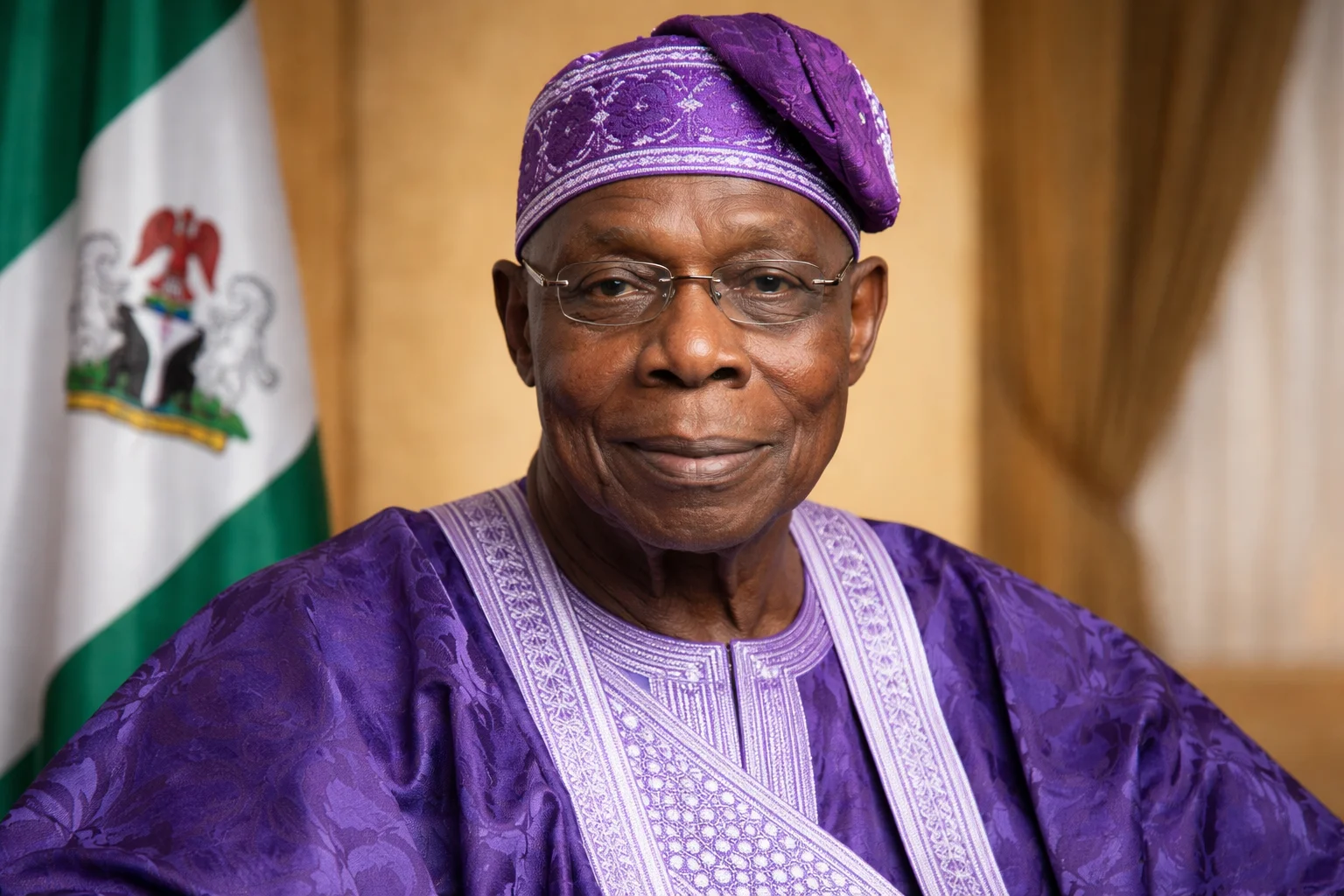
Olusegun Obasanjo was born on 5 March 1937, according to his passport. No contemporary birth record exists, and the date is generally regarded as an estimate. He was born in Igbogun Olaogun village within the Owu Kingdom.
His father, Obasanjo Bankole, was among the early settlers and founding figures of the village in the early 1920s. Bankole was a successful farmer and palm wine tapper but was socially regarded as poor because he lacked formal education, which carried considerable prestige in Yorubaland at the time. His mother, Bernice Ashabi, was a petty trader.
The family had six children, but only two survived: Olusegun and his sister, Adunni Oluwola. Obasanjo was raised as a Baptist. His sister later converted to Islam in order to marry a Muslim man.
Education and Early Challenges
At the age of eleven, Olusegun Obasanjo began primary school in his village. After three years, in 1951, he transferred to Baptist Day School in the Owu quarter of Abeokuta. In 1952, he moved to Baptist Boys’ High School, Abeokuta. His education was partly funded through state grants. He performed well academically and became an enthusiastic Boy Scout.
During his secondary school years, he showed no involvement in politics, but he rejected his Christian forename, “Matthew”, as an anti-colonial gesture. This time in his life was very difficult. His father abandoned the family, plunging his mother and siblings into poverty. To support his education, Obasanjo worked on cocoa and kola farms, fished, collected firewood, sold sand to builders, and undertook manual labour at his school during holidays.
In 1956, he sat his secondary school examinations after borrowing money to pay the fees. That year, he began courting Oluremi Akinlawon, the daughter of an Owu station master, and they became engaged by 1958. After leaving school, he moved to Ibadan and worked as a teacher. Although he passed the entrance examination for University College Ibadan, he could not afford the tuition. He then decided to pursue civil engineering and responded in 1958 to an advertisement for officer cadet training in the Nigerian Army.
Joining the Nigerian Army
In March 1958, Olusegun Obasanjo joined the Nigerian Army so he could keep studying while also earning a salary. He did not tell his family at first because he was afraid they would not approve. At the time, the army was transitioning from British to Nigerian control ahead of independence, with increasing emphasis on training indigenous officers.
He was sent to a military training school in Teshie, Ghana. While he was there, he stayed in touch with his fiancée. In September 1958, he was chosen for more training at the Mons Officer Cadet School in Aldershot, England. He did not like the school, which he felt treated people unfairly and discriminated against non-British trainees. He also found the English weather difficult. This experience made him more strongly opposed to British rule. He completed his training, became an army officer and earned an engineering qualification.
While he was in England, his mother died. His father passed away the following year.
Early Military Career
In 1959, Olusegun Obasanjo returned to Nigeria and was posted to Kaduna as an infantry subaltern with the Fifth Battalion. This was his first experience living in a Muslim-majority region. In October 1960, Nigeria attained independence while he was stationed there.
Shortly after independence, the Fifth Battalion was deployed to the Congo as part of a United Nations peacekeeping force during the Congo Crisis. Stationed in Kivu Province with headquarters in Bukavu, Obasanjo was involved in protecting civilians, including ethnic Belgians, from mutinous soldiers opposed to Patrice Lumumba’s government.
In February 1961, he was captured by mutineers while evacuating Roman Catholic missionaries near Bukavu. Although execution was considered, he was released on orders from rebel leaders. He was appointed temporary captain during the conflict. The battalion returned to Nigeria in May 1961, and Obasanjo later reflected that the experience strengthened its Pan-African outlook.
On his return, he purchased his first car and was hospitalised with a stomach ulcer. After recovery, he was transferred to the Army Engineering Corps. In 1962, he was posted to the Royal College of Military Engineering in England, where he excelled and was described as the best Commonwealth student ever. That year, he paid for Oluremi Akinlawon to travel to London for training.
They married in June 1963 at the Camberwell Green Registry Office, informing their families only afterwards. Obasanjo was ordered back to Nigeria later that year, while his wife remained in London for a further three years. In Nigeria, he commanded the Field Engineering Squadron in Kaduna and was promoted to major in 1965. He invested in land in Ibadan, Kaduna and Lagos.
Advanced Military Training Abroad
In 1965, he was sent to India to study at the Defence Services Staff College in Wellington and the School of Engineering in Poona. En route, he visited his wife in London. He was disturbed by the poverty he observed in India but developed an interest in its culture and comparative religion.
Crisis and Civil War
Olusegun Obasanjo returned to Nigeria in January 1966 amid a military coup led by Major Emmanuel Ifeajuna. He warned of the risk of civil war and offered to mediate between the coup plotters and the new military government under General Johnson Aguiyi-Ironsi. After Ironsi’s unification decree in May 1966 heightened ethnic tensions, a counter-coup in July led to Ironsi’s assassination and the rise of General Yakubu Gowon.
During the violence, Obasanjo narrowly avoided danger in northern Nigeria and was temporarily relocated for his safety. By January 1967, he had been posted to Lagos as Chief Army Engineer.
Following the declaration of the Republic of Biafra in May 1967, Obasanjo was appointed commander of the Western State, helping to block Biafran advances towards Lagos. He later became rear commander of Murtala Muhammed’s Second Division, overseeing logistics and teaching military science at the University of Ibadan.
In May 1969, Gowon replaced Colonel Benjamin Adekunle with Obasanjo as commander of the Third Division, despite his limited combat experience. Based in Port Harcourt, he commanded up to 40,000 troops, repelled Biafran counterattacks and was wounded while touring the front.
In December 1969, he launched Operation Finishing Touch, capturing Umuahia, followed by Operation Tail-Wind in January 1970, which secured the Uli airstrip. On 13 January 1970, he accepted Biafra’s surrender from Philip Effiong. He emphasised discipline and restraint, punishing looting and rape, and prioritised reintegration and infrastructure restoration. By May 1970, water supplies had been restored across the region. His role made him a national war hero.
Post-War Career and Rise to Leadership
Olusegun Obasanjo returned to Abeokuta in June 1970 to a hero’s welcome. He was appointed Brigadier commanding the Corps of Engineers in Lagos, sat on the army decommissioning committee, and attended the Royal College of Defence Studies in 1974. In January 1975, Gowon appointed him Commissioner for Works and Housing.
He expanded his business interests, registering Temperance Enterprises Limited in 1973 and investing in property. His first marriage ended in the mid-1970s. In 1976, he married Stella Abebe in a traditional Yoruba ceremony.
Following the July 1975 coup that removed Gowon, Obasanjo became Murtala Muhammed’s deputy in a military triumvirate. He played a central role in administrative reform, anti-corruption measures and preparations for a return to civilian rule.
After Muhammed was assassinated during a failed coup in February 1976, Obasanjo narrowly escaped death and was persuaded to assume leadership as head of state. He pledged continuity and moved into Dodan Barracks for security.
Head of State: Policies and Reforms
As head of state, Olusegun Obasanjo pursued austerity to combat inflation, reduced public spending and promoted agriculture, education, housing and infrastructure. His government launched Operation Feed the Nation, introduced the Land Use Decree in 1978, merged oil institutions into the Nigerian National Petroleum Corporation, and pursued major irrigation, power and steel projects.
He expanded free primary and secondary education, though funding cuts led to student unrest and harsh responses. His administration demobilised 12,000 soldiers, curbed ostentatious government spending and addressed corruption symbolically. He faced criticism for political repression, notably following the destruction of Fela Kuti’s Kalakuta Republic.
Obasanjo used Nigeria’s resources and influence to assert continental leadership, backing anti-apartheid and anti-colonial struggles, strengthening ties with the United States, loosening links with the United Kingdom, and raising Nigeria’s global profile, culminating in a non-permanent seat on the UN Security Council.
He oversaw the drafting of a new constitution, lifted the ban on political parties and organised elections. Despite low turnout and allegations of rigging, Shehu Shagari was declared president. On 1 October 1979, Obasanjo handed over power, inaugurating Nigeria’s Second Republic.
Return to Civilian Life
After leaving office, Obasanjo returned to Abeokuta, became a farmer, expanded Obasanjo’s Farms Limited and remained influential at home and abroad. He published several books, co-chaired the Commonwealth Eminent Persons Group on apartheid and undertook mediation roles across Africa.
He opposed military rule under Ibrahim Babangida and later Sani Abacha. In 1995, he was arrested, tried by a military court and sentenced to imprisonment on treason charges. He spent three years in harsh prison conditions, deepened his Christian faith and attracted international support. He was released after Abacha’s death in 1998.
Presidency: 1999–2007
Obasanjo joined the Peoples Democratic Party and emerged as its presidential candidate. Despite losing in his home region, he won the February 1999 election with 63 percent of the vote and selected Atiku Abubakar as vice-president. He was sworn in on 29 May 1999.
During his first term, he expanded press freedom, retired senior military officers, restructured defence oversight and promoted national reconciliation. Re-elected in 2003, he expanded the police force, addressed internal security crises and signed the Greentree Agreement resolving the Bakassi dispute.
Economically, he inherited a fragile economy marked by low growth, high inflation, unemployment and poverty. GDP growth rose to about 6 percent under his presidency, foreign reserves increased from roughly 2 billion dollars to about 43 billion dollars, and Nigeria secured major debt relief from the Paris and London Clubs. He established the Niger Delta Development Commission, expanded universal basic education, doubled the minimum wage in 2000 and created key anti-corruption institutions, including the ICPC and EFCC.
When he tried to cut government support that kept petrol prices low, people across the country went on strike. Many Nigerians also opposed his plan to sell state-owned companies, and corruption continued to be a serious problem. At the same time, the government spent more on healthcare, especially on fighting HIV/AIDS and expanding basic health services across the country.
In foreign policy, he worked to restore Nigeria’s international reputation, strengthened ties with the United States and the United Kingdom, led regional peacekeeping efforts and played prominent mediation roles across Africa.
Challenges and Controversies
Obasanjo faced intense ethnic and religious tensions, including the adoption of sharia penal law in twelve northern states, which he later described as the most challenging issue of his presidency. He doubled the size of the police force, intervened in major internal conflicts and established the Niger Delta Development Commission.
In November 1999, troops were sent to Odi, Bayelsa State, following the killing of police officers. Most of the town was destroyed. Obasanjo later described the incident as regrettable but refused to apologise, although reconstruction was later undertaken.
During his second term, there were claims that he wanted to amend the Constitution to allow him a third term. Although he denied this, some politicians alleged he actively promoted the agenda. The National Assembly stopped the plan, and he left office after the 2007 elections.
Later Political Career and Mediation
After leaving office, Olusegun Obasanjo chaired the Board of Trustees of the PDP before resigning in 2012. He remained politically active, mediating national issues, leaving and rejoining political parties, and formally retiring from partisan politics in January 2022.
Internationally, he served as a United Nations Special Envoy to the Democratic Republic of the Congo, led African Union election observation missions and played a central role in mediating the Ethiopian–Tigray conflict, culminating in a ceasefire in November 2022. In 2025, he was appointed mediator in the Democratic Republic of the Congo amid the M23 insurgency.
Olusegun Obasanjo: Wives and Children
Olusegun Obasanjo was married more than once and also had other long-term relationships.
His first wife was Esther Oluremi Obasanjo (née Akinlawon). They got married in London in 1963. When Obasanjo first became military head of state, she acted as First Lady. Later on, they separated and divorced.
He later had a relationship with Lynda Soares, who was a businesswoman. Sadly, she died in 1987 after being killed during an armed robbery.
In 1976, Obasanjo married Stella Abebe Obasanjo. She became Nigeria’s First Lady when her husband was elected president in 1999. She remained First Lady until she died in 2005 following a surgery complication.
Another woman he married was Mojisola Adekunle-Obasanjo. She was an army officer and later became a politician. Mojisola even started her own political party. She died in 2009.
Apart from these marriages, Obasanjo also had other serious relationships that resulted in children, even though he was not officially married to all the women. One of these relationships was with a journalist called Gold Oruh.
Obasanjo is believed to have about twenty children, although no one agrees on the exact number. Most of them work in various fields, including politics, business, technology, and education.
One of his well-known children is Iyabo Obasanjo-Bello. She is his first child, and the one most people know about. Iyabo was elected as a senator between 2007 and 2011 and also served as a health commissioner in Ogun State. She studied veterinary medicine.
Another child, Dare Obasanjo, works in the technology industry outside Nigeria, mainly in the United States. Adeboye Obasanjo served in the Nigerian Army and was injured during a Boko Haram attack in 2014. Olumuyiwa, also called Muyiwa, is the son of Stella Obasanjo and mostly stays out of the public eye, only appearing at family or official events.
Net Worth
Olusegun Obasanjo is very rich. Most estimates put his net worth at between one and a half billion dollars and 1.7 billion dollars.
Most of his money didn’t come from being president. A huge part comes from farming. He owns Obasanjo Farms, also called Ota Farm, which is one of Nigeria’s biggest private farms. They raise animals like chickens and cows, grow crops, and have fish farms. This business makes him a lot of money.
He also owns many properties, both in Nigeria and abroad. These include houses and commercial buildings, which add a lot to his total net worth. After leaving office, he earns money by speaking at international events and giving advice on African politics and peace. People pay him for consulting and public speaking.
Obasanjo has written several books about leadership and his life. Money from book sales and royalties from speeches is another way he earns. He also invests in companies and owns shares in businesses, like the Transnational Corporation of Nigeria, though we don’t know exactly how much those shares are worth.
Some of his money comes from his work in the military and politics, including salaries, pensions, and allowances over many years, but this is only a small part of his wealth. People also say he owns luxury cars, planes, and other expensive personal items.