
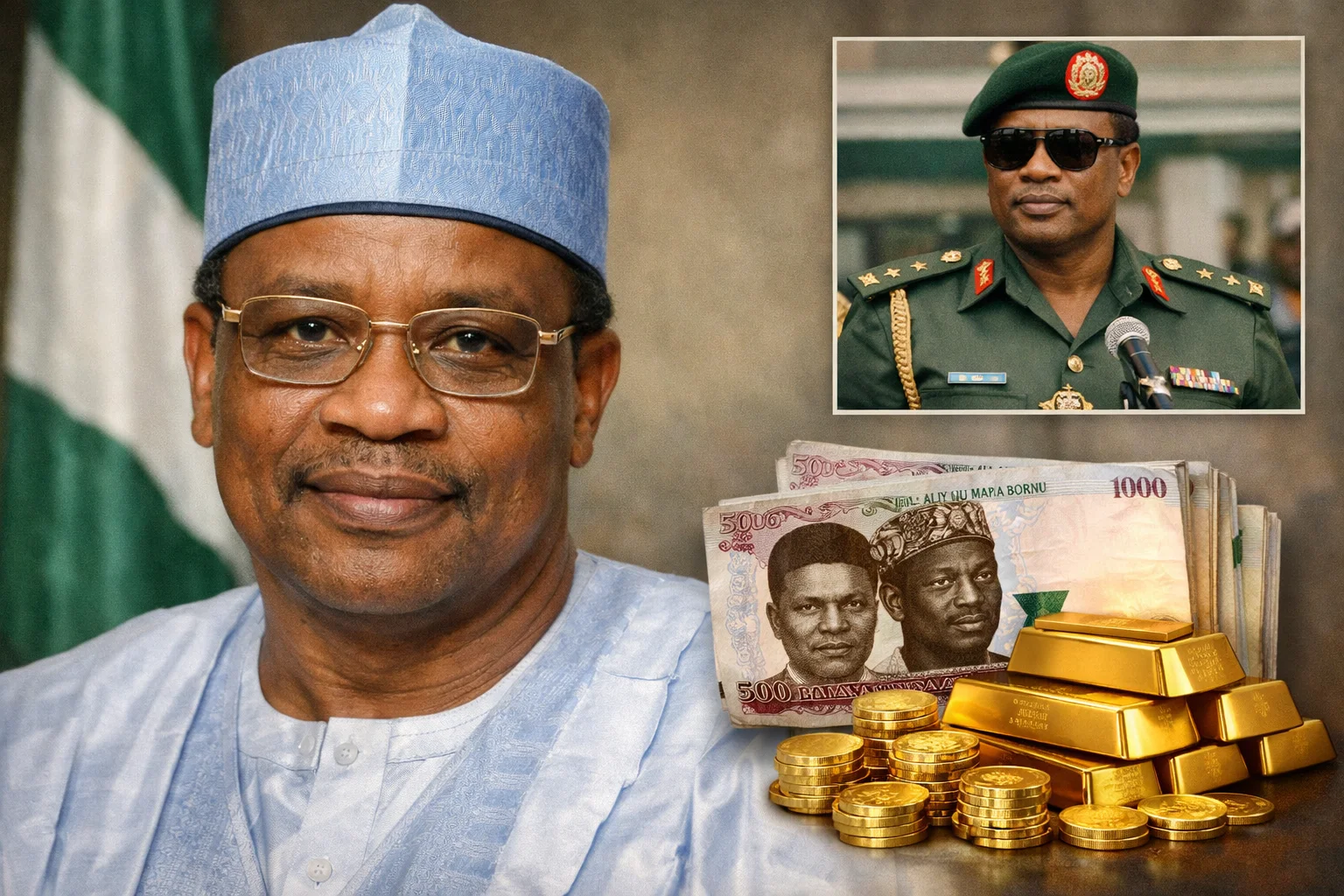
Ibrahim Badamasi Babangida was born on 17 August 1941 in Minna, which was part of British Nigeria at the time, now in Niger State. His parents were Muhammad and Aisha Babangida.
As a child, he studied the basics of Islam and then went to primary school from 1950 to 1956. After that, from 1957 to 1962, he attended Government College Bida. Some of his classmates there would also become important military leaders later, like Abdulsalami Abubakar and Mamman Vatsa.
In 1962, he joined the Nigerian Army, starting at the Nigerian Military Training College in Kaduna. He went to the Indian Military Academy for a few months in 1963 and officially became a second lieutenant, which is a starting officer rank. He first commanded the 1 Reconnaissance Squadron from 1964 to 1966.
In early 1966, he trained in the UK at the Royal Armoured Centre, learning about tanks and armored vehicles. That same year, he witnessed the first violent coup in Nigeria that killed many leaders, including Sir Ahmadu Bello. Later that year, he helped with a counter-coup that removed General Aguiyi Ironsi from power and put General Yakubu Gowon in charge.
Military Career and Civil War
When the Nigerian Civil War started, Babangida was sent to the 1st Division under General Mohammed Shuwa. In 1968, he commanded the 44 Infantry Battalion, which fought hard in Biafra, the region trying to break away. In 1969, he was shot in the chest during a mission but refused to remove the bullet, carrying it with him for life. While recovering, he married Maryam King on 6 September 1969. He returned to fight later that year and in January 1970, he was told that the Biafran Army surrendered, ending the war.
After the war, he was promoted twice and became an instructor at the Nigerian Defence Academy. In 1972–1973, he went to the U.S. Army Armor School to learn more about armored warfare. He then commanded the 4 Reconnaissance Regiment and later the Nigerian Army Armoured Corps in 1975. He participated in a coup that same year, which was part of Nigeria’s frequent military takeovers.
From 1975 to 1979, he was one of the youngest members of the Supreme Military Council, the group that ran the country. In 1976, after General Murtala Mohammed was assassinated, Babangida acted quickly to stop another coup by taking back control of the radio station from the people trying to take over. In 1977, he took the Senior Officers Course at the Armed Forces Command and Staff College in Jaji and in 1979–1980, he attended the Senior Executive Course at the National Institute of Policy and Strategic Studies.
Ibrahim Babangida’s Rise to Power
From 1981 to 1983, Babangida became Director of Army Staff Duties and Plans. He played a major role in the 1983 coup that ended the civilian government, which brought General Muhammadu Buhari into power.
He was made Chief of Army Staff on 1 January 1984. While in this role, he started planning a coup against Buhari. On 27 August 1985, Babangida successfully overthrew Buhari and became President and Commander-in-Chief of Nigeria’s Armed Forces.
He set up the Armed Forces Ruling Council to make laws and reorganized national security, creating the State Security Service, National Intelligence Agency, and Defence Intelligence Agency. Buhari was kept under house arrest until 1988.
Presidency and Economic Reforms
As president from 1985 to 1993, Babangida made big changes. In 1986, he created the Nigerian Political Bureau to study Nigeria’s problems and suggest solutions.
Around the same time, Nigeria had an economic crisis, so Babangida started the Structural Adjustment Program (SAP) with help from the IMF and World Bank. This included privatizing government companies, removing controls on farming and prices, devaluing the naira so exports would increase, encouraging foreign investment, and asking Nigerians to be self-reliant and honest.
In 1987, he started MAMSER, which promoted social responsibility and reducing corruption. Babangida also improved infrastructure: he finished the Third Mainland Bridge, dualised the Kaduna-Kano highway, built the Shiroro Hydroelectric Power Station, Toja Bridge, Jibia Water Treatment Plant, and Challawa Cenga Dam.
He created two new states in 1987, Akwa Ibom and Katsina, and nine more in 1991, bringing the total to thirty. He also raised oil royalties for states from 1.5 to 3 percent and moved Nigeria’s capital from Lagos to Abuja on 12 December 1991.
Foreign Policy and Challenges
Internationally, Babangida opposed apartheid in South Africa, sent troops to Liberia, hosted the Abuja Treaty which helped create the African Union, and maintained strong relations with the U.S. and U.K.
In 1986, Nigeria joined the Organisation of Islamic Cooperation, which caused controversy because Nigeria is a secular country.
During his rule, his government survived two coup attempts, executed Mamman Vatsa in 1985 and Gideon Orkar in 1990, and faced the assassination of journalist Dele Giwa in 1986.
His era is remembered for widespread corruption, with estimates of over 12 billion dollars stolen.
Transition to the Third Republic
Babangida began planning the transition to the Third Republic in 1989. He allowed political parties and created a two-party system: the Social Democratic Party (SDP) and the National Republican Convention (NRC).
Elections for the legislature happened in 1992, but Babangida annulled the SDP presidential primaries, removing Shehu Yar’Adua and Adamu Ciroma.
On 12 June 1993, Moshood Abiola and Babagana Kingibe of the SDP won the presidential election against Bashir Tofa and Slyvester Ugoh of the NRC. Babangida annulled the results, claiming national security reasons, which led to protests and unrest.
In August 1993, he resigned and created the Interim National Government led by Ernest Shonekan, which was later overthrown by Sani Abacha.
Post-Presidency
After leaving office, Babangida stayed politically active. He helped form the Peoples Democratic Party (PDP) and supported Olusegun Obasanjo in the 1999 presidential election.
Ibrahim Babangida tried to run for president in 2007 but withdrew due to moral reasons, and again considered running in 2011 but withdrew after security concerns.
He had corrective surgery in 2017 and has since called for a younger generation to lead Nigeria.
On 20 February 2025, he publicly admitted that the 1993 elections were free and fair and that MKO Abiola had actually won, expressing regret for annulling them.
Ibrahim Babangida Wife and Children
Ibrahim Babangida was married to Maryam Babangida. Her original name was Maria Ndidi Okogwu. She was born on 1 November 1948 in Asaba, in Delta State, Nigeria. Later, when Babangida became the head of Nigeria from 1985 to 1993, she became the First Lady of the country. They got married on 6 September 1969, just before Maryam turned 21. Before the marriage, she converted to Islam, and she remained Babangida’s only wife until she passed away. Maryam died on 27 December 2009 in Los Angeles, California, because of ovarian cancer when she was 61 years old. During her time as First Lady, she was well known for her work helping women and for her charity and women’s empowerment programmes.
Ibrahim and Maryam had four children together. Their names are Aisha Babangida, Mohammed (sometimes called Muhammad) Babangida, Aminu Babangida, and Halima (or Halimat) Babangida. All four children were born while Babangida was moving up in military ranks and later serving as Nigeria’s leader.
Their first child, Aisha Babangida, was born on 25 May 1970. She became a humanitarian leader and works as the chairperson of the Better Life Program for the African Rural Woman. She is also very active in charity work and leadership programs in Nigeria.
Their first son, Mohammed Babangida, married Rahma Indimi, who is the daughter of a very rich businessman named Mohammed Indimi, and they have children together.
Aminu Babangida, another son, was born in the late 1970s and works in business in Nigeria.
Halima Babangida is their youngest daughter. She got married in May 2017 to Auwal Lawal Abdullahi, who is a businessman and holds the traditional title of Sarkin Sudan Gombe.
Ibrahim Babangida Net Worth
Ibrahim Babangida is believed to be very rich, but no one knows exactly how much he is worth. Wikipedia and other sites say his net worth is over five billion dollars.
Most of his wealth come from oil and business. He is said to own a big part of Fruitex International London Limited and its Nigerian oil company, Fruitex Oil Exploration and Production Limited—some sources say he owns about 65 percent. This company works in oil, exploration, production, and transportation, and it makes a lot of his money.
He is also said to have shares in Nigeria’s telecom business, sometimes linked to 24 percent of Globacom, the country’s second-largest telecom company, though he has denied some of these claims. He is reported to have investments in other businesses too, like security, farming, and service companies.
Babangida owns a lot of property, including a huge mansion in Minna, Niger State, and other homes in Nigeria and abroad. Reports also say he has luxury cars and a private jet, but these are just estimates and not officially confirmed.
He is connected to education too, including Ibrahim Badamasi Babangida University in Niger State.
Some people say part of his wealth comes from oil money during his time as president, especially from high oil prices, but these are just claims and have never been proven in court. There are also rumours about secret bank accounts or hidden assets, but nothing has been officially confirmed.