
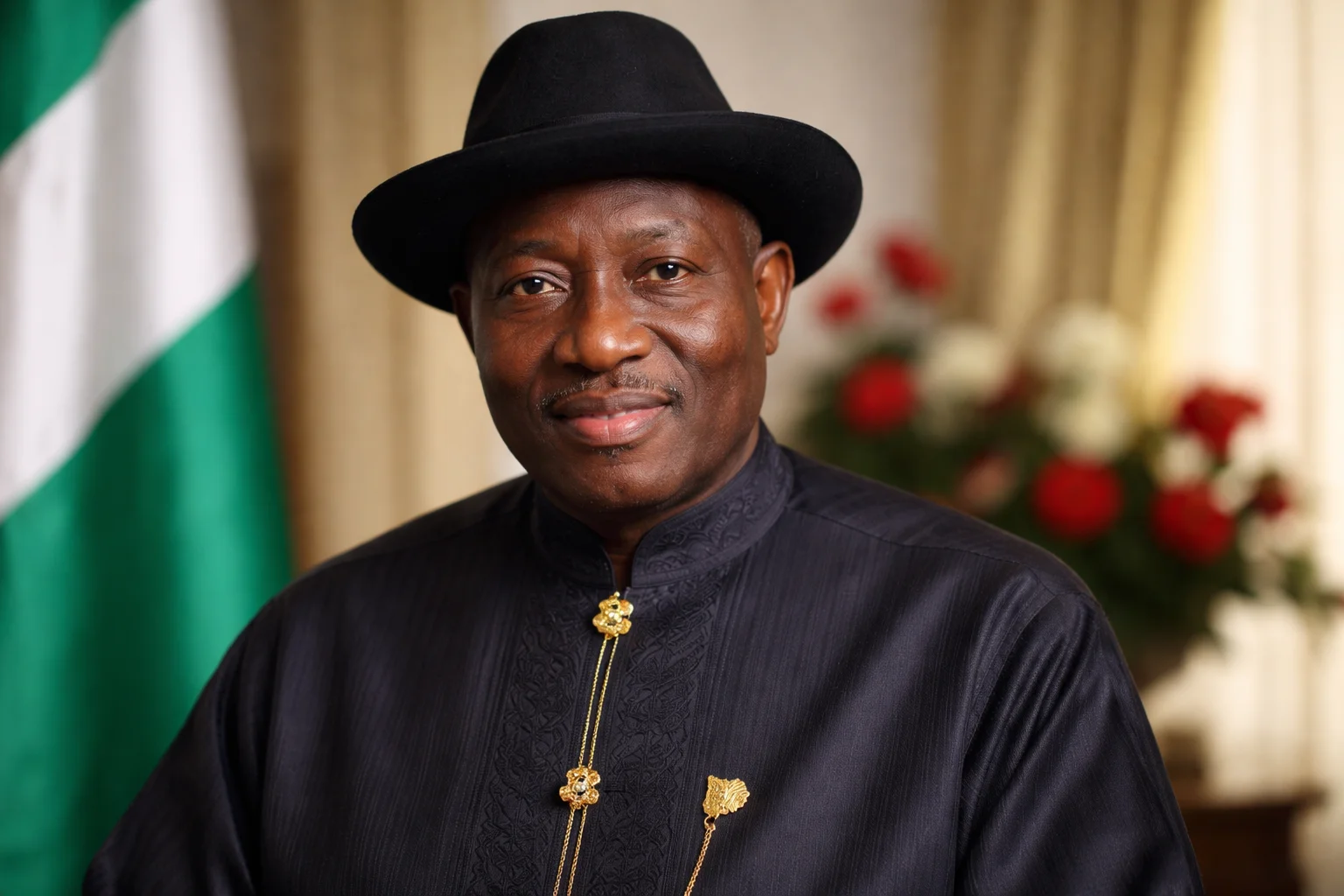
Goodluck Jonathan’s full name is Goodluck Ebele Azikiwe Jonathan. He was born on 20 November 1957 in a town called Otuoke, in Bayelsa State, Nigeria. Goodluck Jonathan was born into a Christian Ijaw family. His father, Lawrence Ebele Jonathan, made canoes, and his mother, Eunice Ayi Ebele Jonathan, was a retired farmer. He went to Christian schools for his early education. Later, he studied at the University of Port Harcourt, where he earned degrees in zoology, hydrobiology, and fisheries biology. After finishing his studies, he taught at Rivers State College of Education from 1983 to 1993.
Early Work Before Politics
Before he started working in politics, Jonathan worked in education as an inspector and a lecturer, and he also worked as an environmental-protection officer. He became involved with the Peoples Democratic Party (PDP) in the late 1990s after Nigeria’s military ruler, General Sani Abacha, died in 1998.
Deputy Governor of Bayelsa State (1999–2005)
In 1999, Jonathan was chosen as the running mate of Diepreye Alamieyeseigha in the Bayelsa State gubernatorial election. They won, and Jonathan became Deputy Governor on 29 May 1999. He was re-elected in 2003 and became known as a hardworking deputy governor.
Governor of Bayelsa State (2005–2007)
On 9 December 2005, the Governor at the time, Alamieyeseigha, was removed because of money laundering charges. Jonathan then became Governor of Bayelsa State and served until 29 May 2007, when he moved to the national government.
Vice President of Nigeria (2007–2010)
Jonathan became the Vice President of Nigeria on 29 May 2007 under President Umaru Musa Yar’Adua. He stayed low-profile but joined cabinet meetings and helped make decisions as part of important councils, like the National Security Council, the National Defence Council, the Federal Executive Council, and he was the chairman of the National Economic Council.
Acting President (2010)
On 9 February 2010, President Yar’Adua went to Saudi Arabia for medical treatment, so Jonathan became Acting President. The next day, he made some small changes to his cabinet. When President Yar’Adua died on 5 May 2010, Jonathan was sworn in as full President on 6 May 2010. On 18 May, Namadi Sambo was officially made Vice President.
Presidency of Nigeria (2010–2015)
Jonathan started his full term as President on 29 May 2011. He focused on a Transformation Agenda, which aimed to improve Nigeria’s government and make life better for citizens. He continued the seven-point policy plan started by the previous president, working on anti-corruption, electricity, and election reforms.
Economic Policies
During Jonathan’s time as President, Nigeria became Africa’s largest economy after updating the country’s GDP. His government collected more than US$454 billion from oil revenue. They built new railways, roads, and bridges, like the second Niger Bridge, and upgraded airports such as the Akanu Ibiam International Airport. He also tried to fix Nigeria’s electricity problems by breaking up the national electricity company into 15 private firms in 2010.
Money Matters and Controversies
Jonathan faced money problems in his government. He suspended the Central Bank Governor, Sanusi Lamido Sanusi, because of missing oil money. He was accused of taking over ₦3 trillion from the Central Bank for political projects. There were claims that billions of naira, including military and oil money, were misused.
Corruption and Governance
Jonathan’s government had many corruption allegations. His wife, Patience Jonathan, was reportedly involved in money laundering in 2006. Huge amounts of money, like ₦3.98 trillion (US$20 billion) and ₦398 billion ($2 billion), were said to have been used improperly.
Nigeria’s Place in the World
Jonathan wanted Nigeria’s foreign policy to focus on people, human dignity, and helping the country through trade and economic partnerships.
National Issues
In 2010, a lead poisoning incident killed over 400 children, and Jonathan promised $4 million to help clean the villages. In 2012, when the government removed fuel subsidies, people protested. Jonathan partially restored the subsidies and started the Subsidy Reinvestment and Empowerment Program (SURE-P) to improve roads, bridges, and maternal health. In 2014, he held a National Conference with 492 delegates to talk about Nigeria’s problems. That same year, when Ebola came from Liberia, Nigeria contained the outbreak successfully. Jonathan also signed the Same Sex Marriage Prohibition Act, making gay relationships and groups illegal in Nigeria.
Security and Boko Haram Insurgency
During his presidency, Boko Haram, a violent group, carried out attacks across Nigeria from 2010 to 2015. They bombed places like Abuja and churches and kidnapped schoolgirls in Chibok. In 2015, Boko Haram pledged loyalty to ISIL, becoming ISWAP. With help from neighbouring countries, the Nigerian military slowly took back towns and villages.
2015 Presidential Election
Jonathan thought he would win the election but lost to Muhammadu Buhari. On 31 March 2015, he admitted defeat, making history as the first Nigerian president to hand over power peacefully to the opposition.
Life After the Presidency (2015–Present)
After leaving office, Jonathan stayed active. In 2019, he became an advisor to the Bayelsa Education Trust Fund board and chairperson of the International Summit Council for Peace. In 2020, he helped mediate talks in Mali as a special envoy for ECOWAS. He considered running in the 2023 presidential election under the APC but did not participate. Later, he led the African Union and COMESA delegation during Zimbabwe’s 2023 elections.
Chancellor of Cavendish University Uganda
Since 27 April 2021, Jonathan has been the Chancellor of Cavendish University Uganda. He followed former presidents Benjamin Mkapa of Tanzania and Kenneth Kaunda of Zambia in this role.
Goodluck Jonathan Wife & Children
Goodluck Jonathan is married to Patience Jonathan. People also call her Dame Patience Jonathan. She was Nigeria’s First Lady when he was president, and before that, she was Second Lady when he was vice president. Patience Jonathan is from Port Harcourt in Rivers State. She met Goodluck Jonathan when he was a teacher, and she was his student. They got married in 1993 and have stayed together throughout his political life.
Goodluck Jonathan and Patience Jonathan have two children. They have one son, called Ariwera Jonathan, and one daughter, called Aruabai Jonathan. These are the children most books and trusted sources talk about.
The family also helped raise a girl named Elizabeth Faith Sakwe, who was treated like a daughter and later got married.
Meanwhile, some social media claim has it that Goodluck Jonathan married a second wife called Dr Ayima Lott‑Jonathan or Mrs Lott J, and that she has kids and works with schools, but nobody knows if this is true.
Awards and Honours
In Nigeria, Jonathan received the Grand Commander of the Order of the Federal Republic (GCFR) and the Grand Commander of the Order of the Niger (GCON). From other countries, he was awarded the First Class of the Order of the Welwitschia in Namibia on 22 March 2014. In 2013, he received the chieftaincy title Se lolia I of Wakirike Bese.
Goodluck Jonathan Net Worth
As President of Nigeria from 2010 to 2015, Goodluck Jonathan has a net worth of about $12 million in 2025. That fits with what he said in 2007 when he became Vice President — he said he had about ₦295 million (around $8.5 million). That’s the only official number he ever gave.
Some think he might be a little richer now, maybe $15–23 million, because of his pension, jobs after being President, and maybe investments. Others say he’s worth $100 million or more, but that’s not true. Even the Nigerian government said that was wrong.
Where does his money come from? Because he was Vice President and President, he gets a pension and benefits from the government. This includes money for retirement, travel, medical care, a house, a car, security, and staff.
After leaving office, he also makes money from international jobs, like helping with elections or being a special envoy. He gets paid for talking at events and schools about leadership and peace. He also wrote a book, which makes him money.
Goodluck Jonathan also owns houses and land in Nigeria, like in Abuja, Bayelsa, and Lagos.