
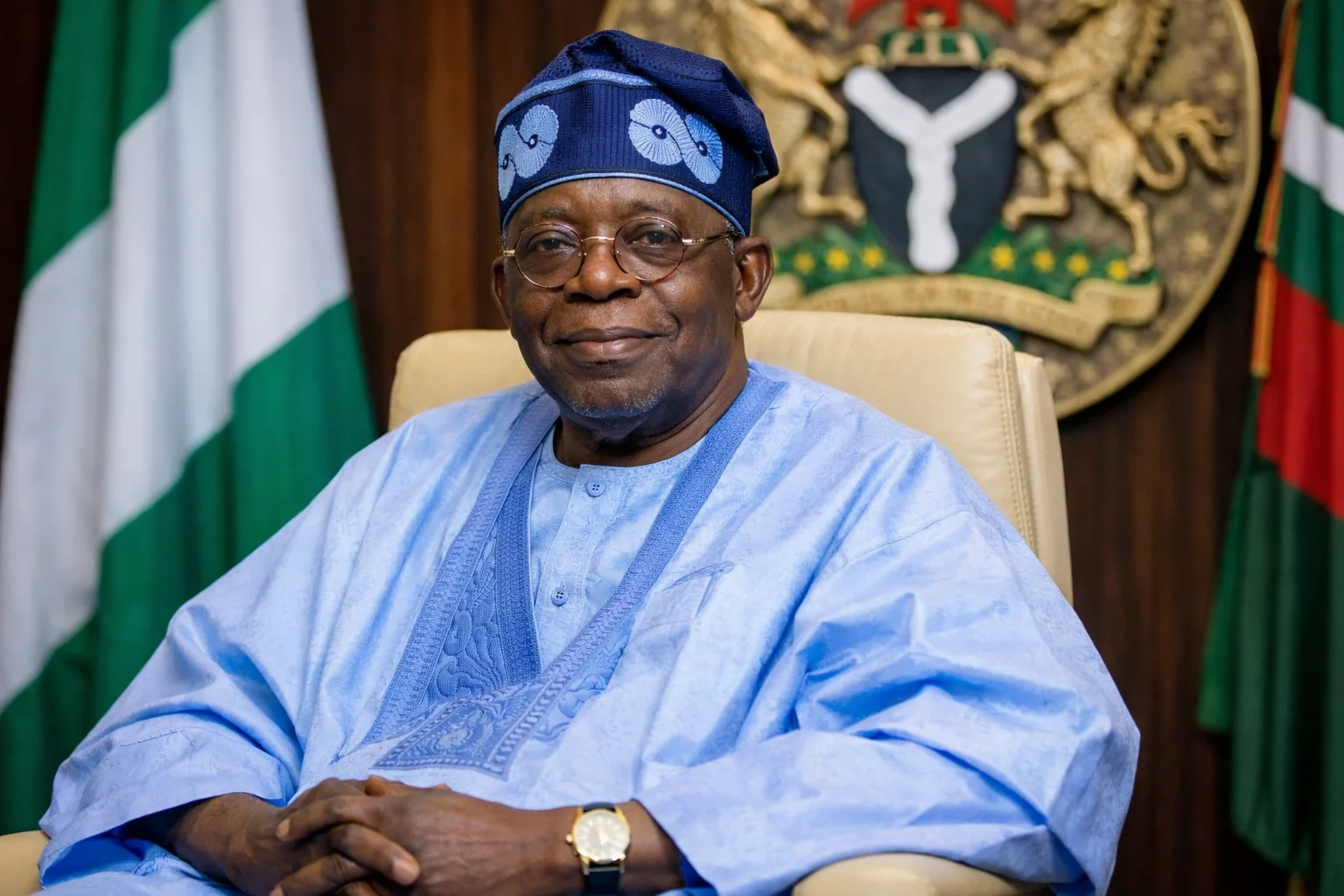
Bola Ahmed Adekunle Tinubu is a politician. Since 29 May 2023, he has been the President of Nigeria, making him the 16th president. Before this, he was once the Governor of Lagos State for eight years and, before that, a Senator who represented Lagos West.
Bola Ahmed Tinubu Family and Where He Came From
Tinubu was born in Lagos. He comes from the Yoruba ethnic group and is a Muslim.
Bola Tinubu’s mother was Abibatu Mogaji, a very famous and powerful market trader in Lagos. She became the Ìyálọ́jà of Lagos, making her the top leader of the market women, and she was a very respected figure in her community. She was born in 1916 and passed away on 15 June 2013 at about 96 years old. Tinubu has said that he learned determination, hard work, and discipline from his mother.
His father, however, is much less clear. Some suggest names like Olumosa or Adeyemo Tinubu and say he may have left the family early.
Most reliable records indicate that Bola Ahmed Tinubu was born in 1952, but some of his political opponents claim his age is different. Some sources claim that his exact age has never been fully verified.
His Education Life
As a child, Tinubu went to St John’s Primary School in Aroloya, Lagos, and later to Children Home School in Ibadan.
When he was older, in 1975, he travelled to the United States to study. He first went to Richard J. Daley College in Chicago, then moved to Chicago State University, where he studied accounting and management.
Life was not easy for him there. To pay for school, he worked as a dishwasher, a night security guard, and a taxi driver. He studied very hard and did very well. He made the Dean’s Honour List, became president of the accounting society, and even helped teach other students who were struggling. In 1979, he finished school with a Bachelor of Science degree, graduating summa cum laude, with a GPA of 3.54, which is very high.
Early Work Life
After university, Tinubu worked as an accountant in the United States for big companies like Arthur Andersen, Deloitte, and GTE Services Corporation. At Deloitte, he gained experience in auditing and management consultancy for Fortune 500 companies.
He later worked as a consultant for National Oil, a Saudi Aramco joint venture partner. There, he helped build proper accounting and auditing systems, which brought him his first big financial success.
Later, he moved to London and worked for Mobil Oil UK, before returning to Nigeria in the 1980s to work for Mobil Producing Nigeria Unlimited, now called Seplat Energy. He became a senior executive and treasurer.
While working, he also helped his community in Lagos and led a group called Primrose Group, which pushed for political change during the military government of Ibrahim Babangida. Eventually, he left his good-paying job to go into politics full time.
How He Entered Politics
Tinubu joined politics in 1991 by joining the Social Democratic Party. He supported Moshood Kashimawo Abiola, who wanted to be president.
In 1992, Tinubu was elected as a Senator for Lagos West. In the Senate, he led important committees that dealt with Banking, Finance, Appropriation and Currency.
But in 1993, the military annulled the presidential election that Abiola had won. Tinubu then helped form NADECO, a group that fought for democracy and wanted Abiola recognised as president.
Exile and Fighting for Democracy
When General Sani Abacha took power, Tinubu was arrested, harassed, and threatened many times. In 1994, he escaped Nigeria to save his life. From abroad, he continued fighting for democracy with NADECO.
He returned to Nigeria in 1998, after Abacha died, which paved the way for the country to return to civilian rule.
Governor of Lagos State
Before the 1999 elections, Tinubu was supported by leaders of the Alliance for Democracy, especially Abraham Adesanya and Ayo Adebanjo. He won his party’s primaries and became the Governor of Lagos State in January 1999.
He ruled from 29 May 1999 to 29 May 2007, serving two terms. His deputies at different times were Kofoworola Bucknor, Femi Pedro, and Abiodun Ogunleye. He took over from Buba Marwa and later handed power to Babatunde Fashola.
During his time, most south-west states fell under the ruling People’s Democratic Party, but Tinubu remained the only governor from his party to survive. He fought many battles with the federal government, especially after creating 37 new Local Council Development Areas. The federal government stopped Lagos’ funds, but the Supreme Court later ruled in his favour.
He built many roads and infrastructure projects to support Lagos’s fast growth. He won many awards, including Best Governor in Nigeria, Best Practices Prize, and Best Computerised Government Award. Abia State University gave him an honorary Doctor of Law degree. He also received many traditional titles and supported many organisations.
He won re-election in 2003 with Femi Pedro as deputy. Later, he had serious political fights with PDP leaders like Adeseye Ogunlewe and Bode George.
In 2006, Tinubu tried to convince Atiku Abubakar to become the leader of his party and run for president with Tinubu as vice president. Atiku refused, later ran without Tinubu, and lost.
Tinubu and Femi Pedro later fell out. Pedro left the party while still the deputy governor. Tinubu finished his term in 2007, and Babatunde Fashola became governor.
Building Opposition Power
After leaving office, Tinubu worked hard to unite opposition parties against the ruling PDP. In 2009, reports said there was a plan to kill him.
In 2011, he supported Nuhu Ribadu and Fola Adeola for president and vice president. There were reports that Tinubu made secret political deals with the Jonathan government over legal issues linked to his school records, which he denied and challenged in court.
Creating the APC and Buhari Years
In 2013, Tinubu helped merge several parties to form the All Progressives Congress (APC). In 2014, he supported Muhammadu Buhari for president and stepped aside for Yemi Osinbajo to be vice president.
And in 2015, Buhari won, ending 16 years of PDP rule, the first time an opposition party defeated a sitting president. Tinubu stayed very powerful in government and supported Buhari again in 2019. In 2020, party troubles, including removing APC chairman Adams Oshiomole, were seen as attempts to weaken Tinubu’s future presidential ambition.
Becoming President
Tinubu announced he wanted to be president on 10 January 2022. On 8 June 2022, he won the APC primary election.
On 1 March 2023, Nigeria’s election body, the Independent National Electoral Commission (INEC), declared him president-elect, after he won with 8,794,726 votes. The election was marred with violence, vote buying, delays, and accusations of fraud. His opponents rejected the result and went to court.
Bola Ahmed Tinubu Presidency
Tinubu became president on 29 May 2023. He was sworn in by the Chief Justice. He received Nigeria’s highest honour, GCFR. His vice president, Kashim Shettima, also received a national honour.
Big Decisions
On his first day, he removed fuel subsidies, which made fuel prices jump and caused protests. Labour unions threatened strikes. The policy saved Nigeria about 10 billion dollars a year and was praised by the World Bank.
He suspended Central Bank Governor Godwin Emefiele, who was later arrested. The Naira was allowed to fall freely. These reforms were described as the most radical since the 1986 Structural Adjustment Programme.
He created the National Economic Council, led by Shettima, with Wale Edun playing a key role.
Security and Government
He appointed George Akume and Femi Gbajabiamila to top positions, suspended EFCC boss Abdulrasheed Bawa, and appointed Nuhu Ribadu as National Security Adviser. He retired over 150 senior military officers, putting security under stronger civilian control.
Foreign Affairs and Later Events
He travelled to Paris, London, and the G20 summit in India, meeting world leaders. In 2024, appointing his son-in-law, Oyetunde Ojo, caused nepotism accusations. He restored Nigeria’s old anthem and declared emergency rule in Rivers State, which many said was unconstitutional.
In 2025, coup plots were uncovered, arrests were made, and military leaders were changed. Tinubu rejected accusations from US President Donald Trump and approved regional and US military actions against Islamic State targets in Nigeria.
His Beliefs
Tinubu believes in progressive ideas, fairness, justice, freedom, and helping people through government action. His economic ideas are called Tinubunomics and are meant to be different from past governments. He wrote about these ideas in a book with Brian Browne.
His Image and Controversies
He is often called the Godfather of Lagos. A documentary called The Lion of Bourdillon talked about his power. He sued, and it stopped airing.
Tinubu has faced many allegations, including a 1993 US case where he lost 460,000 dollars in a settlement. He denies wrongdoing. Other investigations were later dropped or left unresolved.
His Personal Life
Bola Tinubu is married to Oluremi Tinubu, usually called Remi. They have been married since 1987. Remi Tinubu is the First Lady of Nigeria and was also the First Lady of Lagos State when her husband was governor. She is both a politician and a pastor. For many years, she was a senator representing Lagos Central. She is a Christian, while Bola Tinubu is a Muslim.
Bola Tinubu has six children in total. Three of them are with his wife, Remi, and three were born before he married her. One of his children has died, so five are still alive.
With Remi Tinubu, he has three children. One is a daughter called Zainab Abisola Tinubu. She likes to live quietly and does not share much about her work or life with the public. Another daughter is called Habibat Tinubu. She went to a famous music school in the United States called Berklee College of Music because she studied music. She also keeps her life private. Their son is called Olayinka Tinubu. Not much is known about what he does because he also stays out of the public eye.
Before marrying Remi, Tinubu had three children with other women. His first son, Olajide Tinubu, known as Jide, was born in 1974, studied law in the United Kingdom, worked as a lawyer in London, and died in 2017. Tinubu’s daughter, Folashade Tinubu-Ojo, born in 1976, studied business in London and is a well-known businesswoman and market leader in Lagos, where she has served as Iyaloja-General. His youngest son from this period, Oluwaseyi Tinubu, called Seyi, was born in 1985, studied law in the UK, qualified as a lawyer, and later became an entrepreneur. He runs an advertising company, leads a job-creation charity, and lives in Nigeria with his family.
Bola Ahmed Tinubu Net Worth
Bola Tinubu is really, really rich—he’s worth about $8.4 billion. He started by working as an accountant in the United States and made a lot of money from big jobs and bonuses, including one worth $850,000.
Bola Ahmed Tinubu invested heavily in lands and buildings in fancy parts of Lagos, like big estates, commercial buildings, malls, and waterfront properties.
He also has media businesses, like TVC, Radio Continental, and The Nation newspaper, and invests in things like toll roads through the Lekki Concession Company, oil and gas companies like Oando Plc, and trading ventures he ran in his early career, including rice and chemicals.
Being governor and now president has helped him get even richer because of all his connections. He also owns luxury items like a private jet, fancy cars, and several expensive homes.
Bola Ahmed Tinubu holds Nigeria’s highest honour, GCFR. He is also the Asiwaju of Lagos and the Jagaba of Borgu.