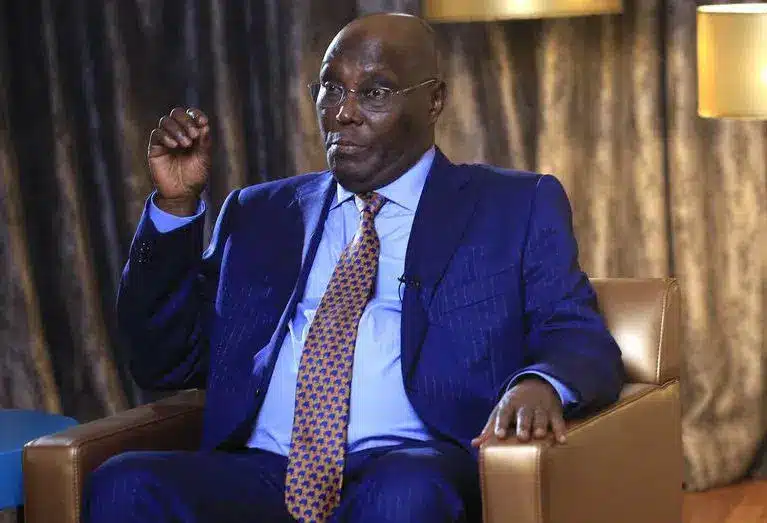
Former Vice-President Atiku Abubakar has hit back at President Bola Tinubu over petrol prices, subsidy funds, student loans and the government’s economic reforms.
Atiku’s Senior Special Assistant on Public Communication, Phrank Shaibu, issued the response on Tuesday, September 1, after Tinubu said Nigeria’s economy had stabilised and was moving towards stronger growth.
Tinubu had welcomed the National Bureau of Statistics’ second-quarter GDP report, which put economic growth at 4.43 per cent, compared with 4.23 per cent in the same quarter of 2025.
The President said his administration had taken difficult decisions to stabilise the economy and promised measures to ease pressure on vulnerable Nigerians.
“In the next few weeks, we are addressing some of the challenges being faced by our vulnerable population by providing cheaper means of transport, ramping up food production and implementing various relief programmes that will touch lives at the grassroots,” Tinubu said.
He also pointed to higher oil and gas production, foreign reserves, improved credit ratings, infrastructure projects and NELFUND student loans.
Tinubu said the reforms were beginning to produce results and promised that economic growth would reach households.
“Under our watch, the economy is on the irreversible path to experience even more growth that all homes will feel at the dining table and in their pockets,” he said.
Shaibu questioned the timing of the promised relief measures.
“Why did Nigerians have to suffer for more than three years before your government discovered that economic growth must reach ‘the dining table and the pocket’?” he asked.
He also challenged the government over petrol prices, arguing that Nigerians faced higher pump prices despite Nigeria’s status as an oil-producing country.
Petrol sold for about ₦1,310 to ₦1,400 per litre in several Nigerian markets as of August 31. Some NNPCL stations in Abuja sold at ₦1,345 per litre, while prices in Lagos and Ogun stood at about ₦1,310.
Shaibu compared Nigeria’s petrol price with prices in other oil-producing countries.
GlobalPetrolPrices listed August 31 retail petrol prices at US$0.024 per litre in Libya, US$0.327 in Angola, US$0.34 in Kuwait, US$0.35 in Algeria and US$0.621 in Saudi Arabia.
At an exchange rate of about ₦1,332.44 to the dollar on August 31, those prices amounted to roughly ₦32 in Libya, ₦436 in Angola, ₦453 in Kuwait, ₦466 in Algeria and ₦827 in Saudi Arabia.
Shaibu also questioned the cost of petrol for low-income workers after the Federal Government raised the national minimum wage to ₦70,000 in 2024.
At ₦1,400 per litre, 40 litres of petrol costs ₦56,000, leaving ₦14,000 from a ₦70,000 monthly wage.
Atiku’s camp also renewed its call for targeted support for domestic refineries.
His proposed petroleum policy would provide qualifying refineries with preferential access to Nigerian crude, while linking the support to production, domestic supply, pricing and volume conditions.
The proposal also calls for a fiscal limit, independent audits and tracking of crude supplied to participating refineries.
The Presidency has rejected Atiku’s proposal to restore targeted petrol subsidy, arguing that subsidy removal reduced the government’s fiscal burden and supported investment in domestic refining.
Shaibu further challenged the government’s claim that subsidy removal mobilised ₦15.8 trillion between June 2023 and December 2025.
The Federal Government has said the ₦15.8 trillion represented additional resources mobilised for the Federation rather than money held in a single government account.
The Federal Government received about ₦5.43 trillion, while states received ₦6.52 trillion and local governments received ₦3.88 trillion.
Shaibu also demanded a reconciliation of Federation Account figures involving nearly ₦30 trillion.
Atiku’s camp has cited differences between amounts available for distribution and amounts distributed through the Federation Account.
For January 2024, it cited ₦2.068 trillion available against ₦1.149 trillion distributed.
For June 2025, it cited ₦4.232 trillion available against ₦1.818 trillion distributed.
For June 2026, it cited ₦4.501 trillion available against ₦2.551 trillion distributed.
The figures do not establish that ₦30 trillion is missing because Federation Account calculations include deductions and other adjustments. Atiku’s camp has asked the government to reconcile the entries.
Shaibu also demanded details of import-duty exemptions after the Comptroller-General of the Nigeria Customs Service, Adewale Adeniyi, told the Senate Committee on Finance that Import Duty Exemption Certificate approvals covered imports worth about ₦34 trillion in 2025.
The ₦34 trillion refers to the value of imports covered by the exemptions, rather than ₦34 trillion in Customs revenue forgone.
Military hardware accounted for about 60 per cent of the exemption value, while other categories included healthcare supplies, manufacturing inputs, food commodities and compressed natural gas vehicles.
The Atiku camp also challenged Tinubu’s reference to NELFUND as an education intervention.
NELFUND provides interest-free loans for approved institutional charges and upkeep. Under the current repayment system, employed beneficiaries repay through salary deductions, while repayment starts two years after completion of the National Youth Service Corps programme.
Atiku has proposed a review of the scheme, lower education costs and debt forgiveness for qualifying student-loan beneficiaries.
“The good news for Nigerian students is that Atiku has reviewed the current student-loan policy,” Shaibu said.
“His approach will reduce the underlying cost of education and, after review, provide forgiveness for qualifying student debts so that young Nigerians can graduate with hope rather than repayment burdens.”
He added: “Education should open doors, not mortgage the future.”
Shaibu ended his response with a direct warning to Tinubu.
“Whenever you misrepresent Atiku’s proposals, Bola, I will answer the record,” he said.
“You chose not to name Atiku. That is your prerogative. Atiku chose to stand with the people. That is a commitment. And that, Bola, is precisely why you cannot stop responding to him.”