Article Was Last Updated August 26, 2026
Peter Gregory Obi is a Nigerian businessman and politician who has served as Governor of Anambra State and has played a prominent role in national elections and economic discourse. This biography, published with coverage from First Nigerian, examines his early life, education, business and political careers, his role in Nigeria’s Labour Party, and the 2023 presidential election results.
It also covers the Obidient movement, net worth, investments, family life, wife and children, Pandora Papers reports, and his views on Nigeria’s economy, including his criticism of Tinubu and wider issues in Nigerian politics and democracy.
Peter Obi Biography
Peter Obi was born on July 19, 1961, in Onitsha, Anambra State, Nigeria, into a Christian family from the town of Agulu.
For his secondary education, he attended Christ the King College in Onitsha and got his West African Examinations Council certificate.
In 1980, he attended the University of Nigeria in Nsukka, where he studied Philosophy and graduated in 1984.
Later, he studied at several business schools, including Lagos Business School, the International Institute for Management Development in Switzerland, Harvard Business School, Saïd Business School in England, Cambridge Judge Business School, and the Kellogg School of Management.
Banking Career and Entry into Politics
After finishing school, Obi worked as a banker before moving fully into politics. He ran for the position of Governor of Anambra State in 2003 under the All Progressives Grand Alliance (APGA), but initially lost to Chris Ngige.
However, in 2006, the court annulled Ngige’s victory and declared Obi the winner of the 2003 election. Obi started his first tenure as governor on March 17, 2006, taking over from Chris Ngige.
Impeachment and Reinstatement
On November 2, 2006, the Anambra State assembly impeached Obi, accusing him of “gross misconduct.” They removed him from office and replaced him with his deputy, Virginia Etiaba, who became Nigeria’s first female governor.
Obi challenged the impeachment in court and refused to participate in the 2007 state gubernatorial election. A court in southeastern Nigeria ruled on the case, and authorities reinstated him as governor on 9 February 2007.
Second Tenure as Governor
Obi won re-election for a second term on 7 February 2010 and remained in office until 17 March 2014, when Willie Obiano took over as governor.
After the 2015 general election, President Goodluck Jonathan appointed him as chairman of the Nigerian Security and Exchange Commission (SEC).
Vice-Presidential Ambition
In 2019, Obi sought the vice-presidential nomination under the Peoples Democratic Party with presidential candidate Atiku Abubakar, but they lost to the incumbent president, Muhammadu Buhari of the All Progressives Congress (APC).
2023 Presidential Campaign
In 2022, Obi declared his intention to run for president, initially under the PDP, but later switched to the Labour Party because of complaints about bribery and vote buying during the PDP’s primaries.
During the Labour Party primary, Patrick Utomi gave up his presidential ticket so Obi could run. On July 8, 2022, Obi announced Yusuf Datti Baba-Ahmed as his running mate for the 2023 election.
His campaign drew large support, especially from young people, who became known as “Obidients.”
The Independent National Electoral Commission announced the results of the presidential election on 1 March 2023. Bola Tinubu of APC won with 8.79 million votes. Obi came in third with 6.1 million votes but won in Lagos and Abuja.
Due to allegations of voter manipulation and rigging, Obi said he would challenge the election results.
Political Defection and 2027 Ambitions
Later, on December 31, 2025, Obi left the Labour Party and joined the African Democratic Congress (ADC), saying it was for patriotism and national interest.
The defection event took place at Nike Lake Resort in Enugu, where Senators Enyinnaya Abaribe, Victor Umeh, Tony Nwoye, and Gilbert Nnaji attended.
Some critics, like ADC adviser Bayo Onanuga and Labour Party chairman Julius Abure, spoke negatively about the move.
Obi’s former running mate in Labour Party, Datti Baba-Ahmed, announced on January 7, 2026, that he would run for president in 2027 and criticised Obi for leaving Labour Party.
Views on National Issues
Obi has often expressed opinions on national issues. On March 13, 2025, he criticised President Tinubu’s economic policies, saying the naira had fallen from 400 to 1,500 per dollar, rice prices went from 40,000 naira to 100,000 naira, and fuel went from 300 naira to 1,000 naira. He compared Nigeria to Indonesia, noting how the latter’s GDP and per capita income had grown while Nigeria’s decreased.
On January 7, 2026, Obi criticised Tinubu for cancelling about 8 trillion naira of NNPC debt, calling it financial recklessness. On January 4, 2026, after a terrorist attack in Kasuwan Daji Market in Niger State, which reportedly killed 30-50 people and involved kidnappings, Obi called Nigeria “a National Shame.”
And on January 14, 2026, he criticised the Edo State government for arresting 52 students from Ambrose Alli University who protested insecurity, calling the arrests “unacceptable and dangerous for democracy.” Later that day, the police released the students.
Obi has also spoken on taxation, criticising Tinubu’s 2024 tax policy, arguing that raising government revenue while citizens get poorer contradicts good governance. On the same day, January 14, 2026, he highlighted 31 critical problems in Nigeria’s tax laws identified by KPMG.
Advocacy for Education
Education is another priority for Obi. On July 4, 2025, he donated 10 million naira to St. John Vianney Science College in Ukwulu for winning the UK-Nigeria Debate Championship.
He spoke at the NAPPS International Conference and received the NAPPS National Role Model Award. On May 25, 2025, he urged Northern Nigeria to invest in education to fight poverty.
On December 6, 2025, he visited California State University, Sacramento, to observe programs for foster children and formerly incarcerated individuals. He also visited Nigerian correctional centres in Onitsha, pledging to pay NECO exam fees for 148 inmates.
Controversies
Obi has been involved in controversies. The Pandora Papers revealed that in the 1990s, he had offshore companies in tax havens such as Beauchamp Investments Limited in Barbados and Next International (UK) Limited.
In 2010, he set up Gabriella Investments Limited in the British Virgin Islands, named after his daughter, and reorganised it in 2017 as PMGG Investments Limited, creating a trust called The Gabriella Settlement. He claimed he resigned from all companies before taking office and that the money came from his business career.
In October 2021, the Economic and Financial Crimes Commission (EFCC) invited him for questioning. In April 2023, a leaked audio recording allegedly showed Obi describing the 2023 election as a “religious war.” He denied the claim on 5 April 2023, said the audio was fake, and threatened legal action.
Peter Obi Family
Obi married Margaret Brownson Usen in 1992, and they have two children: a daughter and a son.
Peter Obi Wife
The couple have remained married for over 30 years. People often describe her as a private and supportive spouse who has stood by him throughout his business and political career.
He has publicly appreciated his wife on several occasions, especially during birthdays and family events, where he highlights her support and role in holding the family together.
Peter Obi Children
Peter Obi and his wife have two children:
- Gabriella Nwamaka Frances Obi (daughter)
- Gregory Peter Oseloka Obi (son)
Gabriella Obi
Gabriella is their first child. She married in April 2022 in a traditional wedding ceremony. Her husband, Chukwuma Okeke-Ojiudu, has links to Chicago in the United States.
Gregory Obi
Gregory is the couple’s only son. He studied Philosophy at the University of Bristol in the United Kingdom. Most verified information about him relates to his education and family background.
Peter Obi Net Worth
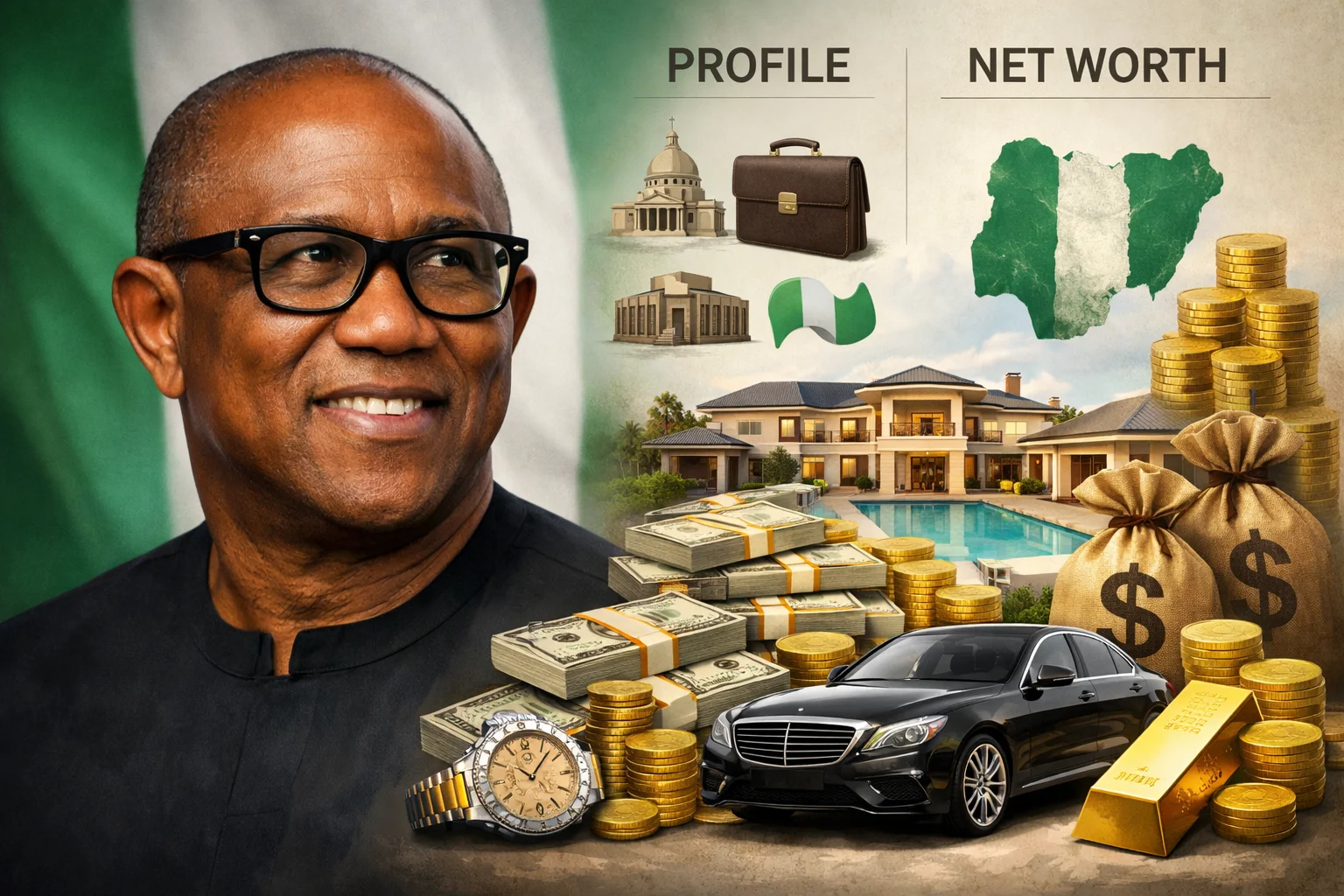
Experts estimate Peter Obi’s net worth in 2026 at between $10 million and $58 million (about ₦15 billion to ₦86 billion). No official record confirms the exact figure, so sources report different values.
Peter Obi made most of his money before becoming a politician. He bought and sold goods and built a successful business called Next International Nigeria Ltd. The company imported and sold products in Nigeria and grew into a very successful business.
He also served on the boards of some banks and financial companies, including:
- Fidelity Bank
- Guardian Express Mortgage Bank
These roles paid him board fees and may have included shares or other benefits.
Peter Obi owns properties in different places, such as:
- Lagos
- Abuja
- Onitsha
- London (bought in the 1990s)
These buildings and houses are an important part of his wealth.
Some reports say he has investments and accounts outside Nigeria, especially in the UK.
As governor, he received a salary and allowances. This income is much smaller than his business earnings, but it still contributes to his total net worth.