Article Was Last Updated August 26, 2026
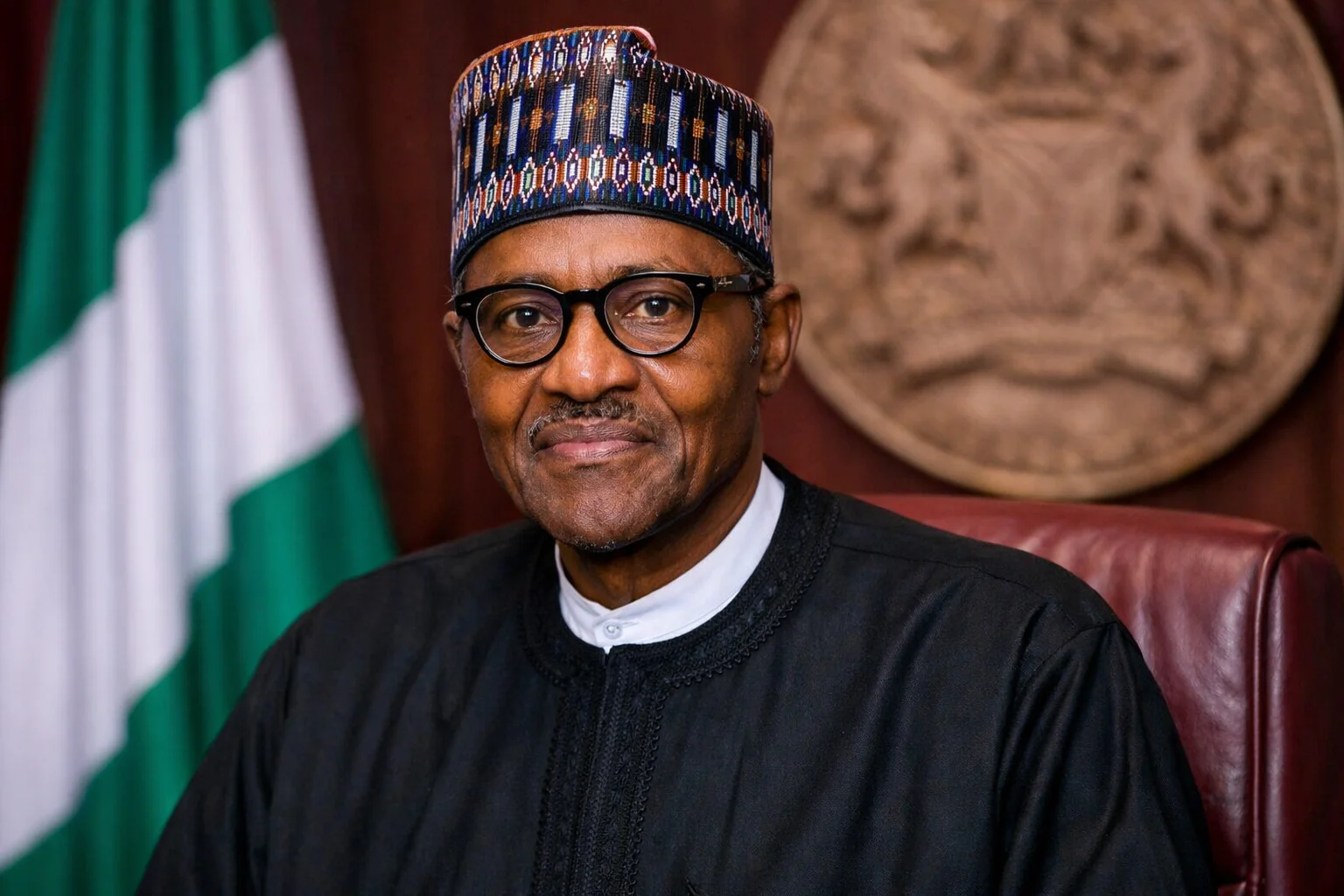
Muhammadu Buhari was a Nigerian military leader and president from 2015 to 2023. This biography covers his early life, military service, presidency, personal life, net worth, and death in 2025.
Muhammadu Buhari Biography
Muhammadu Buhari was born on 17th December 1942, in Daura, which was formerly in the Northern Region of British Nigeria.
He was the twenty-third child of his father, Mallam Hardo Adamu, a Fulani chieftain from Dumurkul in Mai’Adua, and his mother, Zulaihat, who belongs to the Hausa and Kanuri tribes.
His parents named him after Muhammad al-Bukhari, a well-known Islamic scholar from the ninth century. His great-grandfather, Yusuf, was a village chieftain who established Daura’s settlements, including Dumurkul.
Early Life and Education
Buhari’s father died when he was four years old.
After this, Waziri Alhassan, who was the son of the Emir of Daura, Musa dan Nuhu, took responsibility for Buhari’s mother and her six children, including Buhari.
As a child, Muhammadu Buhari went to Qur’anic school and also assisted in cattle rearing.
He obtained his primary education in Daura and Mai’Adua and completed it in 1953. From 1956 to 1961, he was a student of Katsina Middle School, later renamed Katsina Provincial Secondary School.
In his final year, he became both house captain and head boy. In 1960, he won a scholarship from Elder Dempster Lines, which allowed him to travel to the United Kingdom for the summer.
Buhari had intended to study medicine. However, due to a lack of opportunities for study in that area, he decided to follow the advice of his nephew, Mamman Daura, and join the Nigerian military.
Military Career
Entry into the Nigerian Army (1962–1966)
In the year 1962, at the age of 19, the Nigerian Military Training College selected Buhari as one of the 70 recruits for training.
Between 1962 and 1963, he received his training at the Mons Officer Cadet School in Aldershot, England. In January 1963, at the age of 20, he received his commission as a second lieutenant and became the Platoon Commander of the Second Infantry Battalion at Abeokuta.
Later, from November 1963 to January 1964, he attended the Platoon Commanders’ Course in Kaduna to learn more about leading a platoon.
In 1964, he went back to the United Kingdom to attend the Army Mechanical Transport School in Borden, where he learned about army vehicles and transport.
From 1965 to 1967, Buhari was the Commander of the Second Infantry Battalion and also served as Brigade Major of the Second Sector of the First Infantry Division, helping to plan and run larger army operations.
After the military coup of January 1966, which saw the death of Northern Premier Ahmadu Bello, Buhari took part in the counter-coup of July 1966, which overthrew General Aguiyi Ironsi and made General Yakubu Gowon the Head of State.
Nigerian Civil War (1967–1970)
During the Nigerian Civil War, Buhari was posted to the 1st Division under Lieutenant Colonel Mohammed Shuwa.
He worked as an adjutant and company commander in the Second Battalion, which took part in early fighting around Gakem, Ogoja and Afikpo.
For a short period, he commanded the battalion before the army reassigned him as Brigade Major of the 3rd Infantry Brigade in Nsukka.
As the war progressed and the army moved away from fast advances to securing supply routes, Buhari became involved in training and stabilisation duties.
In 1968, the army transferred him to the 4 Sector, also called the Awka Sector, which covered operations in Awka, Abagana and Onitsha. His unit suffered heavy losses while trying to cut off Biafran food supply routes near the Oji River and Abagana.
Post-War Military Career and Rise to National Office (1970–1979)
After the war ended, Muhammadu Buhari served as Brigade Major and Commandant of the 31st Infantry Brigade from 1970 to 1971.
He then became Assistant Adjutant-General at the headquarters of the First Infantry Division, a role he held until 1972. In 1973, he attended the Defence Services Staff College in Wellington, India.
From 1974 to 1975, he worked as Acting Director of Transport and Supply at the Nigerian Army Corps of Supply and Transport.
After the 1975 coup that brought General Murtala Mohammed to power, the new government appointed Buhari as Governor of the North-Eastern State on 1 August 1975.
When the state split in February 1976, he became the first Governor of the newly created Borno State, serving until 15 March 1976.
Then, in March 1976, after the assassination of Murtala Mohammed, Olusegun Obasanjo made Buhari a federal Commissioner for Petroleum and Natural Resources.
In 1977, he became the head of Nigeria’s National Petroleum Corporation. Nigeria made a lot of investments in its oil infrastructure, such as Bonny, Port Harcourt, Warri, and Kaduna, during this time.
Later, allegations surfaced that US$2.8 billion was missing from NNPC accounts held in the United Kingdom. A tribunal led by Justice Ayo Irikefe found no proof that anyone had stolen the money, although it criticised weaknesses in accounting practices.
He was the Military Secretary at the Army Headquarters and a member of the Supreme Military Council between 1978 and 1979. He attended the US Army War College in Carlisle, Pennsylvania, between 1979 and 1980 and graduated with a master’s degree in Strategic Studies.
Senior Command and the Chadian–Nigerian Conflict (1980–1983)
Between 1980 and 1983, Buhari occupied several senior command positions. He became the General Officer Commanding the 4th Infantry Division, then the 2nd Mechanised Infantry Division, as well as the 3rd Armoured Division stationed in Jos.
Later in 1983, when the Chadian army moved into Borno State, Buhari led the Nigerian army into Chad, contrary to a directive to withdraw. This resulted in the capture of some soldiers.
Military Coup and Head of State (1983–1985)
In December 1983, Buhari joined other senior officers in the coup that overthrew President Shehu Shagari and brought an end to Nigeria’s Second Republic. Buhari became Head of State, while Tunde Idiagbon assumed the position of Chief of General Staff.
Muhammadu Buhari said military rule was necessary because of widespread corruption, a failing economy and declining moral standards.
His government set up a Supreme Military Council and introduced strict laws to enforce discipline, improve security and control the economy. Thousands of civil servants lost their jobs, and Buhari’s administration jailed many politicians and businessmen on corruption charges.
In March 1984, the government launched the War Against Indiscipline, which enforced public order through tough measures such as compulsory queuing and severe punishment for minor offences.
New laws allowed authorities to detain people without trial, restricted the press, and imposed harsh penalties for crimes such as drug trafficking, sometimes applying these laws to actions people committed before the government introduced them.
The government followed strict economic policies focused on cutting spending, reducing imports and rejecting currency devaluation proposed by the International Monetary Fund.
Inflation increased, industries struggled due to shortages, and public dissatisfaction grew. Major controversies included the failed attempt to kidnap former minister Umaru Dikko in London, the “53 suitcases” customs scandal, and strong criticism over human rights abuses.
On 27 August 1985, General Ibrahim Babangida led a palace coup that removed Buhari from power and detained him until 1988.
Political Career
Muhammadu Buhari spent three years under house arrest in Benin City. After his release, he returned to Daura, divorced his first wife, Safinatu Yusuf, and later married Aisha Halilu.
Under General Sani Abacha, he became chairman of the Petroleum Trust Fund, where people praised him for running the organisation transparently, although some critics questioned how officials used military funds.
Later, he participated in democratic politics and ran for president in 2003 and 2007 under the All Nigeria Peoples Party. In 2011, he ran for president under Congress for Progressive Change. His campaign included fighting corruption and restoring discipline. The 2011 election triggered rioting in various parts of Nigeria.
Presidency of Nigeria (2015–2023)
Buhari contested the 2015 presidential election under the All Progressives Congress party’s ticket and defeated the incumbent president, Goodluck Jonathan.
This was the first time an incumbent Nigerian president lost an election. He assumed office on the 29th of May 2015 and won re-election for a second term in 2019.
As president, he focused on tackling corruption, improving security and supporting social welfare.
His administration went after high-level corruption offenders, developed a whistleblowing policy, and established the National Social Investment Programme. This program includes N-Power, cash transfer, small business loans, and a school feeding program.
In 2016, Nigeria went into a recession due to a sudden reduction in the price of oil. However, the economy gradually recovered but grew slowly with a large increase in unemployment.
There were challenges related to security, such as clashes between herdsmen and farmers, banditry, the Boko Haram insurgents, secessionist groups in the south-east region of the country, as well as police misconduct that culminated in the #EndSARS protests in 2020.
Regular health visits to London marked his presidency and significantly affected governance.
Post-Presidency and Death (2023–2025)
Muhammadu Buhari handed over power peacefully to Bola Tinubu on 29 May 2023 and returned to live in Daura. In 2025, he travelled to London for treatment for a long-term illness. He died there on 13 July 2025 at the age of 82.
His body was returned to Nigeria and buried in Daura with full state honours. Many tributes acknowledged his influence on Nigeria’s military and democratic history.
Personal Life, Assets and Honours
Buhari married Safinatu Yusuf in 1971; they had five children and divorced in 1988. Safinatu died from diabetes complications in 2006, and their first daughter died of sickle cell anaemia in 2012, two days after giving birth.
He married Aisha Halilu in 1989, and they also had five children. Their son Yusuf married Zahra Nasir Bayero, daughter of Emir Nasiru Ado Bayero, in 2021.
In 2015, Buhari declared US$150,000, five houses, two mud houses, farms, an orchard, a ranch with 270 cattle, 25 sheep, five horses, various birds, shares in three companies, two undeveloped plots, and two cars—all from his savings.
Muhammadu Buhari Honours
National (Nigeria):
- Grand Commander of the Order of the Federal Republic (GCFR) – 1983
Foreign honours:
- Benin: Grand Cross of the National Order of Benin – 2015
- Equatorial Guinea: Grand Collar of the Order of Independence – 2016
- Guinea-Bissau: Medal of Amílcar Cabral – 8 December 2022
- Liberia: Grand Cordon of the Order of the Pioneers of Liberia – 27 July 2019
- Niger: Grand Cross of the National Order of Niger – 17 March 2021
- Portugal: Grand Collar of the Order of Prince Henry – 30 June 2022
- Senegal: Grand Cross of the National Order of the Lion – 7 July 2022
- Serbia: Second Class of the Order of the Republic of Serbia – 2016
Traditional titles (Nigeria):
- 2017: Enyioma I of Ebonyi and Ochioha I of Igboland – given by the South-East council of traditional rulers
- Before 2017: Ogbuagu I of Igboland
- 2018: Ikeogu I of Igboland
Muhammadu Buhari Net Worth
When Buhari became president in 2015, he told the public what he owned because the law says leaders must declare their assets. He said he had about 150,000 dollars in cash, plus houses, farms, fruit trees, animals, land, shares in companies, and cars.
Looking at what people knew he owned and the money he could realistically have earned as president of Nigeria, experts believe his total net worth was probably between 20 and 30 million dollars.
Timeline of Buhari’s Life and Career
1942: Born in Daura, Katsina State, Nigeria
1963: Commissioned into the Nigerian Army
1983: Became Head of State following a military coup
1985: Removed from office after a military takeover
2015: Elected President of the Federal Republic of Nigeria
2023: Completed second presidential term and left office