
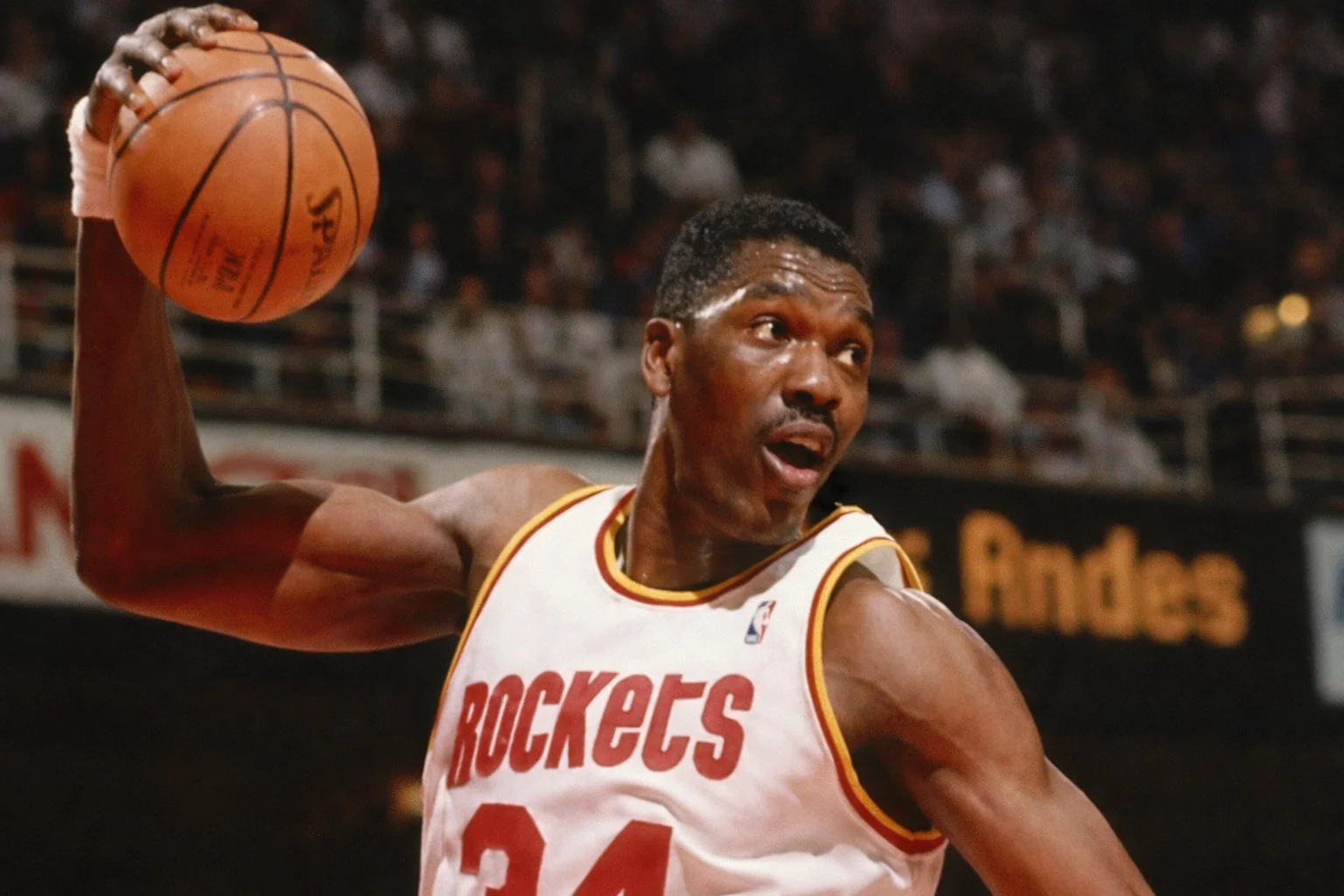
Hakeem Abdul Olajuwon was born on 21 January 1963 in Lagos, Nigeria, the third of eight children in a middle‑class family. He grew up in Lagos. He’s Yoruba and didn’t pick up basketball until he was 15 at Muslim Teachers College, having first played football and handball.
His faith as a devout Muslim was central to his life from early on. He practised Islam seriously, observed Ramadan even during NBA seasons, read the Qur’an regularly, and at one point changed the spelling of his first name from Akeem to Hakeem to match the Arabic form of the name.
Hakeem Olajuwon moved to the US to play for the University of Houston, then got drafted first overall in 1984. He became an NBA legend with the Houston Rockets, winning two championships and earning 12 All-Star selections, an MVP, and a spot in both the Naismith and FIBA Halls of Fame.
Now 63, Hakeem Olajuwon is remembered as one of basketball’s greatest.
Family Background and Early Life
Hakeem Olajuwon was born into a Yoruba Muslim family. He was the third of eight children.
Salim (also known as Salaam) Olajuwon was the father of Hakeem Abdul Olajuwon. As a working-class Yoruba Nigerian, he ran a cement business in Lagos with his wife, who supported the family.
Abike Olajuwon is Hakeem’s mother. She was involved in raising the children.
The Olajuwon family is of Yoruba ethnicity. Hakeem grew up in Lagos with Yoruba traditions and Islamic values.
Not all siblings are known. His brothers are Yemi Kaka Olajuwon, Akinola Olajuwon, Tajudeen Olajuwon and Afis Olajuwon. One sister, Kudirat Olajuwon, is known. Other siblings are rarely named.
Education
Hakeem Olajuwon attended Muslim Teachers College. At first, he played football as a goalkeeper and also did handball. Around the age of 15, a classmate convinced a coach to let him try basketball, giving him his first taste of organised play.
After being noticed for his height and potential, Olajuwon moved to the United States to study and play basketball at the University of Houston around 1980. He studied business-related subjects while working out for coach Guy Lewis. When he arrived in Houston, no one was there to meet him, so he took a taxi to campus.
He redshirted his freshman year because he couldn’t get NCAA clearance right away. The next season, he came off the bench as the sixth man and helped Houston reach the Final Four. That summer, he trained with NBA MVP Moses Malone, which improved his game dramatically.
By his sophomore year, he became a key player for the “Phi Slama Jama” team with Clyde Drexler, known for their dunking and fast style. The team reached the NCAA championship games in 1983 and 1984. Olajuwon was named Most Outstanding Player of the NCAA Final Four in 1983 and a first-team All-American in 1984.
Career
Entering the NBA
Hakeem Olajuwon entered the NBA in 1984 as the first overall pick by the Houston Rockets. That draft also had Michael Jordan, Charles Barkley, and John Stockton. He made an immediate impact, averaging over 20 points and nearly 12 rebounds a game. Teaming with Ralph Sampson as the “Twin Towers,” he helped turn the Rockets into a contender. By 1986, they were in the Finals, and Hakeem held his own against the Celtics.
In 1987, he nearly had a quintuple-double with 38 points, 17 rebounds, 12 blocks, 7 steals, and 6 assists. After Sampson was traded in 1988, Hakeem became the team’s clear leader. He dominated rebounds and blocks and even recorded a quadruple-double. Playoff wins didn’t always come, but his numbers kept piling up.
The mid-90s were his peak. In 1994, he won MVP, Defensive Player of the Year, and Finals MVP in the same season, leading the Rockets to their first title. He blocked John Starks’ shot in Game 6 and scored 25 points with 10 rebounds in Game 7. The next year, Houston swept the Magic, with Hakeem averaging 33 points in the playoffs and outplaying Shaq and David Robinson. His “Dream Shake” made him nearly unstoppable near the basket.
Later Career and Retirement
After the championships, the Rockets stayed competitive but couldn’t beat Jordan’s Bulls. In 2001, Hakeem was traded to Toronto for one final season before retiring in 2002. He left as the NBA’s all-time leader in blocked shots with 3,830 and one of the few with over 3,000 blocks and 2,000 steals.
Over 1,238 games, he averaged 21.8 points, 11.1 rebounds, and 3.1 blocks. He was a 12-time All-Star, 2-time Finals MVP, 2-time Defensive Player of the Year, and 1994 MVP. Hakeem became a U.S. citizen in 1993 and helped Team USA win Olympic gold in 1996. With his Dream Shake, defence, and all-around game, Hakeem Olajuwon remains one of the greatest in NBA history.
Awards & Records
Hakeem Olajuwon won it all in the NBA: two championships (1994, 1995) and two Finals MVPs. He was league MVP in 1994 and Defensive Player of the Year twice (1993, 1994). A 12-time All-Star, he made six All-NBA First Teams and nine more All-NBA selections. On defence, he earned five All-Defensive First Team nods and four Second Team nods. He led the league in rebounds twice and blocks three times.
His No. 34 is retired by the Rockets, and the Defensive Player of the Year trophy is now named after him. He made the NBA 50 Greatest Players list in 1996 and the 75th Anniversary Team.
Internationally, he won Olympic gold with Team USA in 1996. In college, he dominated at the University of Houston: two SWC titles, Final Four Most Outstanding Player in 1983, multiple All-American honours, SWC Player of the Year, NCAA rebounding leader, and his No. 34 retired by the Cougars.
Halls of Fame include Naismith (2008), FIBA (2016), Texas Sports (1998), and Houston Sports (2018). Media named him Sporting News NBA MVP in 1994 and to the 1990s All-Decade teams.
He holds NBA records for most career blocks (3,830), most blocks per playoff game (3.26), most blocks in a single playoff (92), and is the only player with 3,000+ blocks and 2,000+ steals. He’s also one of four players to record a quadruple-double and retired top eleven all-time in points, rebounds, blocks, and steals.
Rankings reflect his dominance: ESPN listed him #10 on their all-time NBA ranking, and SLAM Magazine placed him at number 12 in their 2018 top 100 greatest players.
Wife and Children
Hakeem Olajuwon’s oldest child is Abisola, born in 1987 from his college‑age relationship with Lita Spencer. She followed her dad into basketball, starred in high school, played at the University of Oklahoma, made it to the WNBA, and later moved into coaching. Hakeem married Dalia Asafi on August 8, 1996, in Houston. She was about 18, and he was 33. Their wedding was a private Islamic ceremony, and since then she’s mostly kept a low profile.
Hakeem and Dalia have four children together. Abdullah, the oldest son, played college basketball and for Jordan in the 2025 FIBA Asia Cup. Rahman, another son, also played for Jordan and in college. Aziz, another son, is a rising basketball player who’s going to Stanford and has been to international youth camps. Malik is the youngest and plays basketball in high school and at elite camps.
They also have two girls, Rahmah and Aisha.
Net Worth
Hakeem Olajuwon made most of his money during his 18-year NBA career, mainly with the Houston Rockets and finishing with the Toronto Raptors. He earned around 110 million dollars, peaking at 16.7 million in 2000–01. Winning two NBA championships and a Finals MVP boosted his profile.
He also earned from endorsements with Spalding, Etonic, and L.A. Gear, including a signature shoe line, though these were smaller than his salary.
After retiring, real estate became one of his sources of wealth. He bought commercial buildings, apartments, parking lots, and other properties around Houston. By 2006, he owned at least 25 properties worth over 100 million dollars, usually paying cash to avoid loans or interest due to his Islamic faith. Some of his properties include Houston’s old Federal Reserve Bank turned mosque, the World Trade Center property sold in 2000 for 8 million, and a 41-acre plot near NASA’s Johnson Space Center developed into a retirement community.
Hakeem also explored other ventures. He launched the DR34M brand of clothes and shoes, used the DR34M Mansion in Houston for events and retail, and runs Big Man Camps for professional and aspiring players. Some reports mention Olajuwon Farms LLC.
Mentoring and training camps provide steady income while letting him pass on his skills.
By 2026, all of this adds up to a net worth of about 300 million dollars, making him one of the richest former NBA players.