
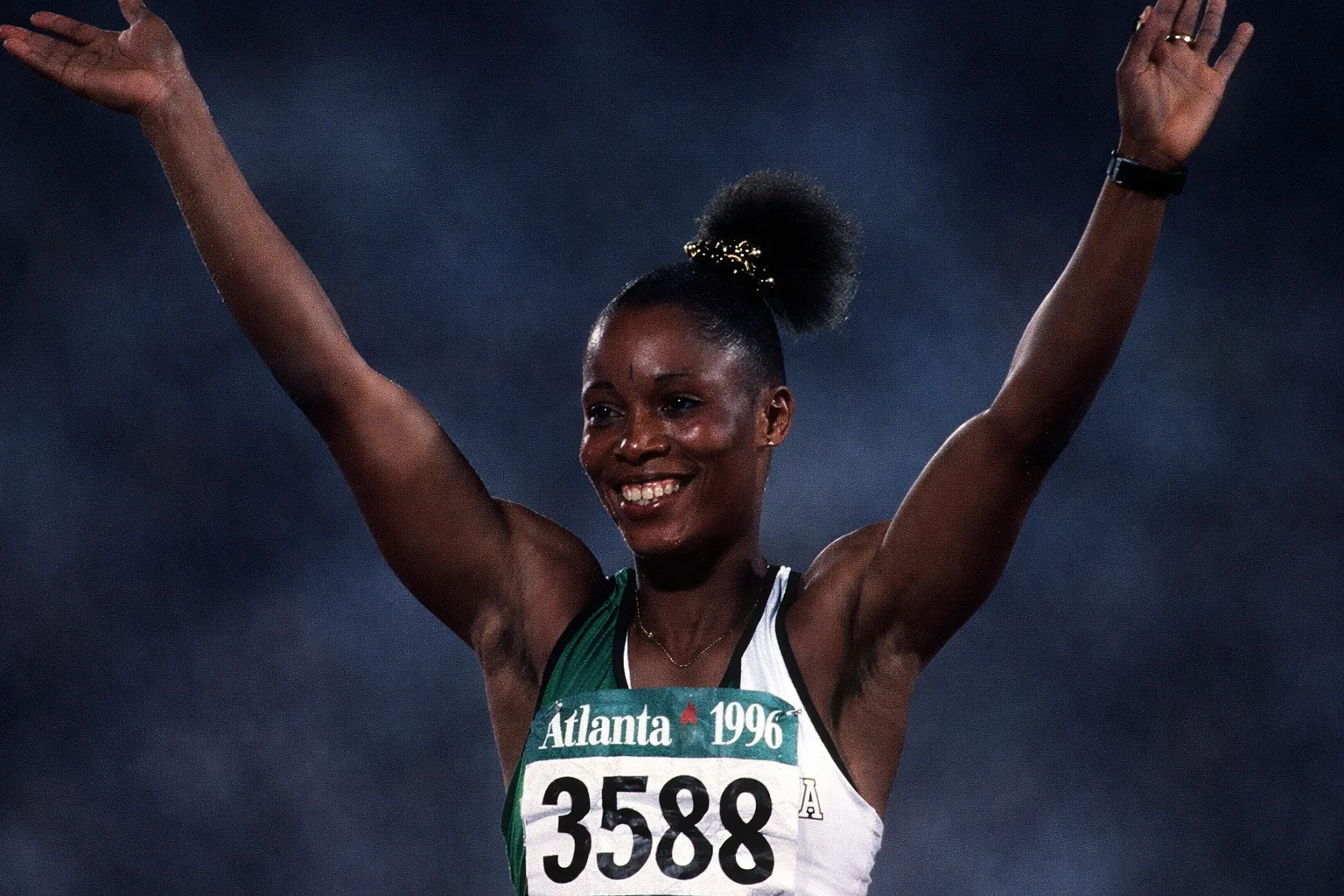
Chioma Ajunwa-Opara was born on 25 December 1970 in Umuihiokwu, Ahiazu-Mbaise, Imo State, Nigeria. She is Igbo and a Christian. As of 2026, she is 55 years old.
She grew up poor and got into sports at a young age despite financial struggles.
Chioma Ajunwa started as a footballer and played for Nigeria at the 1991 FIFA Women’s World Cup. She later switched to athletics, focusing on sprinting and the long jump.
In 1996, she won Olympic gold in the long jump in Atlanta with a 7.12-metre jump. She became the first Nigerian to win an individual Olympic gold medal and the first Black African woman to win gold in a field event.
After sports, she joined the Nigeria Police Force and rose to senior ranks, including Assistant and Deputy Commissioner of Police.
Family and Early Life
Chioma Ajunwa was born into a large Igbo family in Imo State, and is the last of nine children and arrived much later than her siblings.
Her father died when she was still very young. His death left the family without its main source of income and changed the course of their lives.
After this, her mother became the sole caregiver. She raised all nine children alone under severe financial pressure. Paying school fees was often difficult, and this later affected Chioma’s ability to attend university at the time she wanted.
By the time Chioma was growing up, her older siblings were already adults. Most were married and had left home, leaving her mother to raise her largely on her own. Her mother had given birth to Chioma at an older age because she wanted another girl, which explains the wide age gap between Chioma and her sisters.
Chioma has six brothers and two sisters. She is the youngest child and the third daughter. Because of the age difference, some people assumed she was an only girl.
Education and Academic Background
Chioma Ajunwa started her education here in Nigeria, moving from primary to secondary school in Imo State, where she showed early talent in athletics. At 18, she gained admission to a university but couldn’t attend because her family couldn’t afford the tuition.
She then considered training as an automobile mechanic, but didn’t continue because her mother didn’t agree. She focused on her athletic career and later served in the Nigeria Police Force.
After retiring from sports, she returned to school, earning a bachelor’s degree in Human Kinetics and Health Education and a master’s degree in Sports Administration and Management from the University of Lagos. She was also awarded an honorary doctorate from St. Gregory’s University for her contributions to sports.
Career in Football
As a teenager, Chioma Ajunwa fell in love with football and eventually made it into the Nigeria women’s national team. In 1991, she represented the Super Falcons of Nigeria at the first FIFA Women’s World Cup in China. Back then, women’s football in Nigeria was still pretty new, and there wasn’t much support or proper facilities for the players.
She played mainly as an attacker but rarely got playing time. In most matches, she was on the bench, and this frustration led her to leave the team. She doesn’t regret it because it allowed her to focus fully on athletics, where she would later make history.
Her football career remains significant because she is one of the few Nigerian women to have competed at both a FIFA Women’s World Cup and the Olympic Games as a top-level athlete.
Transition to Athletics
Chioma Ajunwa later focused on athletics. In 1989, she won gold in the long jump at the African Championships. In 1990, she earned bronze in the 4×100 metres relay at the Commonwealth Games in Auckland. And in 1991, she claimed another long jump gold at the All‑Africa Games.
Her career peaked at the 1996 Atlanta Olympics when she leapt 7.12 metres on her first attempt in the long jump final, winning gold. That made her the first Nigerian to ever win an individual Olympic gold and the first black African woman to win Olympic gold in a field event.
After Atlanta, she won silver at the 1997 World Indoor Championships in long jump and set personal bests, including 7.12 metres in the long jump and 7.02 seconds in the indoor 60 metres sprint.
Ajunwa is the only woman to compete at both a Women’s World Cup in football and the Olympics in track and field. The Nigerian government honoured her with the Member of the Order of the Niger and the Golden Jubilee Independence Award. Her Olympic jump remained one of Africa’s best for decades and continues to inspire athletes across the continent.
Doping Allegations and Suspensions
Back in 1992, Chioma Ajunwa tested positive for banned substances and was suspended from competition for four years. She has always maintained that she never took anything deliberately to boost performance and suggested that some medications given to athletes in Nigeria at the time might have contained banned ingredients without their knowledge.
After serving her suspension, she made a remarkable comeback that she jumped 7.12 meters in the long jump and won gold at the 1996 Atlanta Olympics. She became the first Nigerian and West African woman to win individual Olympic gold in track and field.
In 2002, news reports claimed she had failed another drug test in Greece, which could have led to a lifetime ban, but the details were unclear, and there’s no confirmed record of a formal sanction.
Ajunwa has since focused on anti-doping education. Through her Chioma Ajunwa Foundation, she works to warn young athletes in Nigeria about banned substances and the risks of doping, using her own experience as a lesson.
What is the Chioma Ajunwa Foundation?
The Chioma Ajunwa Foundation was started by the Olympic gold medallist herself as a non-profit. It focuses on helping young people, discovering talented athletes, and supporting communities through sports and social projects.
The foundation provides scholarships, promotes healthy living, and fights drug abuse. It also helps communities with food and clothing drives. Sports are a big focus because they teach discipline and open doors for young people.
One of its main projects is the Golden Dreams campaign, launched in 2025 at Lagos National Stadium, which educates youth about the dangers of drugs and illegal activities. The campaign includes talks, interactive sessions, and collaborations with organisations like the National Drug Law Enforcement Agency.
The foundation runs talent hunts and sports competitions in football, taekwondo, athletics, and more. It has sponsored Under 16 athletics championships with the Abia State Government and plans to build a sports centre to train young female athletes.
Community support extends to medical outreach, scholarships, and clean water projects, aiming to improve life for people who need it most.
The foundation has a website and social media for updates, partnerships, and support.
Husband and Children
Chioma Ajunwa first met Howell Chidera in Japan while she was competing. He was one of the Nigerians supporting her at the event. They stayed in touch after that, became close, and eventually got married.
After many years of marriage without children, they were blessed with triplets. Their children—two sons, Joshua and Caleb, and a daughter, Rose—were born on 3 September 2012.
Chioma has spoken openly about how emotional and meaningful it was to finally have children and confirmed that they are her biological kids.
Net Worth
Chioma Ajunwa is worth about $1.5 million.
Most of her wealth comes from winning Olympic gold and her other sports achievements, which got her awards, sponsorships, and speaking engagements.
After she retired, she did endorsement deals, like being a brand ambassador for Richlife Africa Project, and runs her own foundation to help young people in sports and education.
She also spent years in the Nigeria Police Force, reaching Deputy Commissioner, and her salary and pension added to her income.
House
Chioma Ajunwa received a three‑bedroom apartment in Lagos as a reward for winning Nigeria’s first Olympic gold in a field event in 1996. The promise had been made years earlier by a Lagos official and was fulfilled in June 2021 when Governor Babajide Sanwo‑Olu handed her the flat at the Babatunde Raji Fashola Housing Estate in Iponri.