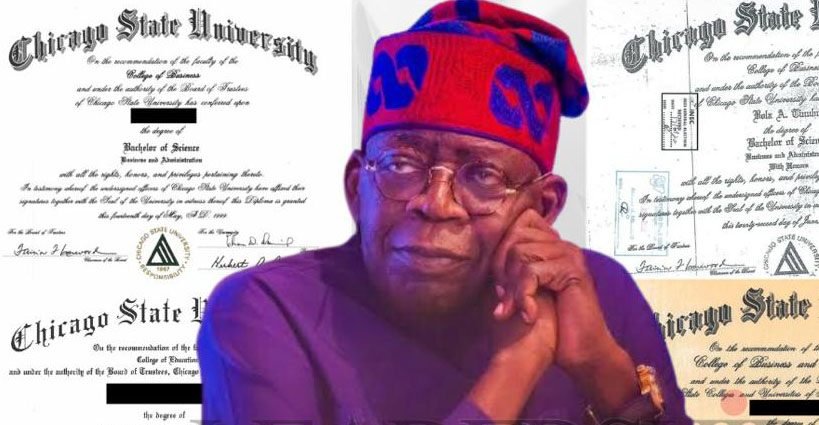
Deputy Spokesperson of the House of Representatives Philip Agbese has accused opposition figures of damaging Nigeria’s image abroad through a campaign over documents held by United States government agencies concerning President Bola Ahmed Tinubu.
Agbese spoke to journalists in Abuja on Wednesday evening while reacting to efforts by a Washington-based lobbying firm to draw the attention of officials in the Donald Trump administration and members of Congress to allegations concerning Tinubu.
He said political disagreements should not be pursued through foreign governments at the expense of Nigerians living, studying, working and doing business outside the country.
“This has gone beyond politics,” Agbese said.
He said opposition politicians had the right to criticise the Tinubu administration but should not turn foreign governments and institutions into instruments for settling domestic political disputes.
The comments came as a federal court case in Washington continued over requests for records held by the Federal Bureau of Investigation and other US agencies.
What The US Case Is About
The case, Aaron Greenspan v. Executive Office for US Attorneys et al., Civil Action No. 23-1816 (BAH), was filed in the United States District Court for the District of Columbia in June 2023.
Aaron Greenspan, founder of PlainSite, submitted Freedom of Information Act requests to several US agencies seeking records relating to Tinubu and other individuals.
One request, FBI No. 1588244-000, sought the entire FBI file on Tinubu.
A second request, FBI No. 1593615-000, sought FBI Form 302 interview records involving Tinubu in FBI Case No. 245-IP-71386-UUUUUU during 1992 and 1993.
The wider requests involved agencies including the FBI, Drug Enforcement Administration, CIA, Internal Revenue Service, Department of State and Executive Office for US Attorneys.
Greenspan went to federal court after the agencies did not provide the records he had requested through the FOIA process.
Judge Howell Rejected The Blanket Response
The FBI initially used a Glomar response, which allows an agency to refuse to confirm or deny whether responsive records exist when doing so could implicate information protected by FOIA.
On April 8, 2025, US District Judge Beryl Howell ruled that the FBI and DEA could not continue using that response in relation to the requested records concerning Tinubu.
Howell found that previous US government disclosures had already acknowledged the existence of an investigation involving Tinubu, removing the basis for the agencies to maintain a blanket refusal to confirm or deny the existence of responsive records.
The court ordered the agencies to process responsive material while allowing them to withhold information covered by valid FOIA exemptions.
The ruling did not require the agencies to release every document without redaction.
The FBI and DEA subsequently produced records while withholding or redacting material under various exemptions.
What The FBI Is Withholding
The FBI has relied on several FOIA exemptions in withholding or redacting parts of the material.
They include Exemption 6, which protects certain personal information, and Exemption 7(C), which protects personal privacy in law-enforcement records.
The bureau has also cited Exemption 7(D) for confidential-source information, Exemption 7(E) for law-enforcement techniques and procedures, and Exemption 7(F) for information that could reasonably be expected to endanger someone’s life or physical safety.
The FBI told the court on August 20 that it could not fully explain its reliance on Exemptions 7(E) and 7(F) in an open filing because doing so could reveal information those exemptions protect.
It asked Howell to allow additional material to be submitted ex parte and in camera, allowing the judge to examine the explanation privately.
The FBI submitted the material under seal on August 28.
The contents of the sealed submission have not been made available in the public court record.
What Tinubu Wants The Court To Do
Tinubu intervened in the case through his lawyers.
In a 16-page filing dated August 28, his legal team asked Howell to deny Greenspan’s motion for summary judgment and allow the FBI and DEA to retain their existing redactions and withholdings.
The lawyers argued that the disclosure of information contained in law-enforcement files could interfere with Tinubu’s privacy rights.
They relied on FOIA privacy protections and the US Privacy Act.
Tinubu’s lawyers also challenged Greenspan’s arguments concerning the agencies’ searches, the DEA’s Vaughn Index, the specific documents withheld and the exemptions relied upon by the agencies.
The 1993 $460,000 Forfeiture
The requested material includes records connected to a 1990s US investigation involving narcotics-related offences.
A separate proceeding from 1993 involved about $460,000 associated with Tinubu that was surrendered to the US government through a civil forfeiture case.
The forfeiture was a civil proceeding and did not result in a criminal conviction against Tinubu.
The 1993 forfeiture is part of the historical background being raised in the current dispute, while the Washington case concerns access to federal records under FOIA.
Why Atiku’s Lobbying Firm Is Involved
Former Vice-President Atiku Abubakar hired Washington lobbying firm Von Batten-Montague-York as part of efforts to draw attention in the United States to the documents and allegations involving Tinubu.
The reported value of the agreement is $1.2 million.
The lobbying effort began after Greenspan had already filed the 2023 lawsuit.
Atiku’s involvement is therefore separate from the origin of the federal case, although his campaign has brought renewed political attention to the proceedings.
Atiku Responds To Agbese
Atiku has called on the Presidency to address questions surrounding the 1993 forfeiture rather than attack the lobbyist working on the matter.
He said the government should explain the circumstances surrounding the forfeiture instead of making the lobbying firm the focus of its response.
The dispute has also involved a 2003 letter purportedly issued by the US Consulate in Lagos concerning Tinubu’s US arrest records. The lobbying firm has questioned the authenticity of the document.
Agbese Says Nigerians Could Bear The Consequences
Agbese said political campaigns that portray Nigeria negatively before foreign governments could affect Nigerians who travel, study, work or conduct business abroad.
He urged Trump and his administration to scrutinise the motives of people presenting themselves as advocates for Nigeria before acting on information supplied through political lobbying.
“America and Nigeria have a relationship that is far bigger than the ambitions of desperate politicians,” Agbese said.
He said that relationship should focus on security, trade, investment, development and the interests of both countries.
Agbese urged politicians challenging Tinubu to take their arguments to Nigerian voters ahead of the 2027 election.
“Let Nigerians decide their leadership,” he said.
What The Court Still Has To Decide
The court must determine whether the FBI and DEA have adequately justified the remaining redactions and withholdings under FOIA.
Howell will also consider the FBI’s sealed explanation for its reliance on Exemptions 7(E) and 7(F) and Greenspan’s request for further disclosure.