Article Was Last Updated August 26, 2026
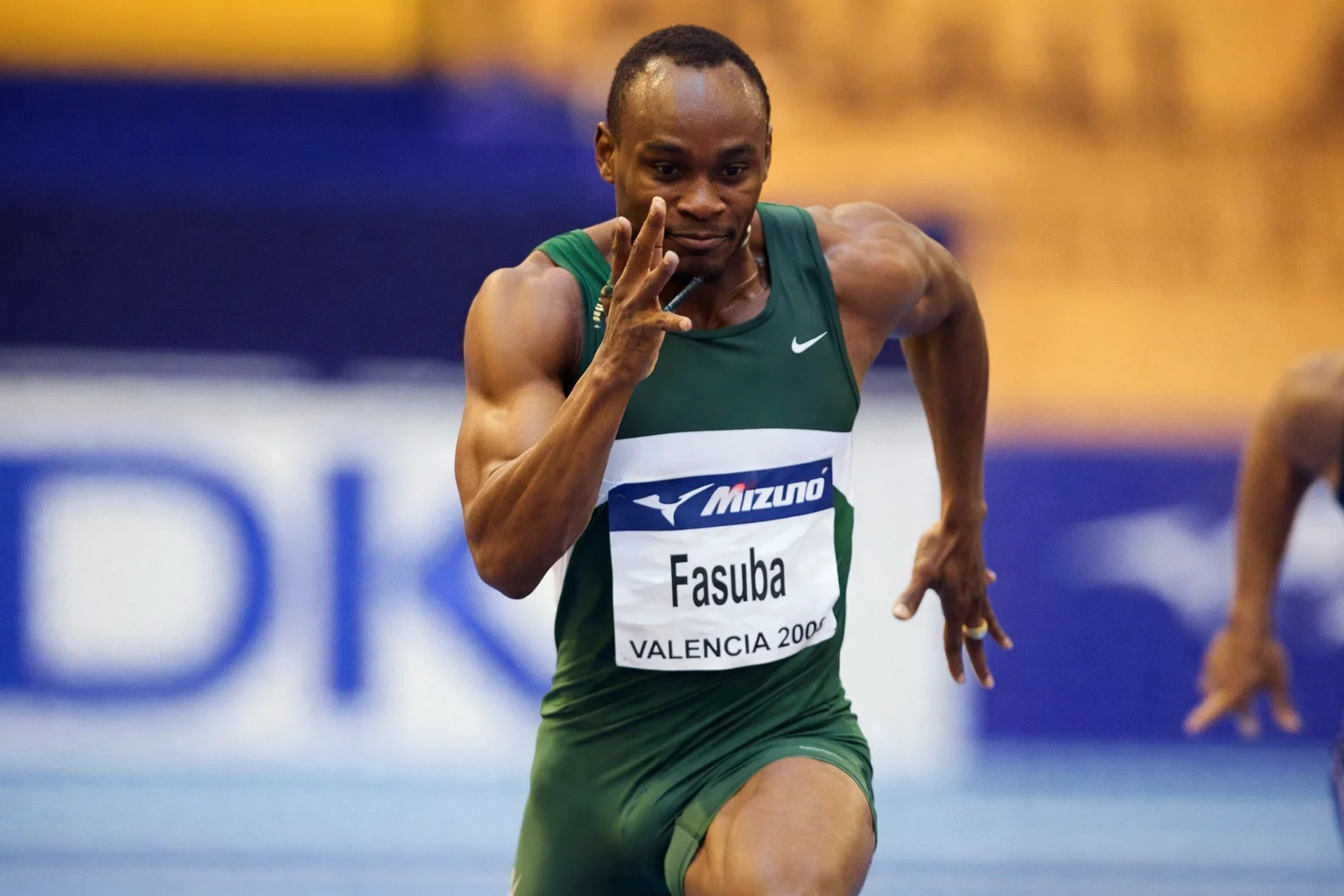
Olusoji Adetokunbo Fasuba was born on 9 July 1984 in Sapele, Delta State, Nigeria. As of 2026, he is 42. Fasuba is widely linked to Ekiti State through family roots. By heritage, he is considered Yoruba through his father’s lineage.
As a student, he stood out for his speed and also played football, volleyball and basketball. He attended Merit Mixed Secondary School on an athletics scholarship and dominated sprint events, plus high and long jump.
His breakthrough came in 2003 after winning the 100 metres at the Afro Asian Games. In 2004, he won Olympic bronze in the 4 by 100 metres relay and became African 100 metres champion. He won Commonwealth silver in 2006, double gold at the 2007 All Africa Games, and world indoor gold over 60 metres in 2008. That same year, he competed at the Beijing Olympics. He also ran 9.85 seconds, becoming Africa’s fastest man.
Family Background of Olusoji Fasuba
Olusoji Fasuba is the oldest of three children, with a younger brother, Kayode, and a sister, Yinka.
His father, Olumide, is a Yoruba Nigerian, and his mother, Evelyn, was born in Jamaica. She was a sprinter herself back in the day. She’s a first cousin to Don Quarrie, the Olympic 200m gold medallist from 1976.
So right from the start, Soji had sprinting in his blood.
Education
Olusoji Fasuba’s speed won him an athletics scholarship to Merit Mixed Secondary School, where he shone in sprinting, high jump, and long jump.
After secondary school, he joined Obafemi Awolowo University but found the academics tough and, with his mum’s support, left to focus on athletics, becoming one of Nigeria’s top sprinters.
Years later, after his peak career and a stint in the Royal Navy starting in 2011, he went back to school. He studied Cyber Security at the UK Open University and by late 2025 graduated with a First Class degree.
Career
Fasuba’s sprinting talent started showing on the international stage in the early 2000s. In 2003, he ran with Nigeria’s 4×100m relay team at the World Championships, finishing fourth, and later won the 100m at the Afro Asian Games, his first major title.
In 2004, he took gold in the 100m at the African Championships and a few months later won bronze with Nigeria’s 4×100m relay team at the Athens Olympics. By 2005, he competed in the 100m and 200m at the World Championships but didn’t reach the finals.
Early in 2006, he finished fifth at the World Indoor Championships and won silver at the Melbourne Commonwealth Games, coming second to Asafa Powell. In May, he set a new African record in the 100m with 9.85 seconds at the Doha Grand Prix, breaking Frankie Fredericks’ old mark. Despite injury struggles, he defended his African 100m title and also won gold in the 4×100m relay, earning Nigerian Male Athlete of the Year.
In 2007, Fasuba took gold in the 100m and 4×100m at the All-Africa Games, though a drugs test cut the party short. He later finished fourth in the 100m at the World Championships in Osaka with 10.07 seconds.
Historic Wins and Olympic Setbacks
In 2008, he made history, winning 60m gold at the World Indoor Championships in Valencia—the first African to do it. At the Beijing Olympics, things didn’t go his way; he came fourth in his second-round 100m heat and missed the semis.
Fasuba competed at the 2009 World Championships but was eliminated in the second round of the 100m. By 2010, he wasn’t selected to defend his 60m indoor title and stepped away from professional athletics. He specialised in the 100m but also ran the 60m and 200m.
His personal bests include 100m in 9.85s, 60m indoors in 6.49s, 200m in 20.52s, and 50m in 5.76s. His 9.85s African record stood until 2021 and made him one of the fastest sprinters outside North America and the Caribbean at the time.
Transition to the Royal Navy
In April 2011, Olusoji Fasuba joined the Royal Navy through the Oxford Careers Office, seeking a stable future for his family beyond competitive athletics and citing limited support for elite athletes in Nigeria.
He went through about 10 weeks of basic naval training, followed by a 12-week specialist logistics course at the Defence Maritime Logistics School. He qualified as a Logistician (Supply Chain) Rating, managing the storage, supply, and movement of equipment and materials.
Fasuba was posted to HM Naval Base Devonport and rose to Leading Logistician. He served aboard HMS Bulwark, an assault ship, and HMS Somerset, a Type 23 frigate, taking part in missions in the Mediterranean and Middle East alongside navies from the US, France, Portugal, and Albania.
His shipmates nicknamed him “Flash” because of his sprinting history, and he stayed active in sports through inter-services competitions, even trying other disciplines like bobsleigh.
Wife and Children
Olusoji Fasuba met Ngozi Nwokocha at his first national athletics training camp in 2003. She was also a sprinter, specialising in the 400 metres, and ran for Nigeria in the 4×400 metres relay at the 2004 Athens Olympics. After that, injuries, especially a meniscus issue in her right knee, slowed her career, and the couple focused on building a family.
They later married and moved to Plymouth, United Kingdom, where Olusoji joined the Royal Navy and works in logistics while supporting his children’s athletics. Their first daughter, Annabelle, was born around 2011–2012. She grew up in Plymouth and started making a name for herself as a sprinter from 2024.
By U‑15 level, she was breaking long-standing records, including the City of Plymouth 100 m record, running sub‑12 seconds. She has won national age‑group titles in the 60 m, 100 m, and 200 m and has continued to excel as she moved into the U‑17 category, breaking club records and indoor competition titles. Her personal bests put her among the fastest in her age group in the UK, and she is already being talked about as a potential future Olympian.
The couple also have a younger daughter. She has shown early sprinting talent at school level, even breaking a Year Three athletics record. They also mention a son in local interviews, but no involvement in sports.
Net Worth
His net worth is roughly $5 million, mostly from sprinting—prize money, bonuses from the national federation, and some sponsorships, though no big global deals.
After retiring around 2011, he joined the British Royal Navy as a Logistician, which gave him a steady salary and benefits.
He’s also been involved in youth sports and football coaching in the UK, while studying cybersecurity for more income opportunities.
On the side, he’s done some public speaking and wrote A Journey Home, which brought in a bit extra.