Article Was Last Updated August 26, 2026
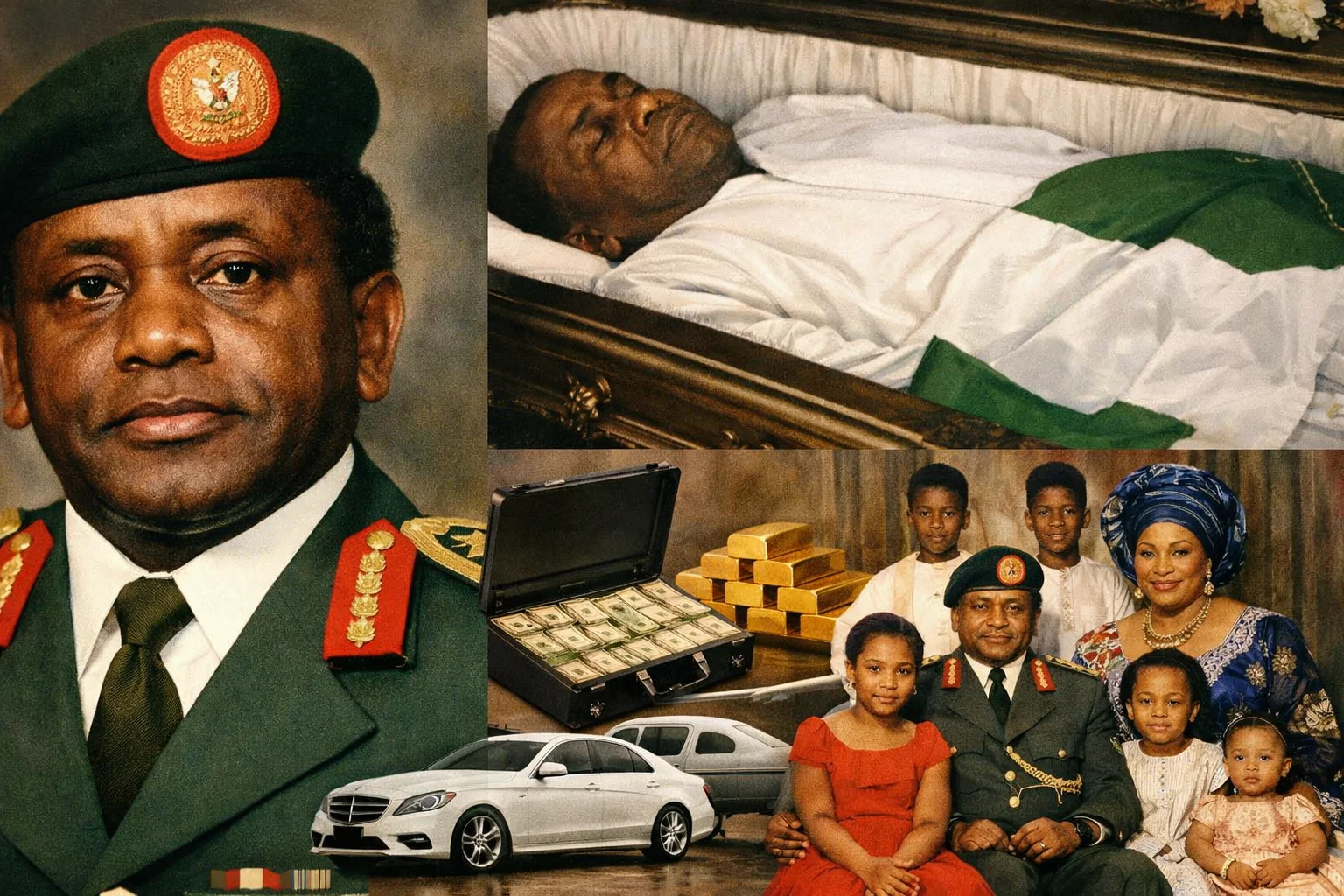
General Sani Abacha ruled Nigeria as a military Head of State from 1993 to 1998. Many people remember his government as one of the most controversial periods in Nigeria’s history because of military rule and corruption allegations. This Sani Abacha biography on First Nigerian examines his life, rule, family, net worth, and death.
Sani Abacha Biography
| Sani Abacha Profile | Details |
| Full Name | Sani Abacha |
| Date of Birth | 20 September 1943 |
| Place of Birth | Kano, Nigeria |
| State of Origin | Borno State |
| Ethnicity | Kanuri |
| Religion | Islam |
| Wife | Maryam Abacha |
| Children | 10 |
| Occupation | Military Officer, Head of State |
| Years in Power | 1993–1998 |
| Date of Death | 8 June 1998 |
| Net Worth | Estimated $1–5 billion |
Who Was Sani Abacha?
Sani Abacha was a Nigerian military leader who basically ran the country like a dictator from 1993 until he died in 1998. He took power through a military coup, overthrowing the government by force, and his rule was the last successful military takeover in Nigeria’s history.
Abacha was born on 20 September 1943 in Kano to a Kanuri family from what is now Borno State. He was a practising Muslim, born into a Muslim family in northern Nigeria, and he followed Islamic traditions throughout his life.
After he took power, he ruled very strictly, ignored human rights, and ordered the killing or imprisonment of political opponents and activists. One well-known case was Ken Saro-Wiwa, an environmental activist whom the government executed, which damaged Nigeria’s international reputation.
Abacha and his family were very corrupt, allegedly stealing billions of dollars and hiding it in countries abroad.
When Abacha died in 1998, General Abdulsalami Abubakar took over, and later Nigeria returned to civilian rule.
Military Career and Coups
Abacha was Muslim and attended military school in Nigeria and then in England, completing his officer training in 1963.
During his career, Abacha took part in almost every major military coup in Nigeria, starting in 1966. That year, he served as a second lieutenant and participated in a counter-coup.
He also fought in the Nigerian Civil War in 1969 as a platoon and battalion commander. Later, he commanded the 2nd Infantry Division in 1975.
By 1983, he served as a senior officer in the 2nd Mechanised Division and sat on the Supreme Military Council, a top military ruling body. He supported Muhammadu Buhari’s rise to power in 1983 and later helped remove him in 1985, installing Ibrahim Babangida as head of state.
Babangida then made Abacha Chief of Army Staff in 1985, and in 1990, he became Minister of Defence. Abacha was the first Nigerian Army officer to reach the rank of general without skipping any ranks.
How Sani Abacha Came to Power
By 1993, Abacha was the defence minister and the most senior military officer when Nigeria had a political crisis. He staged a coup to remove the Interim National Government led by Ernest Shonekan and justified it as bringing stability because the 1993 elections had caused political uncertainty.
Sani Abacha’s Government
As head of state, Abacha ruled from 1993 to 1998. He passed decrees making himself above the law and allowed the government to hold people for three months without trial. He also removed Decree 691, which had limited some government powers.
To keep control, Abacha had a private security force of 3,000 men trained in North Korea, and his top security officer, Hamza al-Mustapha, ran security tightly. The police cracked down on criminals and dissidents, and blamed groups like the National Democratic Coalition for bombings before arresting their members.
Abacha jailed people like Moshood Abiola, who claimed to be president, and a former head of state, Olusegun Obasanjo, for treason. Others, like Shehu Yar’Adua, died in custody. Security forces abused human rights, especially against activists like Ken Saro-Wiwa. The government also charged Wole Soyinka with treason while he was not in the country.
Abacha also faced opposition from international pro-democracy activists.
Political Reorganisation and Elections
Politically, Abacha reorganised Nigeria into six zones: North Central, North East, North West, South East, South South, and South West. He added six new states to reach the current 36.
He held a constitutional conference from 1993 to 1995. In early 1998, he announced elections for August and said civilian rule would start in October, but he had no intention of stepping down.
By April, he had forced all five political parties to support him as the only presidential candidate.
Foreign Relations
In foreign affairs, the Commonwealth suspended Nigeria in 1995 after the execution of Ken Saro-Wiwa. Abacha hosted Nelson Mandela and promised he would try to stop the death sentence, but didn’t.
In 1997, Libya’s Muammar Gaddafi visited Nigeria, breaking UN sanctions, and thousands supported Abacha. Abacha also sent troops to Liberia during its civil war through ECOWAS.
Despite criticism from the US, Abacha had some connections there. In 1997, Senator James Inhofe visited Nigeria, representing a group called the Family. Abacha maintained political and business relationships with the Family until his death.
He also had ties with other US figures like Senator Carol Moseley Braun, Rev. Jesse Jackson, and Louis Farrakhan, who visited Nigeria and supported his administration.
Sani Abacha Wife and Family
Sani Abacha married Maryam Abacha, the former First Lady of Nigeria. They had ten children together.
Who Was Sani Abacha’s Wife?
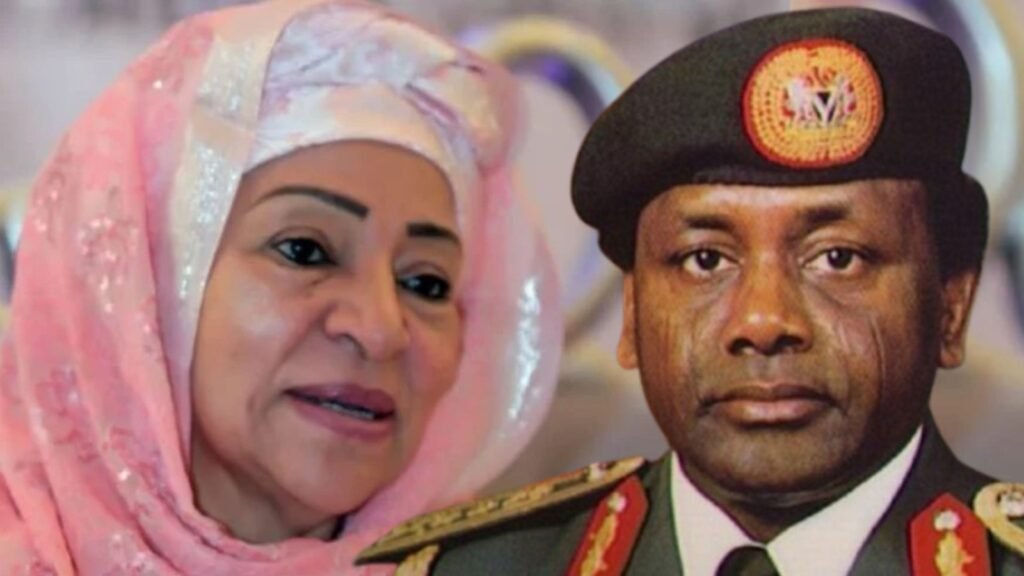
Sani Abacha’s wife was Maryam Abacha (née Maryam Jidah). She was born on 4 March 1947 in Kaduna State, Nigeria, although her family roots trace back to present-day Borno State.
Maryam Abacha served as Nigeria’s First Lady during her husband’s military rule from 1993 to 1998. During this period, she participated in several social and charitable initiatives focused on healthcare, women, and children.
She also contributed to the development of the National Hospital in Abuja, which provides specialised healthcare services for women and children.
How Many Children Did Sani Abacha Have?
Sani Abacha had 10 children with Maryam Abacha. Their family included seven sons and three daughters.
Sani Abacha’s Sons
The sons of Sani Abacha were:
- Ibrahim Abacha (died in a plane crash in 1996)
- Mohammed Abacha
- Abba Abacha
- Mahmud Sani Abacha
- Sadiq Abacha
- Abdullahi Abacha
- Al Mustapha Abacha
Several of Abacha’s sons later became known through business interests and legal proceedings connected to investigations into funds allegedly diverted during the Abacha administration.
Sani Abacha’s Daughters
The daughters of Sani Abacha were:
- Zainab Abacha
- Fatima Gumsu Sani Abacha (commonly known as Gumsu Abacha)
- Rakiya Abacha
Some of Abacha’s daughters have remained active in public life through advocacy work, business activities, family foundations, and public commentary about their father’s legacy.
Sani Abacha Family
The Abacha family remains one of the most prominent political families in Nigeria. In addition to their ten children, reports indicate that Sani Abacha and Maryam Abacha have more than thirty grandchildren.
Sani Abacha Net Worth, Corruption and Loot Recovery
Estimate puts Sani Abacha’s net worth at between $1 billion and $5 billion.
He did not earn the wealth through personal business ventures or investments; instead, it comes from public funds allegedly diverted from Nigeria during his military rule between 1993 and 1998.
Organisations such as Transparency International list him among the most corrupt leaders in modern history.
How Much Money Did Sani Abacha Steal?
Investigators found after Abacha’s death that a network of associates, government officials, and offshore accounts removed billions of dollars from Nigeria’s treasury. Estimates place the total amount of Abacha’s stolen money at up to $5 billion, making it one of the largest corruption scandals in African history.
According to official investigations, Abacha’s administration approved fraudulent security and government funding requests, allowing officials to withdraw funds from the Central Bank of Nigeria. Trusted associates then transferred the money into foreign bank accounts and investment vehicles.
Key figures linked to the scheme included Mohammed Abacha, Ismaila Gwarzo, and Mohammed Sada. One money-laundering operation reportedly involved about $1.4 billion. They used fake funding requests, collected cash from the Central Bank, and moved it offshore.
Authorities discovered Abacha-linked assets in several countries, including:
- Switzerland
- United Kingdom
- United States
- Liechtenstein
- Jersey
- Luxembourg and other financial centres
The funds sat in bank accounts, shell companies, trusts, and other structures designed to conceal ownership.
Abacha Loot Recovery
After Abacha died in 1998, financial authorities launched investigations into the missing funds. Over the next two decades, the government froze, seized, and returned billions to Nigeria through asset recovery programmes and civil forfeiture actions.
Major recoveries came from Switzerland, the United States, Jersey, and other jurisdictions, with recovered funds directed toward infrastructure and development projects in Nigeria. U.S. authorities and Jersey recovered hundreds of millions through civil forfeiture actions, even up to 20 years after his death, and later returned some of the funds.
Despite these recoveries and the scale of alleged corruption, Nigeria’s economy still recorded growth during his rule. Foreign reserves increased from $494 million in 1993 to $9.6 billion in 1997, while external debt fell from $36 billion to $27 billion.
Inflation dropped from 54% to 8.5% between 1993 and 1998, and oil prices remained around $15 a barrel. He built between 25 and 100 km of urban roads in major cities and halted Babangida’s privatisation programmes. Oil largely drove GDP growth, while the government promoted a market-oriented policy direction.
The Abacha administration experienced both corruption and economic development at the same time. Various organisations ranked Abacha and his family among the most corrupt leaders.
How Did Sani Abacha Die?
Sani Abacha died on 8 June 1998 at the Presidential Villa in Abuja at the age of 54. The Nigerian government reported that he died of a sudden heart attack while serving as Nigeria’s military head of state, but doctors did not carry out an autopsy or post-mortem examination to confirm the cause. He was buried the same day according to Islamic tradition.
Questions about Abacha’s death have continued because there was no detailed medical investigation. The lack of an autopsy created uncertainty and led to different theories about what happened.
Was Sani Abacha Poisoned?
Some people claim that Abacha was poisoned, while others say he fell ill shortly before his death. However, no official investigation has provided evidence to support these claims, so they remain unproven.
People close to Abacha rejected the poisoning rumours. His former chief security officer, Major Hamza Al-Mustapha (rtd.), said he died after a brief illness.
His personal doctor, Professor Sadiq Suleiman Wali, saw signs of a serious heart problem and tried to revive him. He also said that without an autopsy, doctors could not be sure of the exact cause of death.
When and Where Did Sani Abacha Die?
- Date of death: 8 June 1998
- Age at death: 54 years old
- Place of death: Presidential Villa, Abuja, Nigeria
- Official cause of death: Heart attack
- Burial: Same day, according to Islamic rites
The official position is that Sani Abacha died of a heart attack on 8 June 1998. Although rumours and alternative theories have circulated over the years, no evidence has emerged to disprove the government’s explanation.